
Oil Markets Tremble as U.S.–Iran Tensions Cast a Shadow Over Fragile Diplomacy
The global oil market woke up unsettled this morning, as prices slipped across nearly every major benchmark while the world watched the latest twist in the increasingly volatile standoff between the United States and Iran. It was not a dramatic crash, not the kind that sends traders into panic, but a slow, deliberate decline — the kind that signals something deeper, something structural, something that speaks of fear rather than frenzy. And today, that fear has a name: uncertainty.
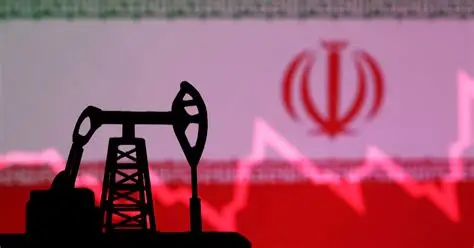
Oil pumpjack silhouette set against Iran’s national emblem as market charts fade in the background, reflecting the growing pressure of U.S.–Iran tensions on global energy stability.
The tension began to rise again after the U.S. Navy intercepted and seized an Iranian‑flagged cargo vessel in the Sea of Oman, an operation that injected fresh instability into a region already strained by a looming ceasefire deadline. Markets reacted instantly. Brent crude slipped below the psychological threshold of 95 dollars, WTI followed the same downward curve, and regional indexes — especially the Oman and Urals benchmarks — experienced sharper, more erratic movements. It was as if the market itself was trying to interpret a diplomatic language written in threats, warnings, and missed signals.
But the real weight pressing on prices today is not the ship seizure alone. It is the question that hangs over Islamabad, where a U.S. delegation is preparing to arrive for what could be a decisive round of negotiations — if Iran shows up at all. Vice President JD Vance is expected to lead the mission, accompanied by senior figures including Jared Kushner and Steve Witkoff, in a last‑minute attempt to salvage a diplomatic path before the ceasefire clock runs out. Yet Tehran’s tone remains cold, skeptical, and deeply mistrustful. Iranian President Masoud Pezeshkian has openly questioned Washington’s intentions, accusing the U.S. of sending contradictory signals designed to force a surrender rather than build a compromise.
In the trading rooms of London, Dubai, Singapore, and New York, the mood is the same: tense, analytical, cautious. Every headline becomes a data point, every statement a potential trigger. The market is not reacting to what has happened — it is reacting to what might happen next. And that is always the most dangerous kind of volatility.
Behind the numbers, behind the charts and the red arrows, lies a deeper story. Oil is not just a commodity; it is a barometer of global stability. When prices fall on a day like today, it is not because the world is calm — it is because the world is holding its breath. The Strait of Hormuz, the narrow artery through which a fifth of the world’s oil flows, remains at the center of the storm. Any escalation, any miscalculation, any failed negotiation could send shockwaves far beyond the Middle East.
For now, the decline in prices is modest, almost gentle. But the atmosphere is anything but. Diplomats are preparing for a meeting that may never happen. Traders are preparing for a market that may turn violent at any moment. And the world is preparing for a week that could redefine the balance of power in one of the most fragile regions on Earth.
As the sun rises over Islamabad, the question is no longer whether the talks will succeed — it is whether they will even begin. And until that answer arrives, the oil market will continue to move like a needle on a compass caught between two magnetic fields: hope and fear.