

The Quantum Dawn of Discovery: How Science Is Entering Its Most Mysterious Decade
There are moments in history when science seems to pause — not because it has reached its limits, but because it is about to leap beyond them. The spring of 2026 feels like one of those moments. Across laboratories, observatories, and deep‑ice research stations, discoveries are emerging that challenge the very foundations of what we thought we knew about Earth, life, and the universe itself.
From the silent shifting of Earth’s magnetic field to the hidden lakes beneath Antarctica, from the whisper of ancient salt crystals to the light of a star that shouldn’t exist, the story of science this year is not one of noise and spectacle, but of quiet revolutions.
The Magnetic Storm Beneath Our Feet
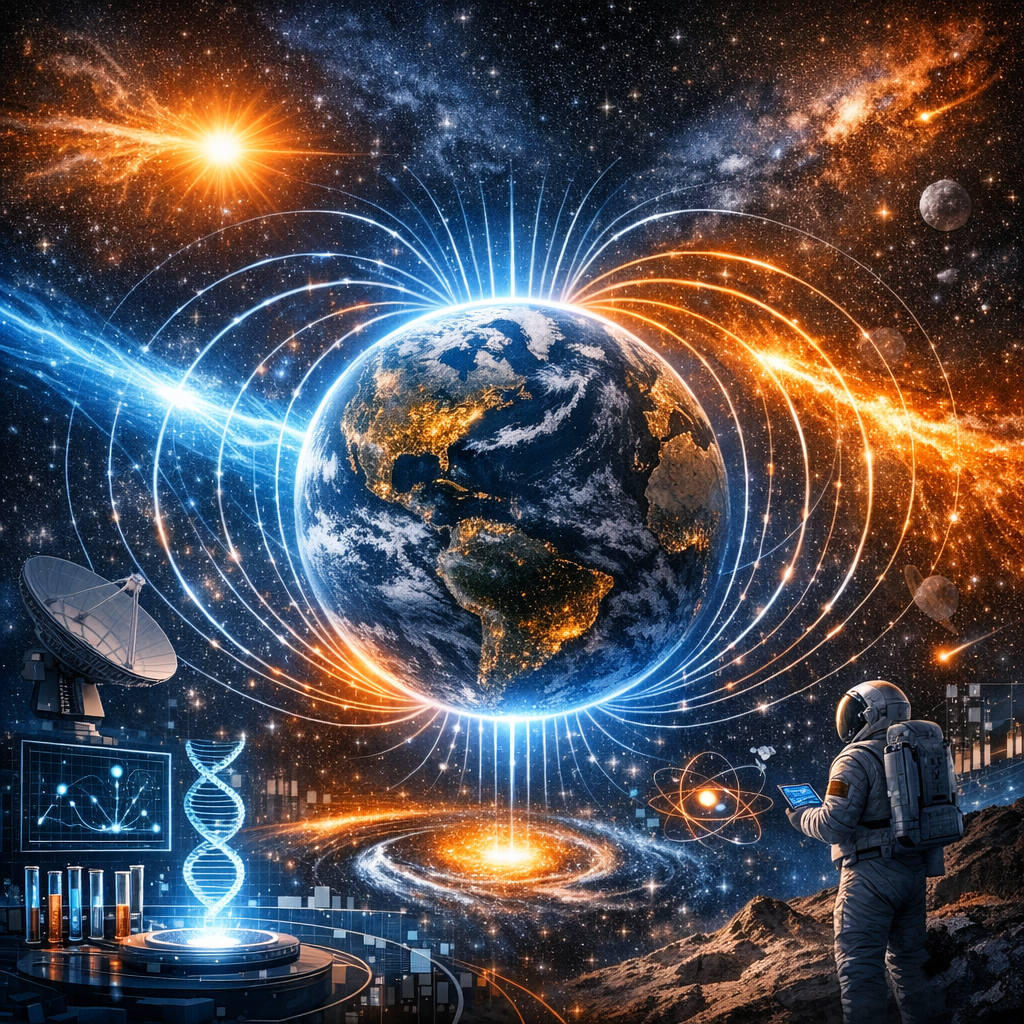
Earth’s magnetic field — that invisible shield protecting us from cosmic radiation — is changing faster than ever recorded. Scientists describe it as a soundless storm, a deep geophysical current reshaping the planet’s magnetic architecture. Beneath our feet, molten iron flows within the outer core, twisting and accelerating in ways that defy previous models.
The implications are profound. Navigation systems, satellite trajectories, even migratory patterns of animals could be affected. Yet what fascinates researchers most is the mystery: why now? The field’s acceleration may hint at a larger planetary cycle, one that connects magnetic reversals to climate shifts and tectonic rhythms.
This discovery resonates with the themes explored in Zemeghub’s earlier article, “The Soundless Storm: How Earth’s Magnetic Field Is Quietly Shifting Beneath Our Feet”, where scientists warned that the planet’s magnetic heartbeat might be entering a new phase. Today, that warning feels prophetic.
The Mirror Beneath the Ice
Far to the south, beneath Antarctica’s frozen crust, a mirror glows in the dark — a subglacial lake teeming with microbial life. These organisms, isolated for millions of years, survive in complete darkness, feeding on minerals and chemical energy rather than sunlight.
Their existence rewrites our understanding of life’s resilience. If microbes can thrive here, they could exist beneath the icy oceans of Europa or Enceladus. The discovery is not just geological; it’s existential. It forces us to reconsider the boundaries of biology and the definition of habitability itself.
The Star That Shouldn’t Shine
In the Andromeda Galaxy, astronomers have found a star emitting light that defies physics — a spectral pattern inconsistent with any known fusion process. It burns without the expected hydrogen signature, suggesting a new kind of stellar evolution.
Some theorists propose that the star may be powered by quantum tunneling at a scale never observed before. Others whisper about exotic matter — particles that could rewrite the Standard Model. Whatever the truth, this “light that shouldn’t exist” reminds us that the universe still hides secrets beyond our equations.
The Whisper of Ancient Oceans
In Chile’s Atacama Desert, scientists have uncovered salt crystals containing chemical traces of a vanished ocean. These microscopic inclusions preserve isotopic fingerprints of water that evaporated hundreds of millions of years ago.
The discovery reveals that Earth’s climate has cycled through extremes far more dramatic than previously imagined — oceans appearing and disappearing, continents breathing in rhythm with geological time. It’s a reminder that our planet’s memory is written not in fossils, but in minerals.
The Breath of Ice and the Memory of Rain
From Antarctica’s glaciers to Martian rocks, the story of water continues to haunt science. Ice cores reveal whispers of ancient atmospheres, while Martian samples show chemical traces of rainfall — proof that the Red Planet once had a climate capable of sustaining rivers and lakes.
Together, these findings form a mosaic of planetary evolution, connecting Earth’s deep past to Mars’s lost climate. They suggest that the processes shaping worlds are universal — that the physics of rain, ice, and magnetism may be the same across the cosmos.
The Hidden Geometry of Thought
Meanwhile, neuroscientists are mapping the brain in dimensions never seen before. Using quantum‑level imaging, they’ve discovered that thought itself may emerge from a four‑dimensional structure — a maze of connections that folds and unfolds like spacetime.
This “geometry of consciousness” could explain how memory, emotion, and creativity arise from physical matter. It’s a revelation that blurs the line between physics and philosophy, between neurons and universes.
The New Frontier of Discovery
Science in 2026 is not about isolated breakthroughs; it’s about convergence. Geophysics meets quantum mechanics. Biology meets cosmology. Artificial intelligence now assists in decoding patterns too complex for human intuition, becoming a silent partner in discovery.
The world is entering a decade where the boundaries between disciplines dissolve — where the study of a magnetic field might reveal something about the brain, and the analysis of a microbe beneath Antarctic ice might teach us how stars evolve.
The Quiet Revolution
The greatest discoveries of our time are not loud. They do not announce themselves with explosions or headlines. They whisper — through data, through silence, through the slow unfolding of truth.
As Earth’s magnetic field shifts, as hidden lakes awaken, as forgotten stars shine, we are reminded that science is not just a collection of facts. It is a story — one that continues to be written beneath our feet, above our heads, and within our minds.
And in that story, the next chapter has already begun.
Dimmi pure cosa preferisci.
scrivi un altro articolo riguarda latest crypto news