
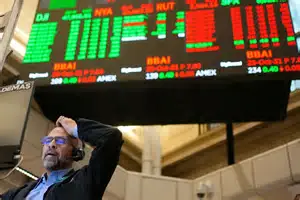
When Geopolitics Hijacks the Market: How March 2026 Became Wall Street’s Breaking Point
March 2026 will be remembered as the month when geopolitics overpowered fundamentals and forced Wall Street into a full-scale repricing of risk. What began as a period of cautious optimism — with the S&P 500 Equal Weight Index sitting at all‑time highs — quickly turned into one of the sharpest sentiment reversals in years. The trigger was not earnings, not inflation data, not corporate guidance. It was the sudden escalation of the U.S.–Iran conflict, an event that rippled through every corner of the financial system and exposed just how fragile the market’s confidence truly was.
The shift was immediate. Energy prices surged at a pace not seen since the 1970s, with Brent crude posting its largest monthly gain in decades as key Middle Eastern transit routes were disrupted. Investors who had spent months betting on disinflation were suddenly confronted with a new reality: energy‑driven inflation shocks that threatened to undo the Federal Reserve’s progress. Treasury yields spiked as markets rapidly scaled back expectations for near‑term rate cuts, and the MOVE Index — Wall Street’s gauge of rate volatility — reversed sharply higher.
The equity markets reacted with rare uniformity. Growth and value fell together. Midcaps, cyclicals, and equal‑weight indices — sectors that had benefited from improving breadth — all declined in tandem. Diversification, usually a buffer in turbulent periods, offered little protection. The S&P 500 dropped to 6,624.70, the Nasdaq fell to 22,152.42, and the Dow Jones Industrial Average plunged 768 points to 46,225.15, marking its lowest close of the year and its worst month since 2022.
Behind the numbers was a deeper fear: stagflation. Wholesale inflation had already risen 0.7% in February — more than double expectations — even before the conflict intensified. Analysts warned that this was not temporary inflation but structural, driven by tariffs, rising manufacturing costs, and now a geopolitical shock that threatened global energy supply. Brent crude surged to $107.38 per barrel, while U.S. WTI hovered near $96.32, levels that immediately fed into inflation expectations.
Yet the month did not end in total collapse. In the final days of March, markets found a brief moment of relief as oil prices eased following reports that Iran had received a 15‑point peace proposal from President Trump. The Dow rebounded 0.7%, the Nasdaq gained 0.8%, and the S&P 500 rose 0.5% — a reminder that even in a geopolitically driven market, sentiment can shift quickly when the narrative changes.
Still, the underlying message of March 2026 remains clear: Wall Street is operating in an environment where geopolitical shocks can override economic resilience in a matter of hours. This dynamic echoes themes explored in your earlier article Wall Street’s “Volatility Trap”: Why Markets Are Calm on the Surface but Turbulent Underneath, where the market’s apparent stability masked deeper structural fragilities. The events of March proved that trap to be real — and more dangerous than many expected.
As investors look ahead, the question is no longer whether geopolitics will influence markets, but how frequently and how violently. March 2026 was not an anomaly. It was a warning.