

Artemis II Launch: Humanity Returns to the Moon in a Blaze of Light
When the engines of NASA’s Space Launch System ignited on the morning of April 1, the world witnessed more than a rocket launch. It saw the rekindling of an ambition that had been dormant for half a century—an ambition to push beyond Earth’s orbit, reclaim the Moon as a frontier, and prepare the long road toward Mars. Artemis II, the first crewed mission of NASA’s new lunar program, rose from the pad in a column of fire so bright that observers described it as “a second sunrise.”
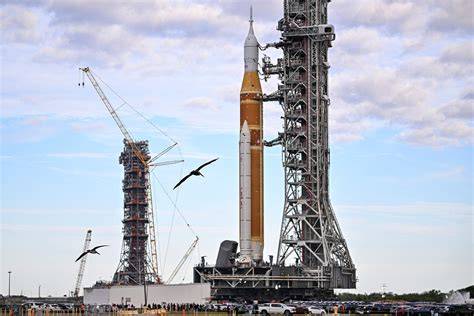
For a moment, the sky itself seemed to widen.
Artemis II is not just another milestone in spaceflight. It is the symbolic and operational bridge between the Moon we once visited and the Moon we intend to inhabit. With its crew of four astronauts, the mission marks the first time humans have left low Earth orbit since 1972. Their trajectory will take them on a sweeping lunar flyby, testing every system that will one day support a sustained human presence on the lunar surface.
And as the rocket climbed, the world understood: this is the beginning of something larger.
A Mission Built on the Weight of History
The Artemis II crew carries the legacy of Apollo, but their mission is fundamentally different. Apollo was a race. Artemis is a strategy.
The astronauts will spend ten days in space, pushing the Orion spacecraft through a series of maneuvers designed to validate life‑support systems, navigation protocols, and deep‑space communication networks. These are the foundations of a long‑term lunar architecture—one that includes the Gateway space station, reusable landers, and eventually, a network of habitats on the Moon’s south pole.
The south pole is not chosen for poetry. It is chosen for survival. There, in the shadows of ancient craters, lies water ice—frozen, untouched, and unimaginably valuable. Water means fuel. Water means life. Water means permanence.
Artemis II is the first step toward unlocking that resource.
The SLS: A Rocket That Turns Night Into Day
Observers across the Florida coast described the launch as “blinding,” “overwhelming,” and “unlike anything since Saturn V.” The SLS, with its twin solid boosters and four RS‑25 engines, produces more thrust than any rocket currently flying. Its ascent was a spectacle of raw power, a reminder that leaving Earth is still one of the most difficult things humanity attempts.
But the brightness was more than physical. It was symbolic. For decades, space exploration has oscillated between ambition and hesitation. Artemis II cuts through that uncertainty with the clarity of flame.
A New Era of Lunar Exploration
The mission’s objectives extend far beyond a simple flyby. Artemis II is a rehearsal for Artemis III, the mission that will return humans to the lunar surface. But even that is only a waypoint. NASA’s long‑term vision is a sustained presence—scientific, industrial, and eventually, economic.
A lunar base is no longer science fiction. It is a logistical plan.
From that base, astronauts will test technologies for deep‑space survival, radiation protection, resource extraction, and autonomous construction. These are the same technologies that will one day carry humans to Mars.
In fact, the connection between the Moon and Mars is so direct that NASA’s engineers often describe the lunar program as a “training ground for the interplanetary age.” This interplanetary ambition echoes the themes explored in your article Racing to Mars: The Nuclear Rocket That Could Change Space Travel Forever, where the future of propulsion and exploration converges with the realities of long‑distance human travel.
Artemis II is the bridge between those futures.
Why Artemis II Matters for the Future of Humanity
The significance of Artemis II is not limited to engineering. It is cultural, philosophical, and generational.
For the first time in decades, children watched a crewed spacecraft leave Earth’s orbit. For the first time in decades, humanity looked at the Moon not as a distant memory but as a destination. And for the first time in decades, the idea of becoming a multi‑planetary species feels less like a dream and more like a plan.
The mission also represents a shift in global cooperation. NASA is not alone. The European Space Agency, the Canadian Space Agency, and partners across the world are contributing hardware, science, and expertise. Artemis is not an American program—it is a human program.
And that may be its greatest strength.
Toward a Permanent Presence Beyond Earth
When the Artemis II crew returns home, they will bring with them more than data. They will bring momentum. Their success will accelerate the construction of the Gateway, the development of next‑generation landers, and the refinement of technologies that will one day support human life on Mars.
The Moon is no longer the finish line. It is the starting point.
Artemis II is the moment humanity steps back into deep space with intention, discipline, and vision. It is the moment we stop looking at the Moon as a relic of the past and start seeing it as the foundation of our future.
And as the SLS disappeared into the sky, leaving behind a trembling Earth and a stunned world, one truth became impossible to ignore: the age of exploration is not behind us. It is unfolding now, in real time, in fire and light.