
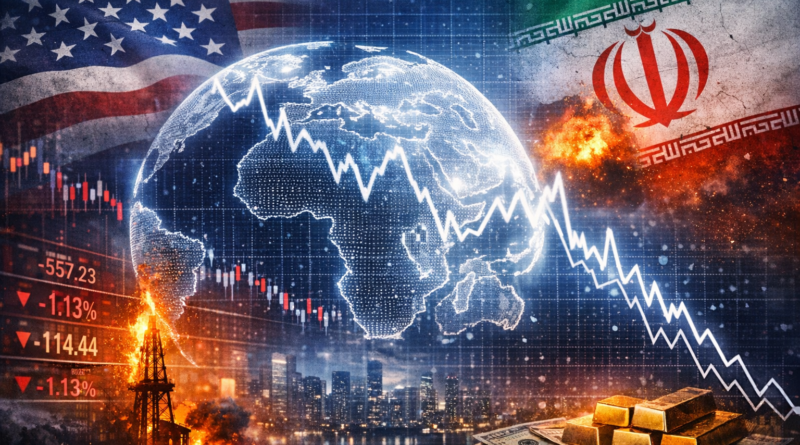
Stock Markets Today: The World Holds Its Breath as U.S.–Iran Tensions Shake the Global Economy
There are mornings when the world wakes up as if someone had pulled an invisible thread stretching across continents, stock exchanges, ports, satellites—tightening it until it vibrates. Today is one of those mornings. The tensions between the United States and Iran are no longer background noise: they have become a wave rolling through global markets, leaving behind volatility, sudden price spikes, flights to safe‑haven assets, and a sense of fragility that appears in the numbers before it appears in the headlines.
Wall Street: the accelerated heartbeat of the American economy
In New York, the screens began flashing early. The Dow Jones fell 557 points (‑1.13%), the S&P 500 slipped 0.41%, and the Nasdaq eased 0.19%. It isn’t panic—not yet. It’s that restrained tension that precedes difficult decisions.
Oil became the absolute protagonist:
- WTI +4.39% at $106.42
- Brent +5.8% at $114.44
Every time oil jumps like this, it means the world is afraid of something. And today that something is the possibility that the conflict between Washington and Tehran could widen, or that the Strait of Hormuz, through which nearly a fifth of the world’s traded oil flows, could suddenly become a bottleneck.
Europe: markets suspended between caution and unease
In London, the FTSE 100 fell 1%, while in Frankfurt the DAX moved without clear direction, as if investors were holding their breath. Europe is vulnerable: it imports energy, depends on maritime routes, and fears any shock that could turn into inflation.
And today, inflation is a word heavier than oil itself.
Asia: a night that brought no relief
In Asia, the tension arrived before dawn. The Nikkei 225 dropped 1.10%, while Hong Kong opened weak, dragged down by global uncertainty. Asian economies live on exports, supply chains, and shipping routes that cross oceans. A conflict in the Gulf is not a distant event—it is a wave that can reach Shanghai, Seoul, Singapore.
India: a giant watching the turbulent sea
In India, markets held up better, but not without trembling. The Nifty50 hovered near 24,146, while the Sensex moved around 77,393. But the number that truly worries analysts is another: Brent at $109.6 per barrel. For a country that imports most of its oil, every extra dollar is a weight added to the shoulders of the economy.
The financial world looks for shelter
When geopolitics burns, finance runs toward what does not burn. Today the world saw:
- heavy buying of gold,
- a return to U.S. Treasury bonds,
- nervous movements in emerging‑market currencies,
- and a Bitcoin that—paradox of modern times—surpassed $80,000.
It isn’t confidence. It’s escape.
The invisible thread that ties everything together
The tension between the United States and Iran is not just a military or diplomatic confrontation. It is an earthquake that shakes:
- energy prices,
- global logistics,
- investor confidence,
- household expectations,
- central bank decisions.
Every missile launched, every ship stopped, every hostile statement becomes an impulse that markets translate into numbers, charts, oscillations.
And tomorrow?
Tomorrow will depend on what happens thousands of kilometers away, in a narrow and fragile stretch of sea. It will depend on the words spoken in Washington and Tehran. It will depend on how much the world is willing to believe that diplomacy can still stop what geopolitics seems determined to accelerate.
Today, the markets have spoken. And what they said is simple: the world is on edge, and every decision weighs more than usual.