
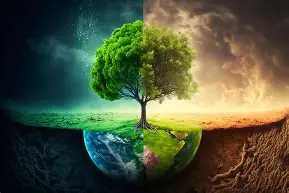
When the Planet Starts Sending Warnings: The New Environmental Signals Reshaping 2026
Environmental Signals Reshaping 2026 mark a turning point in the way the planet communicates its instability. There are years in which the planet whispers, and years in which it raises its voice. In 2026, the Earth is no longer whispering.
There are years in which the planet whispers, and years in which it raises its voice. In 2026, the Earth is no longer whispering. It is speaking in a language of extremes — shifting rivers, destabilized forests, warming mountains, and oceans that behave like systems pushed beyond their limits. Scientists describe this moment as a transition zone, a period in which environmental signals are no longer isolated anomalies but interconnected warnings of a world entering a new phase of instability.
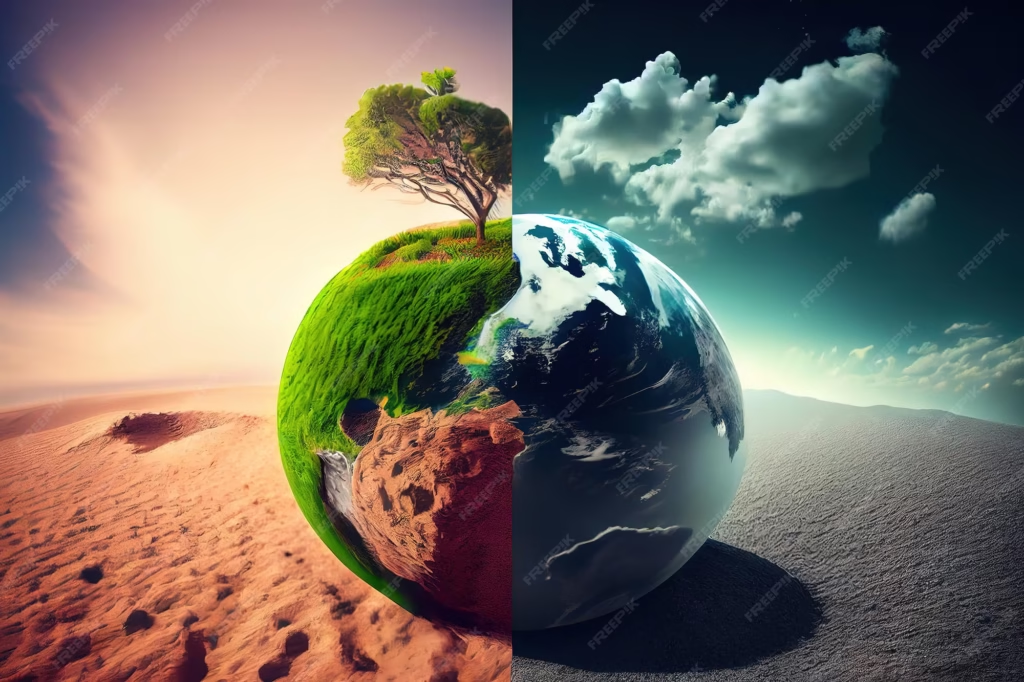
The first signs emerged in the cryosphere. Glaciers that once melted slowly and predictably are now releasing ancient layers of ice in sudden pulses, exposing microbial ecosystems that have been dormant for tens of thousands of years. Researchers monitoring these regions report that melt patterns are no longer seasonal but erratic, driven by atmospheric rivers and heatwaves that strike even in the depths of winter.
The awakening of ancient microbes, once considered a distant theoretical risk, has become a tangible scientific concern — a theme explored in our earlier article Ancient Microbes Are Awakening as Glaciers Melt — A New Global Risk, which now reads less like a warning and more like a preview of what is unfolding.
But the cryosphere is only one part of the story. Across the world’s rivers, oxygen levels are collapsing at a pace that has stunned researchers. Freshwater ecosystems, long considered more resilient than oceans, are now losing oxygen faster than marine environments. Entire river systems are shifting from life‑supporting habitats to zones of biological stress, reshaping fisheries, agriculture, and the communities that depend on them. Scientists describe this as a “freshwater shock,” a rapid destabilization that challenges decades of assumptions about how rivers respond to warming.
Forests, too, are entering unfamiliar territory. Satellite data from early 2026 shows that tree mortality in tropical and temperate regions is rising sharply, driven not only by heat but by the collapse of moisture cycles that once sustained them. In some regions, forests are no longer absorbing carbon — they are releasing it. The Amazon, Southeast Asia, and parts of Central Africa are experiencing what researchers call “structural weakening,” a slow unraveling of ecological networks that once seemed unbreakable.
Meanwhile, the oceans — the planet’s great stabilizers — are showing signs of exhaustion. Marine heatwaves are becoming longer and deeper, altering migration patterns, bleaching coral systems, and pushing species into new territories. The North Atlantic, in particular, is undergoing changes that scientists describe as “unprecedented in the observational record,” with shifts in circulation patterns that could reshape weather systems across Europe and North America.
What makes 2026 different is not the presence of environmental threats, but their convergence. Each signal — melting glaciers, oxygen‑starved rivers, destabilized forests, warming oceans — is part of a larger pattern. The planet is entering a decade in which environmental systems no longer respond gradually but abruptly, crossing thresholds that were once theoretical.
This convergence is forcing governments, scientists, and communities to rethink adaptation strategies. Traditional models, built on linear projections, are struggling to keep pace with a world that is changing in jumps rather than steps. The environmental decade ahead will not be defined by single events but by the interaction of multiple stressors, each amplifying the others.
2026 is becoming the year in which humanity must confront a difficult truth: the planet is no longer simply warming — it is reorganizing. And the signals arriving from every corner of the Earth suggest that the window for slow, incremental adaptation is closing.
The question now is whether societies can adapt as quickly as the planet is changing. Because the Earth has already shifted into its next chapter. The rest of us are still trying to catch up.