
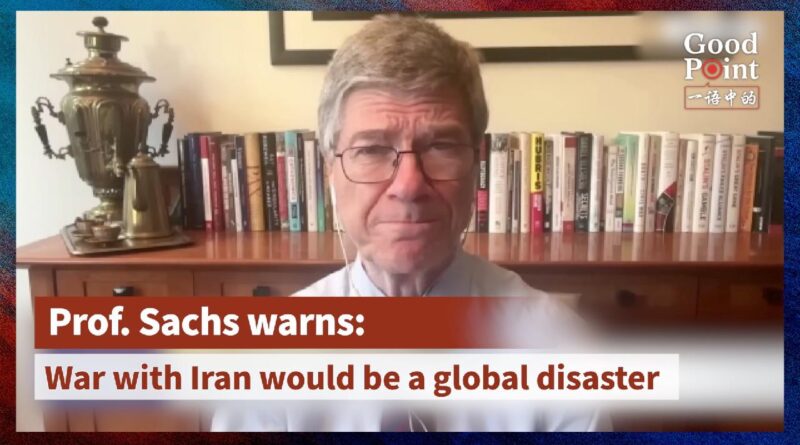
Jeffrey Sachs Warns: “A U.S. Attack on Iran Could Trigger a Global War”
Economist and international policy analyst Jeffrey Sachs has issued one of his starkest warnings in recent years: a military escalation against Iran could push the world toward a global conflict, with unprecedented consequences for security and the global economy. His remarks come at a time when tensions between the United States, Israel and Iran continue to rise, while the Middle East remains one of the most volatile regions on the planet.

In several interviews published between March and April 2026, Sachs described the situation as a “lose‑lose game for everyone,” stressing that the military strategy led by Israel with U.S. support offers no clear strategic advantage and instead risks triggering a chain reaction that no one can control.
A Risk of Unprecedented Escalation
According to Sachs, the combination of airstrikes, naval blockades and military operations across the region is creating the conditions for a much broader conflict. He warns that the war could expand far beyond the Middle East, indirectly involving major powers such as Russia, China and India, all deeply tied to the region’s energy and geopolitical balance.
In a recent interview, Sachs stated that the possibility of a nuclear confrontation cannot be dismissed, especially if the cycle of attacks and retaliation continues. He described the situation as “catastrophic” and urged the international community to intervene before the escalation becomes irreversible.
A Crisis Threatening the Global Economy
Beyond the military risk, Sachs highlighted the economic consequences already unfolding. The Middle East is a strategic hub for global oil supply, and any disruption in shipping routes or production can cause sharp increases in energy prices, with immediate effects on inflation, transportation and industrial output.
According to Sachs, a prolonged conflict could:
- worsen economic crises in vulnerable countries,
- slow down global recovery,
- intensify social tensions linked to the rising cost of living.
He called the conflict “a global economic detonator,” capable of destabilizing markets and governments worldwide.
Criticism of Washington and Tel Aviv’s Strategy
Sachs did not hold back in criticizing the current approach taken by the United States and Israel. He argued that the strategy does not bring stability, but instead fuels the cycle of violence. He described the approach as “dangerous, inconsistent and lacking any diplomatic vision,” warning that U.S. foreign policy risks further isolating Washington on the international stage.
A Call for Diplomacy Before It’s Too Late
Sachs’ message is clear: war is not inevitable, but immediate action is needed. He urged major global powers — particularly Russia, China and India — to apply diplomatic pressure to stop the escalation and bring all parties back to the negotiating table.
His warning is not just an academic analysis. It is an urgent appeal to a world that seems to be moving closer to a red line.