The Mystery of Possible Paths: Why Our Life Isn’t Written and Why God Doesn’t Treat Us Like Puppets
There are questions that don’t come from books but from difficult nights. Questions that rise when life feels heavy, when a choice hurts, when a mistake seems impossible to fix. One of these questions is as old as humanity itself: is my life already written, or can I really change it?
Many people grow up believing that everything is predetermined. That God already knows how our story will end, as if we were characters in a script written before we were even born. It’s an idea that comforts and frightens at the same time. It comforts because it removes responsibility. It frightens because it removes freedom.
But when you look at real life, you understand it doesn’t work that way. Because every day we choose. Every day we change direction. Every day we can ruin or save something. Every day we can become better or worse. Life isn’t a railway track. It’s a constant crossroads.
And to truly understand what this means, you only need to look at Marco’s story.
Marco grew up in a neighborhood where no one talked about the future. His father was absent, his mother worked too much, and the friends he had were boys who learned early how to survive on their own. At twelve he had already seen things a child shouldn’t see. At fifteen he had understood that in his world there were only two options: become a victim or become tough. And he chose the second.
For years he believed his destiny was sealed. Fights, thefts, bad company. Every choice seemed to drag him further down, as if an invisible hand was pushing him toward an ending already written. And when someone tried to talk to him about God, he laughed. “If God exists, He already knows how I’ll end up. And it won’t be good.”
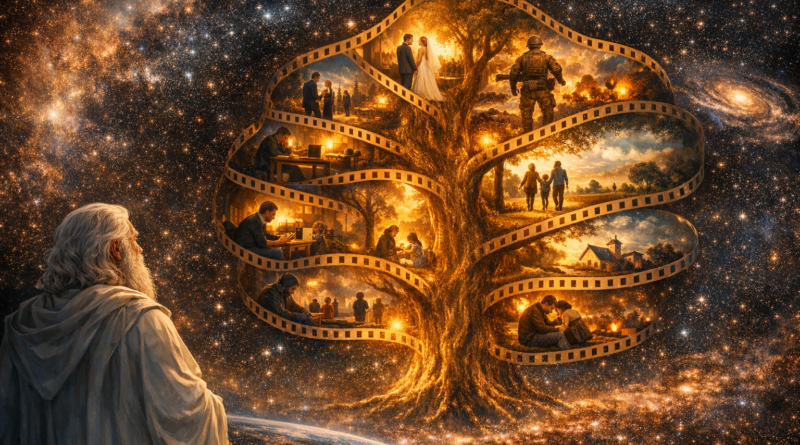
But life isn’t a movie. It’s a tree. And one day, without him looking for it, a new branch opened.
He was twenty‑three when an old man, the owner of a workshop Marco had entered to steal from, instead of calling the police said to him: “If you want to work, be here tomorrow at eight.” Marco didn’t understand. He wasn’t used to trust. He wasn’t used to someone offering him a different path. But the next day, without knowing why, he showed up.
It wasn’t a miracle. It didn’t change everything in one day. But that choice — one single, small choice — changed direction. Like a branch bending toward the light. Marco began working, learning, failing, trying again. And one day, looking back, he realized his destiny wasn’t written. It had been him, with a thousand small and big choices, who built the road he was walking.
And he understood something else: God had never abandoned him. God had never pushed him toward evil. God had never decided for him. But He had placed, at the right moments, people, opportunities, signals. Not to rewrite the ending from above, but to offer new paths.
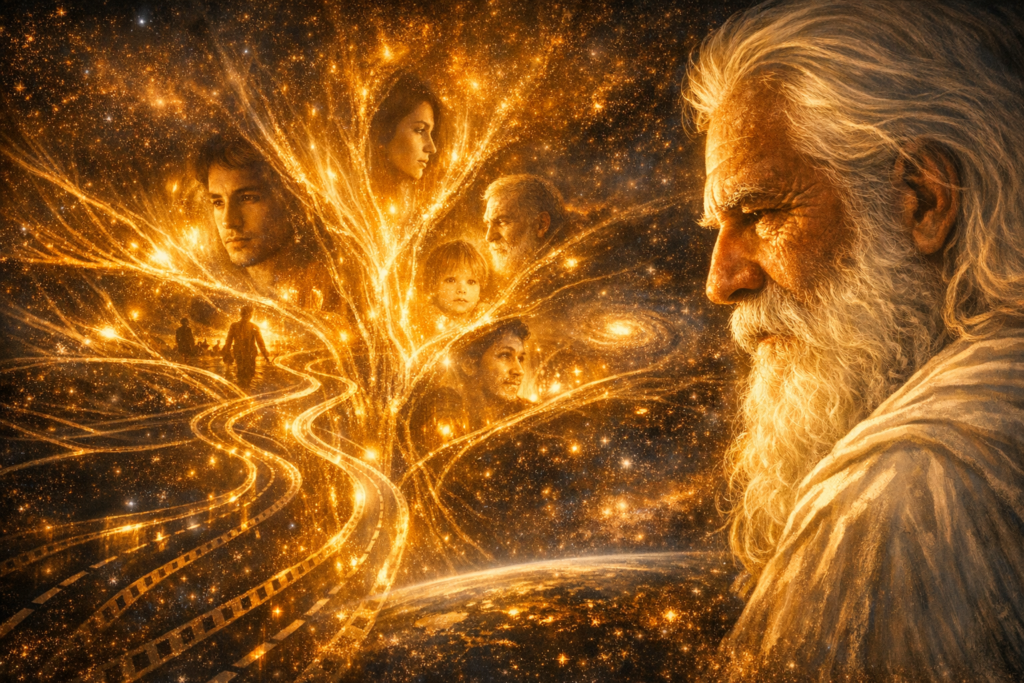
This is how it works. God doesn’t see one future. He sees many. He sees the version of you that falls, the one that gets back up, the one that gets lost, the one that is saved. He sees the path that wounds you and the one that heals you. He sees the one that destroys you and the one that makes you become who you could truly be.
And then the question arises: if God already sees how I will end, am I really free?
The answer lies in a simple mystery: God knows the ending not because He decides it, but because He knows you. He knows your wounds, your fears, your inclinations, your hidden strength. He knows you better than you know yourself. And just as you can predict the choice of someone you deeply love, God sees where your freedom will lead you. But prediction is not control. It is understanding.
Evil, in all this, is not a force created by God. It is an absence. Just as darkness is the absence of light, evil is the absence of good. It is born when freedom moves away from love. When a person chooses selfishness, revenge, hatred, indifference. When they hurt, betray, manipulate. When they use freedom to destroy instead of build.
But even here, God does not step back. He doesn’t say: “You made a mistake, deal with it.” He says: “You made a mistake, but I’m still here.” And He keeps offering new paths. He keeps suggesting. He keeps calling. He keeps hoping. Because love never stops trying, even when it knows you might refuse.
And then there is truth — the one that often hurts more than lies. Not everything is black or white. A lie told to harm is evil. A lie told to protect is human. A lie told to save is justice. Morality is not a rigid code but a fragile balance between intention and consequence. God does not look at the word. He looks at the heart behind it. He looks at whether that word brings you closer to love or further away from it.
In the end, the first question returns: are we free, or is everything already written? The answer is this: we are free inside a universe of possibilities that God sees all at once. And God, with a patience no human could ever have, works to guide us toward the best ending. We don’t always make it. Sometimes we get lost. Sometimes we fall. Sometimes we choose the wrong branch. But as long as there is life, there is possibility. As long as there is breath, there is a path. As long as God exists, there is a better ending waiting somewhere.
We are not puppets. We are not marionettes. We are not characters in a script. We are free human beings, fragile, imperfect, capable of failing and rising again. And God is the presence that sees all the paths and keeps pointing us toward the right one, without ever giving up.