
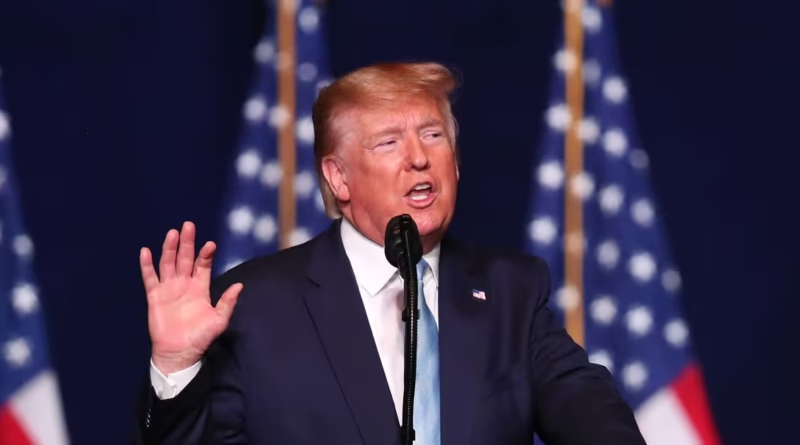
Iran Bounty on Donald Trump: Inside the $58 Million Threat Escalating Tensions With the U.S.
The phrase Iran bounty on Donald Trump no longer belongs to the realm of online rumors or fringe propaganda. It has entered the official vocabulary of the Islamic Republic, carried by the voice of Ebrahim Azizi, head of Iran’s National Security Commission, who announced on state television that Parliament is evaluating a draft law allocating fifty million euros — about fifty‑eight million dollars — as a reward for anyone who attempts to kill the President of the United States. A declaration that has shaken the geopolitical landscape, injecting a new level of volatility into an already explosive confrontation between Washington and Tehran.
The proposal is part of a broader initiative known as the “Counteroffensive of the Armed Forces and Security of the Islamic Republic,” conceived as a direct response to the death of Supreme Leader Ali Khamenei. His killing at the end of February sent shockwaves through the regime, prompting a wave of ideological fervor and calls for retaliation. Azizi framed the measure not merely as a political act but as a religious obligation, invoking the rhetoric of martyrdom that has long shaped the identity of the Islamic Republic. In his words, the death of Khamenei demands a response that transcends diplomacy and enters the realm of divine justice.
The bounty does not target Trump alone. According to Azizi — as reported by Iran International, Asr Iran, Khabar Online, and PressTV — the proposed law would also apply to Israeli Prime Minister Benjamin Netanyahu and Admiral Brad Cooper, commander of the U.S. Central Command. Azizi described the three men as “vile,” “sinister,” and “responsible for the oppression” that, in Tehran’s narrative, culminated in Khamenei’s death. His language leaves no room for ambiguity: Iran is signaling that it views these figures not as political adversaries but as legitimate targets.
Yet the Iran bounty on Donald Trump did not emerge in a vacuum. For months, Iran’s propaganda ecosystem had been preparing the ground. The pro‑regime website Masaf, linked to Ali Akbar Raefipour, claimed to have raised fifty million dollars for a campaign explicitly titled “Kill Trump.” Anonymous SMS messages circulated across the country, urging citizens to join the “International Campaign to Reward the Assassination of Trump.” The associated website reportedly gathered nearly 290,000 sign‑ups and pledges totaling twenty‑five million dollars — a stark indicator of how deeply anti‑American sentiment resonates in certain segments of Iranian society.
The cyber domain mirrored this escalation. The Iranian hacker collective Handala announced a fifty‑million‑dollar fund for what it called “the elimination of the main agents of oppression and corruption,” explicitly naming Trump and Netanyahu. The announcement came shortly after the U.S. Department of Justice offered ten million dollars for information identifying Handala members. The group, along with Parsian Afzar Rayan Borna, had already been accused by the FBI of hacking the personal email account of FBI Director Kash Patel and leaking confidential information. The incident further deteriorated relations between the two nations, setting the stage for the current crisis.
What makes the situation unprecedented is not the rhetoric itself — Iran has long used inflammatory language against the United States — but the possibility that such rhetoric could become law. If approved, the Islamic Republic would be legally obligated to pay the bounty to anyone who carries out the attack. It would mark the first time a modern state codifies into law a financial incentive for the assassination of foreign leaders, crossing a line that even the most hostile regimes have historically avoided.
International reactions have been swift and severe. Washington has condemned the proposal as “a direct and unacceptable threat against a head of state,” while Israel has described it as “state‑sponsored terrorism disguised as legislation.” European governments are watching with growing concern, aware that such a move could trigger a chain reaction of covert operations, cyberattacks, and retaliatory strikes. In a Middle East already fractured by proxy wars, drone campaigns, and ideological rivalries, the idea of a government‑funded assassination program introduces a new and unpredictable variable.
Yet beneath the surface lies a deeper truth: Iran is navigating one of the most unstable periods in its recent history. The death of Khamenei has created a power vacuum, and the leadership is attempting to consolidate control through a narrative of resistance and vengeance. The Iran bounty on Donald Trump is not only a message to the United States; it is a message to the Iranian people — a call to unity through confrontation, a transformation of national grief into political mobilization.
The world watches, aware that when a state places a price on the head of a foreign president, it is not merely challenging another nation. It is challenging the international order itself.