
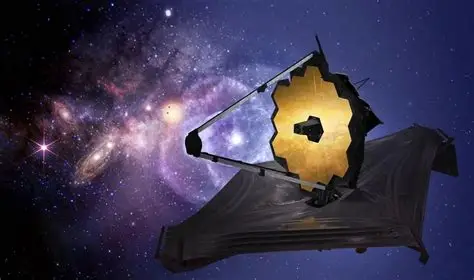
The First Dark Star? Webb May Have Found a Cosmic Ghost From the Dawn of Time
There are discoveries that arrive like a punch to the chest — sudden, disorienting, impossible to ignore. And then there are discoveries that creep in quietly, like a faint pulse in the data, a whisper from the deep past that grows louder with every new observation. The strange object detected by the James Webb Space Telescope belongs to the second category. It didn’t explode into the headlines. It didn’t come wrapped in drama. It simply appeared — a soft, persistent glow from the universe’s earliest dawn — and refused to behave like anything we thought we understood.
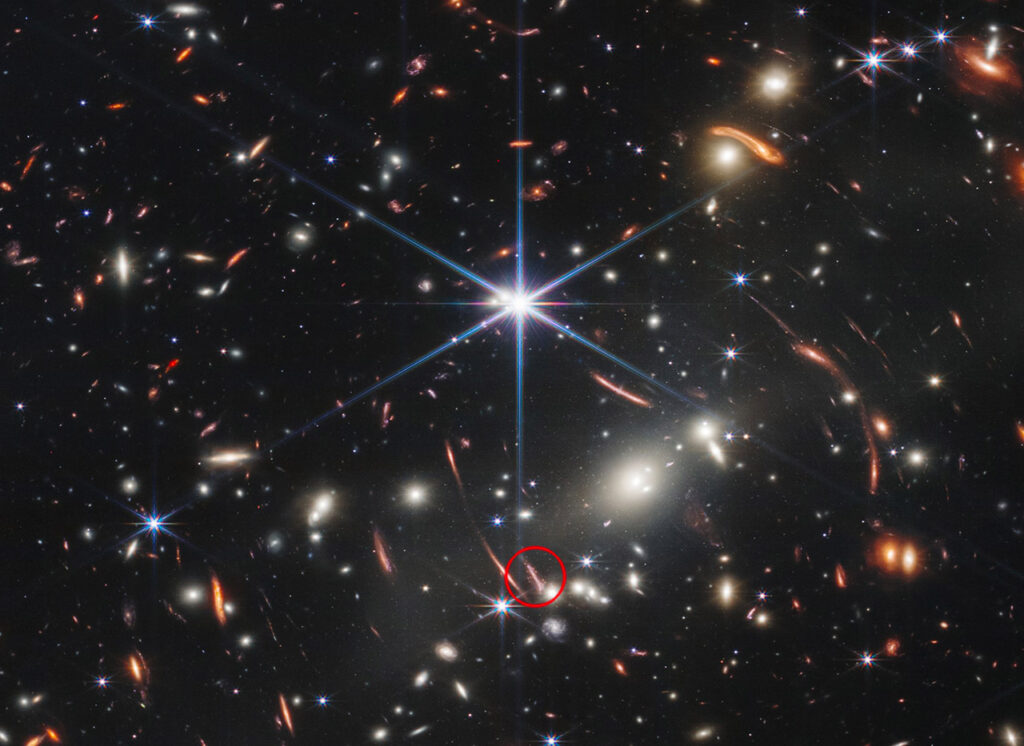
What Webb found is not a galaxy. It’s not a star as we know stars. It’s not a black hole, though it carries the same gravitational swagger. It is something else entirely, something that shouldn’t exist and yet does: a candidate for the first dark star, a hypothetical object powered not by nuclear fusion, but by the annihilation of dark matter itself.
If that sounds like science fiction, it’s because until now it was. Dark stars have lived for years in the margins of cosmology — elegant equations, speculative models, the kind of idea that excites theorists but rarely survives contact with real data. And yet here we are, staring at a luminous anomaly more than 13 billion light‑years away, a relic from the universe’s childhood that seems to match every prediction of a dark star and none of the predictions of anything else.
The object is too large, too cool, too stable, too bright. It glows in the infrared like a slow‑burning ember, not a raging furnace. It sits at a redshift so extreme that its light began traveling toward us when the universe was still learning how to make stars. And its spectrum — the cosmic fingerprint that reveals what an object is made of — refuses to fit into any known category.
Something is happening out there. Something old. Something strange.
And for the first time, astronomers are daring to say it out loud: this might be a dark star.
Dark matter has always been the universe’s great ghost — invisible, untouchable, yet undeniably real. It shapes galaxies. It bends light. It anchors the cosmic web. But it has never been seen directly. We know it exists only because the universe behaves as if it does. A dark star would change that. It would be the first object powered by dark matter that we could actually observe, the first time the invisible becomes visible.
To understand why this matters, you have to imagine the early universe. Not the universe of galaxies and planets and familiar physics, but the universe as it existed a few hundred million years after the Big Bang — a place of darkness, hydrogen, helium, and a density of dark matter far higher than anything we see today. In that environment, a collapsing cloud of gas could trap dark matter particles in its core. As those particles collided and annihilated, they would release energy — not enough to ignite fusion, but enough to keep the star from collapsing. Enough to let it grow. Enough to let it shine.
A dark star would be enormous — hundreds, thousands, even millions of times the mass of the Sun. It would be cool, glowing softly in the infrared. It would live far longer than any massive star has a right to. And it would be bright enough for Webb to see across the entire observable universe.
Which is exactly what Webb has done.
The American scientific community is buzzing. NASA researchers are cautious — they always are — but the excitement is unmistakable. The data fits too well. The anomalies line up too neatly. The object behaves exactly as a dark star should behave, and nothing like anything else.
And the timing couldn’t be more perfect. The United States is entering a new era of space exploration. Artemis II is preparing to return humans to the Moon. Private companies are pushing deeper into orbit. New telescopes are rewriting the boundaries of what we can see. The American public is paying attention to the sky again, hungry for wonder, hungry for meaning, hungry for the next great discovery.
A dark star would be that discovery.
It would be a message from the universe’s first chapter, a reminder that the cosmos is not a finished story but a living, evolving narrative. It would force physicists to rethink the nature of dark matter. It would reshape our understanding of how the first structures formed. It would open a new window into the deep past — a window we didn’t even know existed.
And it would arrive at a moment when Americans are already looking up. Just a few weeks ago, the sky delivered another spectacle: a rare double‑comet drama as R3 Pan‑STARRS and A1 MAPS brightened together in the April sky. We covered that celestial performance in detail, exploring the strange choreography of two icy wanderers racing toward the Sun, a story you can revisit here: Dual Comet Showdown: R3 Pan‑STARRS & A1 MAPS — April’s Celestial Drama Unfolds
But a dark star is something else entirely. Comets come and go. Eclipses pass. Meteor showers flare and fade. A dark star is a fossil — a survivor from a time when the universe was still experimenting with the laws of physics. It is a message from the cosmic dawn, carried across billions of years, waiting for a telescope powerful enough to hear it.
And now we have that telescope.
The James Webb Space Telescope has already rewritten the early universe once, revealing galaxies that formed far earlier than expected, black holes that grew too fast, structures that shouldn’t exist. But this — this is different. This is not a galaxy forming too early. This is not a black hole growing too quickly. This is something that challenges the foundation of how stars work.
If the dark star hypothesis holds, it means the first stars in the universe were not nuclear furnaces but dark‑matter engines. It means the early cosmos was stranger, softer, more luminous than we imagined. It means dark matter — the invisible majority of the universe — was not just a passive background force but an active participant in shaping the first light.
And it means we may finally have a way to study dark matter directly.
The implications ripple outward. If dark stars existed, they could explain why some early galaxies appear too bright. They could account for the seeds of supermassive black holes. They could reshape the timeline of cosmic evolution. They could even hint at the true nature of dark matter particles — their mass, their interactions, their annihilation signatures.
For physicists, this is the kind of discovery that keeps them awake at night.
For astronomers, it is a once‑in‑a‑generation moment.
For the American public, it is a reminder that the universe still has secrets worth chasing.
And for the rest of us — the dreamers, the stargazers, the people who look up at night and feel something stir — it is a promise that the cosmos is not done surprising us.
Somewhere in the deep infrared, a faint glow continues its journey. It carries the memory of a time before galaxies, before planets, before anything we would recognize as a universe. It carries the signature of a star powered by the invisible. It carries a question that has haunted physics for decades.
What is dark matter?
The answer may be written in the light of a star that should not exist.
And for the first time, we may be close enough to read it.