
The Roads That Glow in the Dark: Malaysia’s Nighttime Experiment Captivating the World
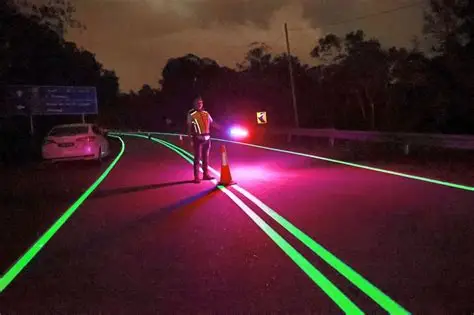
There are places on Earth where night doesn’t simply fall — it transforms. In rural Malaysia, along a quiet stretch of highway that cuts through palm‑oil plantations and low‑lying mist, something extraordinary has begun to happen after sunset. The asphalt itself starts to glow. Not with headlights, not with neon, not with anything artificial in the way we usually understand it, but with a soft, otherworldly radiance that seems to rise from the road like memory, like breath, like something alive.

It began as a local experiment, a small‑scale test meant to improve nighttime visibility without relying on energy‑hungry streetlights. But the moment the first images hit social media — a ribbon of turquoise light snaking through the darkness — the world took notice. The United States, always hungry for stories that blend innovation with environmental imagination, quickly turned its attention toward Malaysia’s glowing roads. They looked like something out of a sci‑fi film, a glimpse of a future where infrastructure doesn’t just exist but interacts with the night.
The science behind the glow is deceptively simple. Engineers infused the road surface with photoluminescent materials — compounds that absorb sunlight during the day and release it slowly after dusk. But the effect is anything but simple. Under the Malaysian night sky, the road becomes a luminous path, a quiet guide through the darkness. Drivers describe the experience as surreal, almost meditative, as if the road is whispering them forward. Locals say it feels like the Earth itself is lighting the way.
But the story doesn’t end with aesthetics. Malaysia’s glowing roads are part of a broader conversation about how nations adapt to rising energy costs, climate pressures, and the need for safer, more sustainable infrastructure. In a world where cities are drowning in artificial light, where the night sky is fading behind halos of pollution, the idea of a road that glows without electricity feels almost radical. It suggests a future where technology doesn’t overpower nature but collaborates with it.
American researchers have been watching closely. Departments of transportation in several states — especially those with long rural highways — have quietly expressed interest. The U.S. has its own challenges: vast stretches of unlit roads, rising accident rates at night, and growing pressure to reduce energy consumption. A self‑illuminating road could be more than a novelty; it could be a solution.
Yet the Malaysian experiment carries something deeper than utility. It taps into a cultural fascination with the night itself. Humans have always been drawn to things that glow in darkness — fireflies, bioluminescent bays, the shimmer of minerals under ultraviolet light. There is something primal in the way we respond to light that doesn’t come from a bulb or a flame. Something ancient. Something that feels like a secret being revealed.
In Malaysia, the glowing road has already become a kind of local landmark. Families drive out just to see it. Photographers wait for the moment when the last traces of daylight vanish and the asphalt begins to pulse with color. Travelers describe it as walking through a dream. And in a world saturated with digital spectacle, the simplicity of a glowing road feels strangely profound.
The phenomenon has also sparked scientific curiosity. Researchers are studying how long the glow lasts, how weather affects it, how the materials degrade over time. They’re exploring whether different colors could be used to signal hazards, guide traffic, or even reduce driver fatigue. Some have suggested that glowing roads could help protect wildlife by reducing the need for bright streetlights that disrupt nocturnal ecosystems. Others imagine entire networks of photoluminescent paths — bike lanes, pedestrian walkways, coastal roads — creating a new kind of nighttime landscape.
For the United States, the Malaysian experiment arrives at a moment when the country is rethinking its relationship with infrastructure. The push for greener, smarter, more resilient systems has never been stronger. And while glowing roads may not be the answer to every challenge, they represent a shift in mindset: a willingness to imagine roads not as static slabs of asphalt but as dynamic, responsive surfaces.
There is also a poetic dimension that resonates deeply with American readers. The idea of a road that lights itself — a path that glows without wires, without power plants, without human intervention — feels like a metaphor for possibility. It evokes the open‑road mythology that has shaped American culture for generations. The glowing road becomes a symbol of movement, of exploration, of the quiet magic that still exists in the world.
And perhaps that is why the story has captured so much attention. In an era defined by noise, conflict, and digital overload, the image of a glowing road in rural Malaysia feels like a reminder that innovation can still be beautiful. That progress doesn’t always have to be loud. That the future can arrive softly, like light rising from the ground.
As night falls again over the Malaysian countryside, the road begins its slow transformation. The last rays of sunlight fade, the air cools, and the asphalt awakens. A soft turquoise glow spreads across its surface, illuminating the darkness without breaking it. Drivers pass through the light like travelers in a dream. And somewhere, thousands of miles away, an engineer in the United States scrolls through the latest images and wonders whether this quiet revolution might soon find its way to American soil.
Because sometimes the future doesn’t announce itself with thunder. Sometimes it arrives as a road that glows in the dark.