
Electric Trucks: How the Tesla Semi and Volvo FH Electric Are Redefining Heavy‑Duty Transport
Why Electric Trucks Are Transforming Heavy‑Duty Transport
There are revolutions that arrive with noise, and others that arrive with weight — literally. The transformation of industrial transport does not come from futuristic concepts or glossy prototypes, but from machines that move silently across highways, carrying tons of cargo with the calm authority of something that is already real. The Tesla Semi and the Volvo FH Electric belong to this second category: two electric trucks that are not trying to imagine the future, but to haul it, kilometer after kilometer, in the most demanding sector of mobility.
The first time the Tesla Semi appeared on an American highway, it didn’t look like a truck trying to imitate the past. Its aerodynamic shape, the central driving position, the absence of engine noise — everything suggested a break with decades of diesel dominance. Yet what made the Semi truly disruptive was not its design, but its numbers. The torque delivered instantly by its electric motors allowed it to accelerate with a fluidity unknown in heavy transport. Fully loaded, it climbed long gradients without losing speed, and its regenerative braking system turned every descent into energy recovered rather than wasted. For drivers accustomed to the vibrations and inertia of diesel engines, the experience felt almost surreal.
But the Semi’s real impact lies in its endurance. In test runs, it covered more than 800 kilometers on a single charge, maintaining highway speeds while hauling a full load. This was the moment when electric transport stopped being a promise and became a logistics tool. Companies began to understand that electrifying long‑haul routes was not only possible, but economically advantageous. Lower maintenance, lower energy cost, fewer mechanical failures — the Semi was not just a cleaner truck, it was a smarter one.
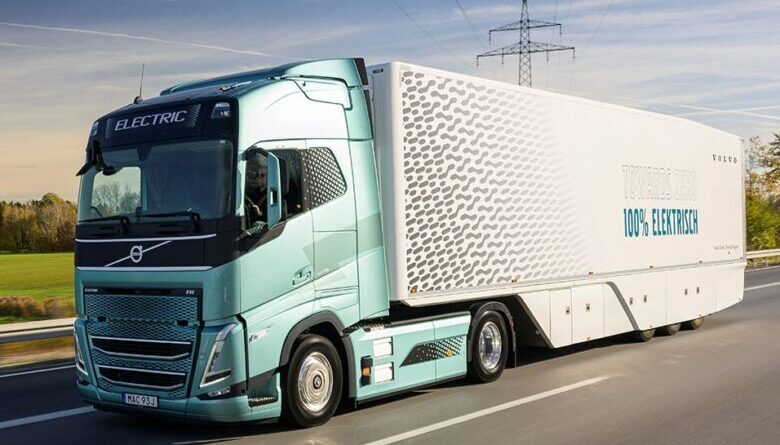
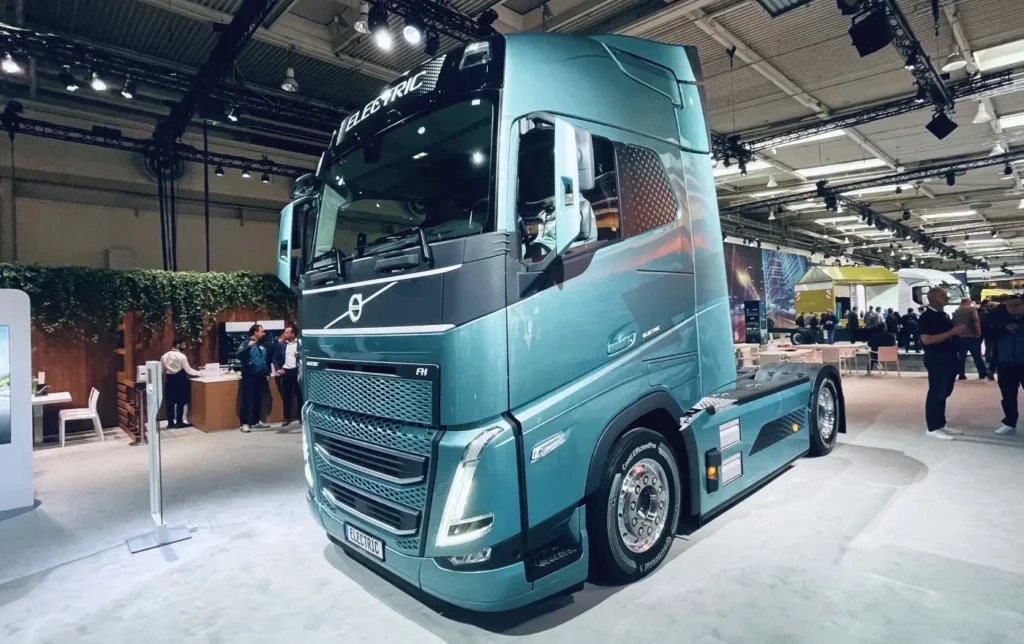
Across the Atlantic, Volvo was shaping a different kind of revolution. The FH Electric did not try to look futuristic; it looked like a Volvo truck, because that is what many European transport companies trust. The innovation was hidden beneath the familiar lines: a battery system capable of powering regional and long‑distance routes, a drivetrain engineered for industrial reliability, and a charging architecture designed around the real needs of logistics hubs. The FH Electric entered service quietly, without the spectacle that often surrounds new technologies, but with the steady confidence of a machine built for work.
What makes the FH Electric remarkable is its integration into existing fleets. It doesn’t ask companies to reinvent their operations; it simply replaces diesel with electrons. Drivers report a sense of control and comfort that diesel trucks cannot match: no gear shifts, no engine roar, no fumes, no vibrations. In cities, the silence becomes a public benefit. In industrial zones, the absence of exhaust gases changes the air itself. And on highways, the FH Electric proves that electric power is not a limitation but a competitive advantage.
Both trucks face the same challenge: infrastructure. Charging a passenger car is simple; charging a 40‑ton truck requires planning, power, and coordination. Yet this challenge is shrinking. Megawatt charging systems are being deployed, logistics hubs are installing high‑capacity stations, and energy providers are adapting to the new demand. The transition is not instantaneous, but it is accelerating. Every new electric truck on the road becomes a data point, a test case, a proof that the shift is not only possible but inevitable.
The most surprising aspect of this transformation is how natural it feels once the trucks are in motion. Watching a Tesla Semi glide past with the quiet determination of an electric locomotive, or seeing a Volvo FH Electric pull out of a depot at dawn without leaving a cloud of diesel behind, gives the impression of a world that is already changing. Not through slogans or promises, but through machines that work, deliver, and repeat the cycle every day.
Industrial transport has always been the backbone of modern economies. For decades, it has relied on diesel as its lifeblood. But the arrival of electric heavy trucks marks a turning point that is both technological and cultural. It is the moment when the most demanding sector of mobility begins to align with the broader shift toward sustainability. Not because it is fashionable, but because it is efficient. Not because it is idealistic, but because it is practical.
The Tesla Semi and the Volvo FH Electric are not competing visions of the future; they are complementary forces pushing the same boundary. One brings the disruptive energy of Silicon Valley, the other the industrial discipline of Northern Europe. Together, they show that the road to decarbonizing freight transport is not a distant horizon — it is already paved, charged, and moving.
And as these electric giants continue to cross continents, they carry with them a simple truth: the future of heavy transport will not be loud, smoky, or mechanical. It will be silent, precise, and electric.
The move toward zero‑emission freight mirrors what is already happening in public transport, where hydrogen buses are entering service across Europe. Our detailed report on hydrogen‑powered buses explores how this technology is reshaping urban mobility.
As electric trucks reshape the future of road freight, a similar transformation is unfolding on the rails, where hydrogen‑powered trains are already proving their reliability in real‑world service. You can explore this shift in our in‑depth analysis of the Alstom Coradia iLint, the world’s first hydrogen passenger train.
According to the International Energy Agency, electric trucks are becoming a key driver in the global transition to zero‑emission freight.