
Bioelectric Medicine: 7 Breakthroughs Showing How Cellular Signals Can Regenerate the Human Body
Bioelectric Medicine is reshaping the future of healing through controlled cellular signals that guide regeneration and redefine how the human body repairs itself.
As researchers decode the patterns of Bioelectric Signaling, they are uncovering a dynamic language through which cells coordinate growth, regeneration, and identity — a silent grammar that medicine is only now beginning to understand.
In the hidden circuitry of the human body, electricity has always been more than a spark — it is a language. Every cell listens to it, responds to it, and shapes itself according to the silent currents that flow beneath the surface of biology. For decades, medicine has focused on chemistry: drugs, molecules, reactions. But a new frontier is emerging, one that does not rely on pharmaceuticals or genetic editing. It relies on bioelectricity, the ancient code that tells tissues how to grow, repair, and transform. Bioelectric Medicine is reshaping this frontier, revealing how electrical patterns can guide tissues to rebuild themselves with a precision once unimaginable.
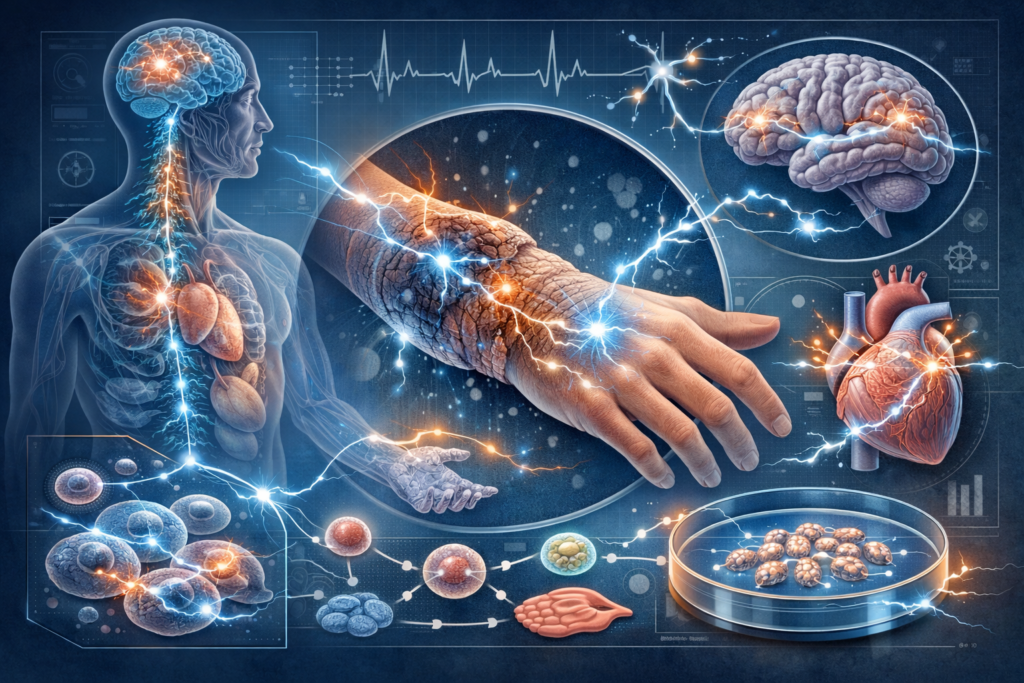
In laboratories around the world, scientists are learning to speak this language with unprecedented precision. By modulating tiny electrical gradients, they can persuade cells to regenerate structures once believed impossible. A damaged limb, a failing organ, a wound that refuses to heal — all of them respond to the right electrical instructions, as if the body were waiting for someone to remind it of what it once knew. This is the birth of bioelectric medicine, a field that treats the body not as a machine to be repaired, but as a living system capable of rewriting itself.
As researchers push deeper into this field, Bioelectric Medicine begins to look less like an experimental discipline and more like a fundamental language of the body, capable of awakening dormant regenerative instructions.
The first human tests are beginning, exploring whether controlled electrical patterns can guide tissues to rebuild what was lost. It is a quiet revolution, one that does not shout but pulses beneath the skin. Patients who once faced irreversible damage are becoming the first witnesses of a new kind of healing — one that does not replace, but restores. The idea that the body can be instructed to regenerate itself challenges centuries of medical thinking and opens a door to possibilities that feel almost mythic.
And this revolution does not stand alone. It is part of a broader shift in biotechnology — a shift toward technologies that treat life as an information system. In some labs, human cells are already being trained to compute, forming the first generation of living processors. Their logic is biological, their architecture alive, their potential vast. It is a transformation explored in our article “Biocomputers Made of Human Cells Enter the Lab — The First Living Processors Are Here,” where clusters of cells begin to perform tasks once reserved for silicon. The idea that a living tissue could one day outperform a microchip is no longer a distant speculation; it is a quiet reality unfolding under the microscope.
Bioelectric medicine and cellular computing share a common truth: life is programmable. Not in the cold, mechanical sense, but in a way that respects the fluidity of biology. Cells respond to signals, adapt to environments, and follow patterns that can be guided rather than forced. The future of healing may not come from external interventions, but from awakening the instructions already written within us. The body becomes both the patient and the technology, both the problem and the solution. The more we understand Bioelectric Medicine, the clearer it becomes that healing is not only a biological process but an electrical dialogue that can be rewritten, amplified, and directed toward renewal.
As researchers push deeper into this field, they are discovering that bioelectricity is not just a tool for repair — it is a map of identity. Electrical patterns define the shape of a limb, the symmetry of a face, the architecture of an organ. They are the blueprint beneath the blueprint, the invisible geometry that tells cells where to go and what to become. By learning to read and rewrite these patterns, scientists are beginning to understand that regeneration is not a miracle; it is a conversation.
The implications stretch far beyond medicine. If we can guide cells to rebuild tissues, could we guide them to resist aging? Could we prevent degenerative diseases before they begin? Could we one day regenerate entire organs without transplants, simply by reactivating dormant instructions? These questions are no longer speculative; they are the natural next steps of a field that is accelerating faster than anyone predicted.
Biotechnology is not simply advancing — it is changing the nature of technology itself. The machines of the future may not be built; they may be grown. They may heal, think, regenerate, and evolve. They may blur the line between biology and engineering until the distinction becomes irrelevant. We are entering an age in which life is the ultimate platform — flexible, powerful, and infinitely complex. And as we learn to read, write, and shape it, the story of humanity is being rewritten at the cellular level.
Recent scientific research continues to reinforce the foundations of this emerging field. A study published in Nature Biomedical Engineering highlights how bioelectric signaling can influence tissue behavior and regenerative outcomes, offering further evidence that the body’s electrical language plays a central role in healing. PubMed – Bioelectric signaling and tissue regeneration