
7 Stunning Facts About Jupiter’s Auroras That Redefine Planetary Power
There are phenomena that, even from millions of kilometers away, manage to shake our imagination more than any storm on Earth. Jupiter’s auroras belong to this category. They are not simple light displays, nor delicate dances of particles like the ones that color the skies of the Arctic and Antarctic. They are something larger, fiercer, more ancient. They are the electric breath of a giant.
Jupiter’s Auroras and the Hidden Engines Behind Their Power
On Earth, the aurora is a gentle encounter between the solar wind and our magnetic field. Charged particles from the Sun slide along magnetic lines and collide with atoms in the atmosphere, lighting up the sky in green, violet, and red. It is a fragile, almost poetic phenomenon, dependent on the Sun’s mood and the silent protection of Earth’s magnetosphere.
Jupiter’s auroras stand as one of the most powerful reminders that even within our own Solar System, there are forces far more intense than anything we experience on Earth.
But on Jupiter, everything changes. The aurora is not a side effect of the Sun: it is an autonomous phenomenon, powered by an internal force that no other planet in the Solar System possesses. Jupiter does not simply react to the solar wind. It dominates it. It bends it. It transforms it.
Its auroras shine constantly, day and night, without pause. They do not need solar storms to ignite. They are fueled by a hidden engine, a titanic mechanism that unites magnetism, rotation, and distant volcanoes. This is where the story becomes surprising: part of Jupiter’s aurora is born from a tiny, tormented, unstable world orbiting close to the giant. A world called Io.
Why Jupiter’s Auroras Defy Everything We Know About Planetary Light
Io is the most volcanic moon in the Solar System. Its surface is a mosaic of lava, sulfur, and incandescent geysers erupting into space. Every eruption launches charged particles that are captured by Jupiter’s magnetic field, dragged into an invisible vortex, and accelerated to extreme speeds. When these particles plunge toward the planet’s poles, Jupiter’s atmosphere lights up like a cosmic beacon. It is an aurora that does not depend on the Sun, but on a volcano located 600 million kilometers from Earth.
It is an almost mythological bond: a giant planet and a tortured moon creating together a light show that no other world can replicate.
And yet, the Sun is not completely excluded from this story. The solar wind, when it strikes Jupiter’s magnetosphere, can amplify the aurora, deforming the magnetic field and creating luminous explosions that stretch for thousands of kilometers. It is as if Jupiter had two hearts: one internal, powered by its dizzying rotation and Io’s volcanoes, and one external, pulsing to the rhythm of the Sun.
Unlike terrestrial light shows shaped by the Sun, Jupiter’s auroras reveal a world where magnetism, rotation, and volcanic fury combine to create a phenomenon unlike any other.
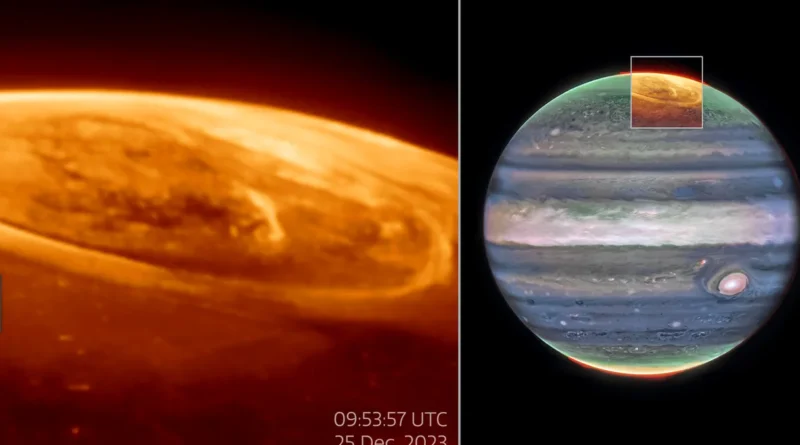
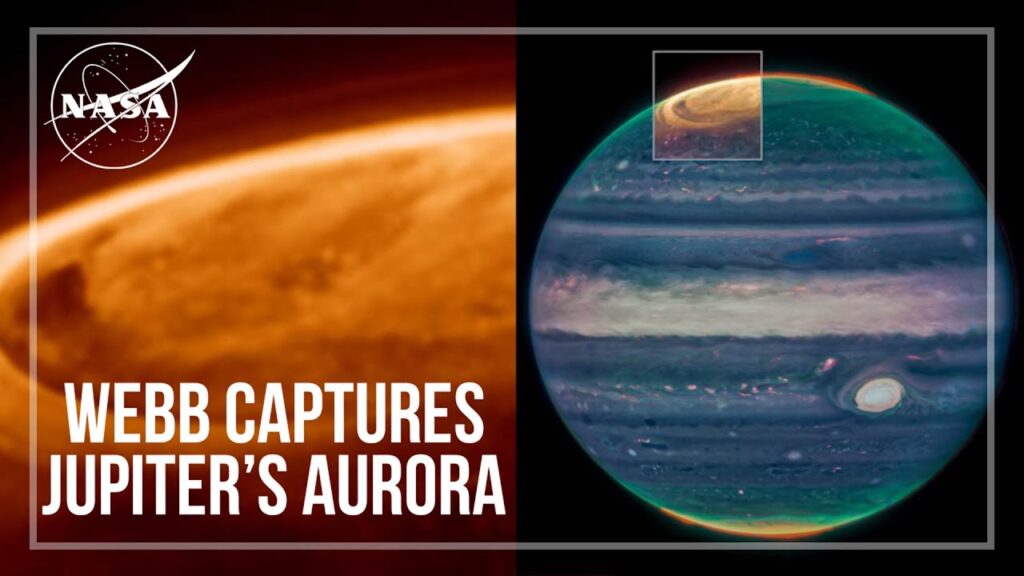
Images captured by the Hubble Space Telescope and the Juno spacecraft reveal luminous arcs wrapping around the planet’s poles, spirals of light moving like electric storms, and sudden flashes that resemble cosmic lightning. Every frame tells a story of pure energy, of forces that challenge our understanding and turn Jupiter into a natural laboratory of extreme physics.
Watching a Jovian aurora means witnessing the power of a planet that knows no moderation. It means seeing matter accelerated to impossible speeds, magnetism bent like a ribbon, and light born from invisible collisions. It means, above all, remembering that our Solar System is not a static place, but a theater of phenomena that surpass anything we can imagine.
And while on Earth auroras are a rare gift, an event dependent on the Sun’s temperament, on Jupiter they are a constant. A luminous signature that reveals the nature of a world built on force, rotation, and energy.
our video, “Jupiter’s Auroras: A Cosmic Light Show Like No Other!”, captures exactly this: the feeling of standing before something that does not belong to the human scale. A phenomenon that is not just beautiful, but that reveals the deep structure of a planet living on storms, magnetism, and distant volcanoes.
Jupiter’s auroras are not just an astronomical phenomenon. They are a message. A reminder of how little we truly know about the worlds around us, and how much there is still left to discover.
In the end, Jupiter’s auroras are more than a spectacle; they are a window into the deep physics that govern the largest planet in our cosmic neighborhood.
As we explore the forces shaping Jupiter’s magnetic storms, it becomes clear that our understanding of distant worlds is still evolving. A deeper look at how new observatories are transforming planetary science can be found in our feature on NASA’s Pandora Telescope.
You can read more about the deeper origins of Jupiter’s auroras in a recent analysis by NASA, which reveals how Juno uncovered the hidden forces shaping these extraordinary polar lights.