
AARO Western United States UAP Case – Five Lights Over the Desert (2021)
AARO Western United States UAP Case — In the vast silence of the American West, where the night sky stretches wider than any horizon, a group of military personnel noticed something that didn’t belong there. Five lights, perfectly spaced, hovering above the desert like markers of an invisible geometry…
In the vast silence of the American West, where the night sky stretches wider than any horizon, a group of military personnel noticed something that didn’t belong there. Five lights, perfectly spaced, hovering above the desert like markers of an invisible geometry. They didn’t blink, they didn’t drift, and they didn’t behave like any aircraft the observers were trained to recognize. For the men watching from the ground, those lights represented a possible breach into one of the most restricted airspaces in the United States.
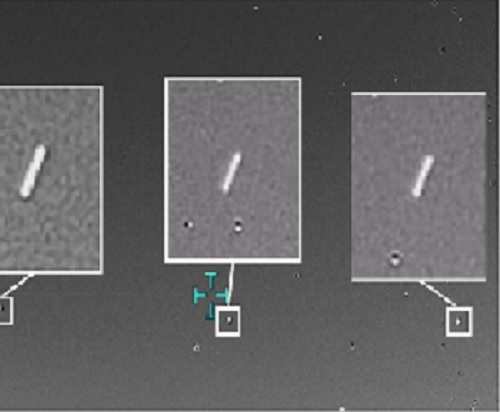
The official report, released by the All-domain Anomaly Resolution Office of the U.S. Department of Defense, recounts the event with the dry precision typical of military documentation. Yet beneath those measured lines, you can sense the tension of that moment — the uncertainty of facing something that refuses to fit into any familiar category. The lights appeared as elongated dots through infrared sensors, moving at a steady, almost deliberate pace. Their altitude was estimated between twenty and forty thousand feet, a range compatible with commercial aviation, but the observers believed the objects were much closer.
The turning point came when AARO analysts, together with intelligence and Science & Technology partners, reconstructed the event using additional data. The lights were not close at all. They were as far as three hundred nautical miles from the military platform — far beyond what the human eye and the IR sensors had suggested. The unusual shapes, which at first glance seemed to hint at something extraordinary, were actually distortions caused by sensor vibration and autofocus. A simple optical illusion, amplified by the sensitivity of the equipment.
When the analysts cross‑checked radar information and civilian air‑traffic data, the mystery dissolved. Each of those lights matched a commercial aircraft traveling along well‑established flight corridors connecting major airports across the western United States. The extreme distance, combined with atmospheric conditions and the characteristics of the infrared sensor, had created a perfect illusion: five lights moving in apparent formation, as if part of a single unknown structure.
The AARO document leaves no ambiguity. The case is officially resolved, and the lights are identified as distant commercial aircraft misinterpreted due to sensor limitations and human perception. Yet what stands out is not the conclusion, but the process. Even a fully explainable phenomenon can appear extraordinary when observed under extreme conditions, through instruments that magnify every vibration and every flicker of light. It is a powerful reminder that the sky does not lie — but it can be misunderstood.
This case, one among many reviewed by AARO, shows how thin the line can be between the unknown and the misinterpreted. And it highlights the complexity of the work carried out by those who must determine, day after day, what is truly anomalous and what only seems so for a fleeting moment.
Official Source: All-domain Anomaly Resolution Office (AARO), U.S. Department of Defense — Case: “Western United States”, 8 May 2023 https://www.aaro.mil