
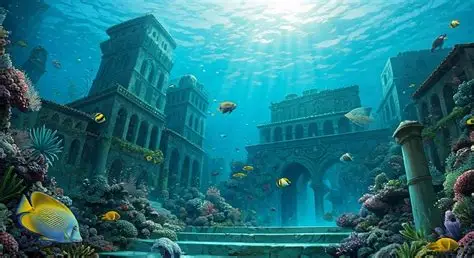
Atlantis: The Shocking Truth Behind the 12,000‑Year‑Old Lost Civilization
Atlantis is not just a myth. It is a collective obsession, an echo that travels across millennia and continues to resonate every time humanity questions its origins, its collapses, and the civilizations that may have vanished without leaving a trace. The story of Atlantis begins with Plato, but it does not end with him. It is a narrative that expands, transforms, and intertwines with archaeological discoveries, geological memories, and ancient traditions that seem to come from a lost world.
According to Plato, Atlantis was a vast island located beyond the Pillars of Hercules, rich in precious metals, built around a capital city shaped in concentric rings of land and water, and inhabited by a powerful, technologically advanced people destined for ruin because of their own arrogance. Its end, described as a sudden cataclysm—one day and one night of earthquakes and floods—has fueled the idea for centuries that Atlantis was a real civilization, erased by a geological event of titanic proportions.
Yet the story does not stop with Plato’s account. The roots of the myth reach into older traditions, such as those evoked by Homer in the Odyssey, where the island of Ogygia appears as a remote, mysterious place linked to the god Atlas and located in the middle of the ocean, almost a poetic anticipation of a submerged world. Other ancient authors, from Hesiod to Philo, left traces of lost islands, vanished civilizations, and cataclysms that echo the same collective memory: that of a world that once existed and then disappeared.
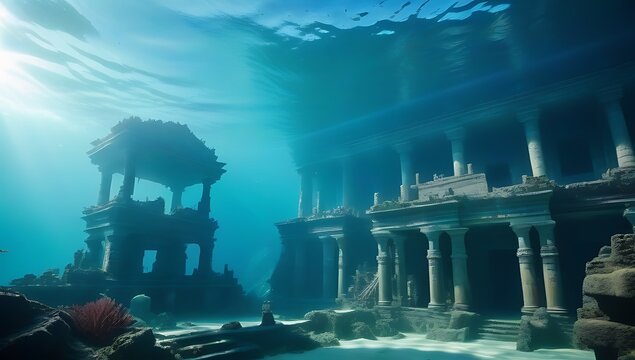
The power of the Atlantis myth lies precisely in this ambiguity. On one hand, Plato presents it as a moral allegory, a warning against corruption and hubris. On the other, he provides geographical and chronological details so precise that they resemble a historical report more than a philosophical invention. This tension between symbol and reality has driven generations of scholars, explorers, and scientists to search for Atlantis in the depths of the Mediterranean, the Atlantic, and even beyond.
Many have identified Atlantis with the Minoan civilization, which flourished on Crete and was devastated by the catastrophic eruption of the Thera volcano, now known as Santorini. The maritime power of the Minoans, their complex architecture, and their sudden collapse caused by tsunamis and earthquakes seem to match Plato’s description, yet the chronology does not align: the eruption occurred around 1600 BCE, while Plato places Atlantis in 9600 BCE, a temporal abyss of eight thousand years that makes the two events difficult to reconcile.
Other scholars have looked toward southern Spain, identifying Atlantis with Tartessos, a wealthy and advanced civilization that prospered between 1000 and 500 BCE and then mysteriously disappeared. The cultural and geographical similarities are fascinating, but once again the scale and timeline of Plato’s narrative seem to exceed what Tartessos can explain.
In recent years, however, a new perspective has begun to emerge. Some researchers suggest that to understand Atlantis, one must start not from geography but from time. Plato gives a precise date: 9600 BCE. If this indication is taken seriously, we enter an era when sea levels were much lower—about 120 meters below today’s levels. This means that vast areas now underwater were once exposed, and an island described by Plato could today lie beneath hundreds of meters of ocean. It is a hypothesis that radically shifts the search, moving it from visible islands to submerged continental shelves where the remains of a forgotten civilization might be hidden.
Modern research, however, does not limit itself to a single theory. Some scholars have begun exploring connections between Atlantis and the cultures of Iberia, the North African Berbers, and the Atlantic islands, suggesting that the myth may be a synthesis of shared memories, geological disasters, and cultural encounters along the routes of the Mediterranean and the Atlantic. Ancient tales of distant islands, circular fortified cities, and mysterious peoples may be fragments of a larger mosaic—a story that Plato collected and transformed into a powerful, coherent narrative.
What makes Atlantis so captivating is its elusive nature. It is a myth that lives between two worlds: philosophy and history, legend and science. Every new archaeological discovery, every geological analysis, every reinterpretation of ancient texts adds a piece to the puzzle, yet none completes it. Atlantis remains an enigma, a shadow moving beneath the waves, a memory that feels real but slips away every time one tries to grasp it.
And yet, perhaps the truth about Atlantis does not lie in a specific place but in what it represents. It is the symbol of lost civilizations, forgotten knowledge, and the cataclysms that have shaped human history. It is the memory of a world that may indeed have existed, erased by a natural event so devastating that it survived only in the stories of the peoples who witnessed it. It is the reflection of the fragility of human societies, capable of reaching extraordinary heights and plunging into oblivion in a single instant.
Atlantis continues to call to us because it speaks about us—our ambitions, our fears, our dreams of greatness, and our dread of disappearing. It is a myth that reminds us that history is not a straight line but a deep ocean, full of hidden currents and submerged worlds. And as long as we continue searching for Atlantis, we will continue searching for ourselves.
To explore another defining moment of ancient history, you can read this in‑depth article about the Battle of Kadesh: 7 Facts About the Battle of Kadesh — Ancient History’s First Peace Treaty.
At the end of this journey, for those who wish to explore the historical origins of the Atlantis legend in greater depth, an authoritative external source offers valuable insight: Where does the legend of Atlantis come from?