
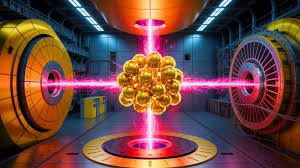
From Lead to Gold: How CERN Made the Alchemists’ Dream a Reality

For centuries, alchemy was considered a mystical and often misguided pursuit—an ancient dream of transmuting base metals into gold.
Medieval alchemists, driven by a mix of ambition and philosophical curiosity, sought to unlock the secrets of matter, believing in the existence of a hidden process that could transform the very building blocks of the material world.
While their methods were more poetic than scientific, the dream of transmutation remained alive, buried within the depths of physics.
And today, that dream is no longer just fantasy—it is a reality, thanks to the cutting-edge technology at CERN.
The Science Behind Modern Alchemy
At the heart of the world’s largest particle physics laboratory, CERN houses the most powerful accelerators ever built, capable of manipulating atoms in ways medieval alchemists could have never imagined.
Using high-energy collisions, scientists at CERN can transform elements by altering their atomic nuclei—effectively achieving what the alchemists dreamed of: transmutation.
This process relies on nuclear reactions, similar to those occurring inside stars. By bombarding lead atoms with high-energy protons, researchers can knock off particles from their nuclei and induce decay that ultimately results in the formation of gold.
The experiment is an extraordinary display of modern physics at work, proving that transmutation is not only possible but grounded firmly in scientific principles rather than mystical speculation.
Practical Implications
While the ability to turn lead into gold exists, the process is far from commercially viable. The energy required for such transformations makes the cost of producing gold this way exponentially higher than simply mining it.
However, beyond its impracticality as a method for wealth creation, nuclear transmutation holds valuable applications in various fields.
One of the most significant areas of study is in nuclear waste management. Scientists are investigating ways to use transmutation to alter radioactive materials, potentially transforming harmful waste into safer substances with shorter half-lives.
The ability to manipulate matter at the atomic level also offers exciting prospects for medicine, with isotopes used in cancer treatments being artificially created using similar methods.
A Testament to Human Ingenuity
What was once dismissed as myth and medieval fantasy is now a stunning example of human ingenuity and scientific progress.
The work done at CERN demonstrates that the boundaries of knowledge are continuously expanding. While the alchemists of old pursued their goal through mystical practices, today’s scientists rely on rigorous experimentation and deep theoretical understanding.
The dream of transmutation is no longer a pursuit of gold for fortune but a quest for deeper knowledge of the universe itself.
And while gold may no longer be the ultimate prize, the ability to manipulate elements at will is proof that science can make even the wildest dreams come true.