
Cosmology Updates 2026: Stunning New JWST Findings Transform Our View of the Cosmic Web
Cosmology updates 2026 continue to reshape our understanding of the Universe, as new peer‑reviewed studies and institutional releases reveal a cosmos more structured, more complex and more finely balanced than previously thought. The James Webb Space Telescope, in particular, is offering unprecedented insights into the large‑scale distribution of matter, the behavior of the cosmic web and the persistent tension in measurements of the Universe’s expansion rate.
Recent observations from the James Webb Space Telescope have enabled researchers to reconstruct the distribution of dark matter with remarkable precision. A study highlighted by the University of California, Riverside — and reported by Reuters — describes one of the most detailed dark‑matter maps ever produced using JWST data, published in Nature Astronomy. These results do not rewrite cosmology, but they significantly improve our ability to trace the invisible scaffolding that shapes galaxies and large‑scale structures.
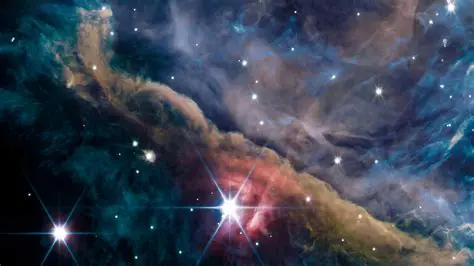
The reconstruction relies on weak gravitational lensing, a technique that measures how massive structures subtly distort the light of distant galaxies. In its standard form, the Einstein radius for a gravitational lens can be expressed.
where is the gravitational constant, is the mass of the lensing object, and , , and represent the cosmological distances between observer, lens and source. This formulation, widely used in gravitational‑lensing literature, provides a rigorous foundation for interpreting JWST’s measurements.
The resulting map reveals a cosmic web that appears more detailed and coherent than previous reconstructions based on Hubble data. Filaments, nodes and mass concentrations emerge with clarity, offering a more refined picture of how galaxies form and cluster across billions of light‑years. These findings do not imply a radical shift in theory, but they strengthen the empirical basis for studying the Universe’s large‑scale structure.
Parallel to these advances, the long‑standing tension in the measurement of the Hubble constant remains unresolved. A recent study reported by AstroSpace, summarizing results published in Astronomy & Astrophysics by the H0LiCOW / H0 Distance Network collaboration, confirms a local‑Universe value of 73.50 ± 0.81 km/s/Mpc. This continues to differ from the lower value inferred from early‑Universe measurements based on the cosmic microwave background. The discrepancy does not yet constitute evidence of new physics, but it represents one of the most persistent open questions in modern cosmology.
JWST has also contributed new observations of the Milky Way’s center, revealing magnetic structures and gas flows around Sagittarius A* that appear more organized than expected. These findings, while still under analysis, suggest that the dynamics of the galactic core may be more complex than current models predict. They do not contradict established physics, but they highlight the need for more detailed simulations and multi‑wavelength observations.
None of these results directly demonstrate cosmic fine‑tuning, nor do they imply hidden dimensions or metaphysical interpretations. However, they do reinforce the idea that the Universe operates through delicate balances and interconnected processes. The more precisely we observe the cosmos, the more its structure appears finely regulated — a theme that naturally intersects with broader philosophical questions about the nature of reality.
For readers interested in exploring how cosmology connects with deeper questions about consciousness, parallel universes and hidden dimensions, you can continue with the article below:
Cosmology and Consciousness: 7 Astonishing Insights into Parallel Universes and Hidden Dimensions
As the 2026 research landscape unfolds, one thing becomes clear: the Universe is not merely expanding — it is revealing itself with increasing depth, precision and mystery.