When the Sun Strikes: How a Massive Solar Storm Threw the Modern World Into Chaos
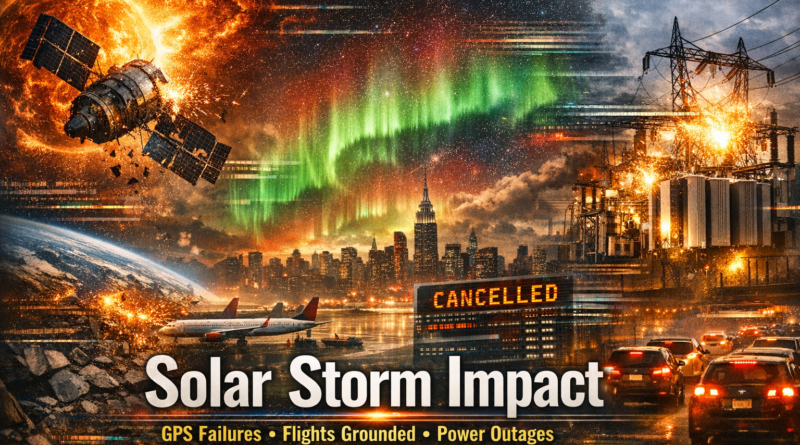
It began as a faint shimmer on the edge of the magnetosphere, a pulse of charged particles racing toward Earth at a speed no human invention could match. Scientists had warned that a major solar storm was possible, but warnings rarely carry weight until the sky itself begins to change. By the time the first auroras appeared over cities that had never seen them before — Madrid, Rome, New York — the damage was already unfolding silently across the planet.
Airports were the first to feel the shock. GPS signals flickered, then vanished, leaving pilots without the digital navigation systems they rely on every second of every flight. Controllers scrambled to reroute planes, grounding hundreds of departures in a matter of minutes. In the terminals, passengers stared at departure boards frozen in time, unaware that the disruption came not from a technical glitch, but from the Sun itself.
Across the oceans, cargo ships drifted off course as their satellite links collapsed. Some slowed to a crawl, others stopped entirely, waiting for coordinates that refused to arrive. The global supply chain — already fragile from years of crises — felt the tremor instantly. Oil tankers, container ships, fishing vessels: all were suddenly navigating blind.
On land, the storm struck the power grids with a force that engineers dread. Transformers groaned under the surge of geomagnetic currents, some overheating, others failing outright. In parts of Canada and Scandinavia, entire regions went dark for hours. In the United States, grid operators shifted into emergency mode, rerouting electricity to prevent a cascading collapse. The world had not seen a solar event of this magnitude in decades, and the systems built to withstand it were being tested in real time.
Yet the most surreal scenes unfolded in the night sky. Curtains of red, green, and violet light rippled over cities where the stars are usually drowned by neon and concrete. People stepped out onto balconies and rooftops, phones raised, capturing the beauty of a phenomenon that was, in truth, a warning. The auroras were brighter, wider, more intense than anything recorded in the modern era — a sign that the storm was not just powerful, but historic.
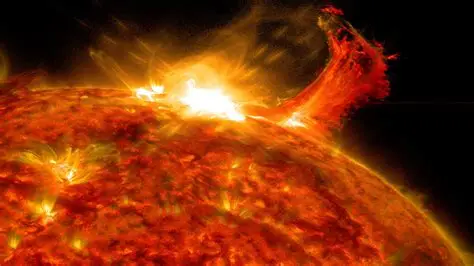
Scientists traced the event to a massive coronal mass ejection, a burst of plasma from the Sun’s surface that had been traveling toward Earth for more than a day. When it hit, it compressed the planet’s magnetic field like a fist closing around a fragile sphere. Space agencies scrambled to protect satellites, placing some into safe mode, shutting down others entirely. Communications networks flickered, then stabilized, then flickered again.
For ordinary people, the effects were uneven but unmistakable. Some lost internet access for hours. Others found their banking apps unresponsive. Farmers relying on GPS‑guided tractors were forced to halt work in the middle of planting season. Emergency services reported delays in dispatch systems. Even the stock markets felt the tremor as trading algorithms struggled with intermittent data feeds.
But beneath the chaos, a deeper question began to surface: how prepared is the modern world for a solar storm that exceeds this one? The last event of comparable scale — the Carrington Event of 1859 — occurred in a world lit by candles and powered by steam. Today, every heartbeat of civilization depends on satellites, grids, and digital signals that can vanish in an instant when the Sun decides to remind us of its power.
As the storm slowly weakens, scientists warn that more waves may follow. The Sun is entering a period of heightened activity, and this event may be only the first in a series. Governments are reviewing emergency protocols. Airlines are rewriting flight paths. Grid operators are studying the failures that occurred in the dark hours of the night.
For now, the world watches the sky with a mixture of awe and unease. The auroras will fade, the systems will recover, and life will return to its familiar rhythm. But the memory of this storm — the night when the Sun reached out and touched the Earth — will linger. It is a reminder that even in an age of satellites and supercomputers, our world remains vulnerable to forces far beyond our control.
And somewhere above us, on the surface of a star 150 million kilometers away, the next pulse is already forming.