The Physics of Consciousness and Reality — A Profound Journey Beyond the Mind
the physics of consciousness and reality reveals a universe where information, awareness, and existence are deeply intertwined.
There is a point where science stops being mere measurement and becomes revelation. A point where physics, neuroscience, and metaphysics begin to speak the same language, as if they were describing different aspects of a single underlying structure. It is the point where we realize that reality is not made only of matter, but of information, and that consciousness is not a byproduct of the brain but one of its most intricate expressions.
This perspective becomes even clearer when we consider how the physics of consciousness and reality challenges the traditional separation between mind and matter.
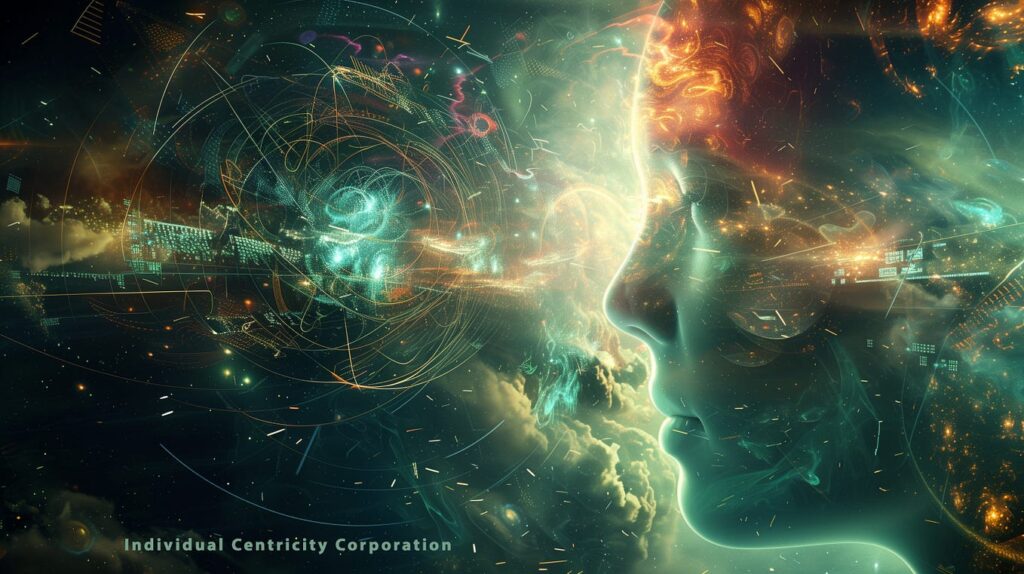
In recent years, this intuition has been emerging with increasing force. Quantum physics suggests that the universe behaves like an informational system; neuroscience reveals that the mind is a process of integration; cosmology hints that space‑time itself may be a construct derived from informational relationships. And when these three worlds meet, a new vision of existence takes shape: a reality in which consciousness is not a guest but an architect.
This perspective connects naturally with what you explored in zemeghub article The Physics of the Self Identity — Information and the Continuity of Conscious Being, where identity emerges as an informational pattern that persists through time. There, the question was: What is the Self? Here, the question becomes: What is the reality the Self perceives?
If the Self is an informational process, then the world it perceives might also be constructed according to the same laws. Not a fixed stage, but a dynamic field of possibilities that consciousness interprets, organizes, and stabilizes. Modern physics suggests that what we call “matter” is simply the densest manifestation of an informational flow. The mind, then, is not separate from the world: it is one of its expressions.
In this view, reality is not an external object but a relationship. It is not something we observe, but something we co‑create through the very act of observing. Consciousness becomes a bridge between the possible and the real, between chaos and form. Every perception is an act of organization, every memory a node in the network of information, every emotion a modulation of the field that moves through us.
And so the question shifts again: if reality is information and consciousness is its interpreter, what does it mean to live? It means participating in a continuous process of construction, in which the world is never fully given but always in the making. It means that every experience leaves an imprint not only on memory but on the very structure of existence. It means we are part of a universe that is not a mechanism but an informational organism in evolution.
Many contemporary theories suggest that the physics of consciousness and reality may share a common informational foundation.
This perspective is not disguised spiritualism nor philosophical science fiction. It is the convergence point of the most advanced theories in physics, the insights of neuroscience, and the millennia‑old questions of metaphysics. It is an invitation to look beyond the surface of things, to recognize that what we perceive as solid is only the visible part of a much deeper process.
If this is true, then the physics of consciousness and reality is not just a scientific question but a doorway into understanding our role in shaping existence.
And perhaps, in the end, the most important question is not “What is reality?” but “What role do we play in its construction?” Because if consciousness is an active part of the universe, then every thought, every choice, every act of awareness contributes to shaping the world. We are not spectators; we are participants.
In this sense, science and metaphysics are no longer separate disciplines. They are two ways of exploring the same truth: that the universe is alive, dynamic, informational, and that consciousness is one of its brightest forms. And that perhaps understanding reality means, first of all, understanding ourselves.
In the end, exploring the physics of consciousness and reality means exploring the deepest layers of ourselves.