
7 Facts About the Battle of Kadesh — Ancient History’s First Peace Treaty
The Battle of Kadesh in Ancient History
The Battle of Kadesh, fought in 1274 BCE, remains one of the most thoroughly documented military engagements in Ancient History. It marked the height of the rivalry between the Egyptian Empire under Ramesses II and the Hittite Empire led by Muwatalli II. Beyond the battlefield, this confrontation is remembered for producing the first recorded peace treaty in human history, a diplomatic milestone that still influences modern international relations.
The battle took place near the fortified city of Kadesh, located along the Orontes River in present‑day western Syria. This region was a strategic crossroads controlling the main commercial routes between the Mediterranean and Mesopotamia. For decades, Egypt and the Hittites had competed for dominance over the Levant, and the city of Kadesh became the focal point of their struggle.
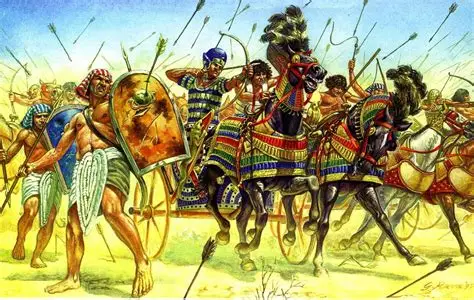
Ramesses II advanced northward with four divisions — Amun, Ra, Ptah, and Seth — each composed of thousands of infantry and hundreds of chariots. Egyptian chariots were lighter and faster, designed for mobility and archery. In contrast, the Hittites deployed heavier, three‑man chariots capable of delivering powerful shock attacks. Muwatalli II assembled a vast coalition of Anatolian and Syrian allies, fielding more than 3,500 chariots, one of the largest chariot forces ever recorded.
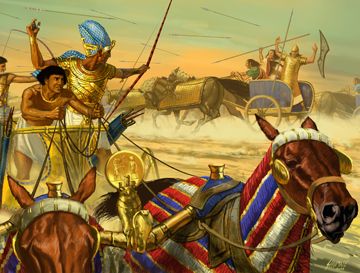
The battle began with a calculated deception. Hittite scouts, posing as deserters, misled Ramesses II into believing that the Hittite army was far to the north. Acting on this false information, the Egyptian forces became spread out. When the Ra division approached Kadesh, it was ambushed by the full strength of the Hittite chariot corps. The sudden attack caused panic, scattering the Egyptian troops and threatening to collapse the entire campaign.
Ramesses II, positioned with the Amun division, found himself isolated. According to inscriptions carved on the walls of the Ramesseum and Abu Simbel, the pharaoh personally rallied his troops and led a countercharge against the advancing Hittites. Although these accounts are naturally propagandistic, archaeological evidence confirms that the Egyptians managed to stabilize their lines until the Ptah division arrived, preventing a complete defeat.
The fighting continued for hours, with neither side able to secure a decisive advantage. The Hittites failed to break the Egyptian formations, while the Egyptians lacked the strength to capture Kadesh. As night approached, both armies withdrew, exhausted and heavily damaged. The battle ended in a stalemate, but its consequences extended far beyond the battlefield.
Several years later, recognizing that prolonged conflict would weaken both empires, Ramesses II and Hattusili III — who succeeded Muwatalli II — negotiated a formal peace agreement. This treaty, preserved in both Egyptian hieroglyphs and Hittite cuneiform, established mutual non‑aggression, military cooperation, and the return of political refugees. It is the earliest surviving example of a written international treaty, and a replica is displayed today at the United Nations Headquarters in New York.
Ancient History: The Political Landscape Before Kadesh
The Battle of Kadesh provides a rare, detailed glimpse into the military strategies, political ambitions, and diplomatic practices of the Late Bronze Age. It also highlights how ancient superpowers managed conflict and negotiated stability long before the rise of classical civilizations. A related turning point in the region’s history is explored in The Sea Peoples and the Collapse of the Bronze Age, which examines the widespread upheavals that reshaped the Mediterranean world around 1200 BCE.
Today, Kadesh stands as a reminder that even in antiquity, diplomacy could succeed where warfare failed. The battle and the treaty that followed remain foundational episodes in Ancient History, illustrating how political strategy and negotiation shaped the ancient world.
Recent archaeological studies have continued to refine our understanding of the Battle of Kadesh and its aftermath. Excavations in the region of the Orontes River have uncovered fortification remains and pottery fragments consistent with Late Bronze Age occupation, supporting the historical accounts of a heavily contested frontier zone. Scholars have also re‑examined the Egyptian and Hittite records, noting differences in how each side portrayed the outcome.
While Egyptian inscriptions emphasize Ramesses II’s personal valor, the Hittite texts describe the battle as a successful defensive operation that preserved their control over Kadesh. These contrasting narratives highlight how both empires used the event to reinforce political legitimacy at home. Despite the propagandistic elements, the convergence of evidence confirms that the battle ended without a clear victor and that the subsequent treaty was a pragmatic necessity for both powers.
This combination of military stalemate and diplomatic innovation makes Kadesh one of the most significant episodes in Ancient History, offering a rare example of how rival superpowers sought stability in an era defined by territorial ambition and constant warfare.