

Plutino Atmosphere: 3 Unexpected Signs of a Temporary Gas Halo in the Kuiper Belt
Plutino Atmosphere is emerging as one of the most surprising discoveries in the distant Kuiper Belt, revealing that even tiny icy worlds may host a faint, temporary gas layer far beyond Neptune.
The concept of a Plutino Atmosphere challenges long‑held assumptions about how small icy bodies behave in the distant Kuiper Belt.
Far beyond the orbit of Neptune, where sunlight fades into a pale memory and the cold becomes almost absolute, a small icy world has begun to challenge what astronomers thought they knew about the outer Solar System. It is a Plutino — one of the many minor bodies locked in a 2:3 orbital resonance with Neptune, sharing a cosmic rhythm with Pluto itself.
Tiny, dim, and almost anonymous, this object has suddenly become the center of scientific attention. And the reason is as fragile as it is extraordinary: a possible temporary atmosphere.
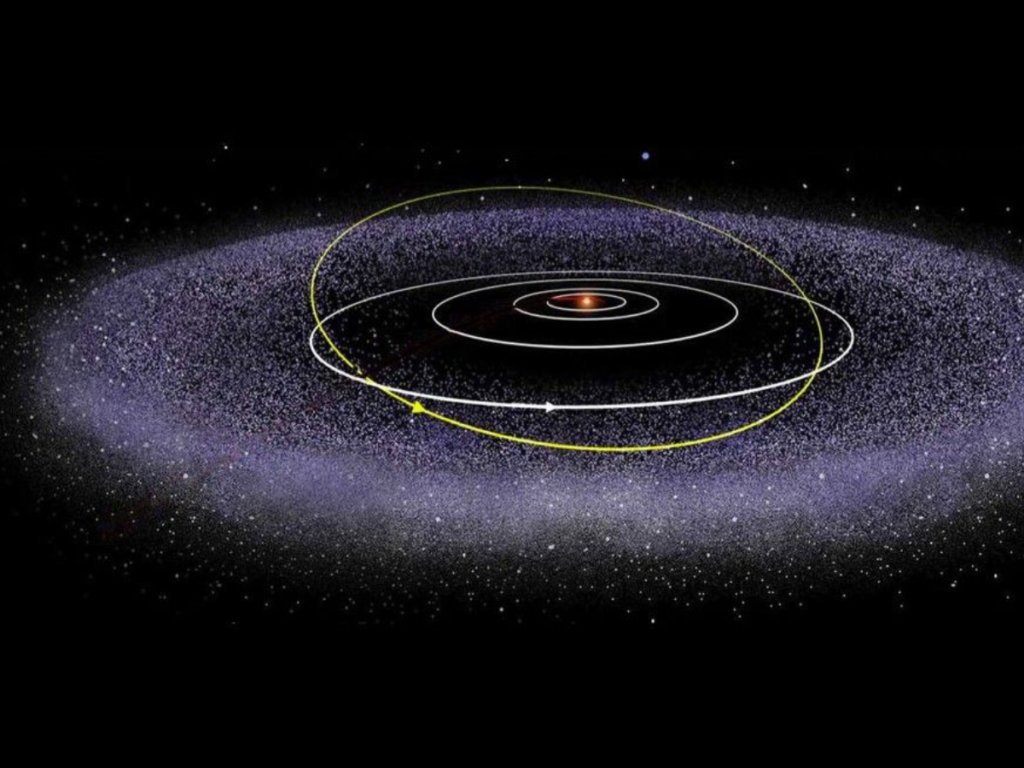
If confirmed, a Plutino Atmosphere would demonstrate that even minor objects can sustain volatile activity far beyond Neptune.
Astronomers are now re‑evaluating how a Plutino Atmosphere could form and collapse over extremely long seasonal cycles.
A Signal That Should Not Exist
The discovery emerged during a rare stellar occultation, when the Plutino passed in front of a distant star. Instead of a sharp, immediate drop in brightness — the signature of a bare, solid body — astronomers observed a soft, gradual dimming.
It was as if something around the object was diffusing the starlight before the body fully blocked it.
That “something” could only be one thing: a thin, transient atmosphere.
For an object so small and so cold, the idea borders on the impossible. And yet, the data speaks clearly.
What Could This Atmosphere Be Made Of?
Even at the edge of the Solar System, a faint touch of sunlight can trigger surprising chemistry. If the Plutino’s surface contains volatile ices, they can sublimate — turning directly from solid to gas — and create a temporary halo.
The most likely components are:
- nitrogen,
- carbon monoxide,
- methane,
the same gases that dominate Pluto’s atmosphere.
But here, the pressure would be unimaginably low — a ghostlike breath, detectable only through the delicate signature it leaves on starlight.
A World That Breathes Slowly
The possibility of a Plutino Atmosphere also raises new questions about the chemical diversity of Kuiper Belt objects.
If confirmed, this discovery suggests that Plutinos are not frozen relics trapped in eternal stillness. They may be active worlds, shaped by:
- ultra-slow seasonal cycles,
- microscopic temperature variations,
- surface patches rich in volatile ices,
- rotational and orbital dynamics that evolve over centuries.
This challenges the long‑held view of the Kuiper Belt as a static graveyard of icy debris.
Instead, it may be a region filled with subtle, ongoing processes — a quiet ecosystem of frozen worlds that change in ways we are only beginning to detect.
Why This Matters
Because it expands the frontier of what we consider “active” in the Solar System.
Understanding whether a Plutino Atmosphere is temporary or recurring may reshape future models of outer Solar System evolution.
This discovery implies that:
- even small bodies can host temporary atmospheres,
- volatile chemistry is more widespread than expected,
- the Kuiper Belt is more dynamic than previously believed,
- Pluto’s atmospheric behavior may not be unique.
Each new observation adds a piece to a puzzle that stretches across billions of kilometers.
What Comes Next: Webb, Rubin, and Future Missions
The next decade will be crucial.
- The James Webb Space Telescope could analyze the chemical fingerprints of these gases.
- The Vera Rubin Observatory will detect more occultations, revealing how common these atmospheres are.
- Future missions to the outer Solar System may one day observe these worlds up close.
If more Plutinos show similar behavior, we may be witnessing the beginning of a new chapter in planetary science.
A Breath in the Darkness
In a region where everything seems frozen and silent, a tiny world has revealed a secret: even at the farthest edges of the Sun’s influence, a world can breathe — slowly, faintly, but unmistakably.
And that single breath may reshape our understanding of the Solar System’s most distant frontier.
In the end, the Plutino’s faint atmospheric whisper reminds us that even the smallest and coldest worlds can hold unexpected stories. As new telescopes sharpen their gaze, these distant objects may reveal patterns, cycles, and secrets we never imagined — quiet signals that the Solar System is still full of surprises.
A potential Plutino Atmosphere also highlights how little we truly know about the Solar System’s frontier. Each new observation forces scientists to reconsider long‑standing theories and explore the subtle processes shaping these distant worlds, revealing a region far more dynamic than once believed.
According to NASA’s research on Kuiper Belt objects, volatile ices can sublimate even at extreme distances from the Sun, creating temporary atmospheres around small icy bodies. /
A similar pattern of unexpected chemistry in extreme environments was explored in our feature on deep‑space molecules, where we examined how complex compounds can emerge far from the Sun — a concept that aligns with the fragile dynamics behind a potential Plutino Atmosphere. A Life‑Linked Molecule Found in Deep Space