
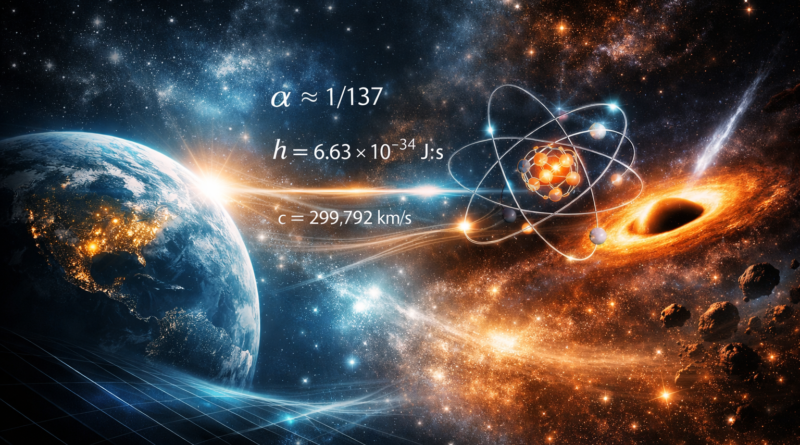
3 Scientific Insights Showing Why Cosmic Fine‑Tuning for Life and the Fundamental Constants of Nature Matter
Cosmic Fine‑Tuning for Life: The Hidden Balance of the Universe
Cosmic Fine‑Tuning for Life is more than a scientific hypothesis — it is a profound shift in how we understand the conditions that make our Universe habitable. A new study from Queen Mary University of London suggests that even the slightest change in the fundamental constants of nature could alter the way liquids flow inside living cells, potentially making life impossible.
There are moments in the history of science when a discovery does more than illuminate a distant corner of the Universe — it reaches into the very core of our existence. That is what emerges from the new study by Queen Mary University of London, a piece of research suggesting that life may depend on a physical balance so fragile it borders on the impossible. A balance that does not concern only stars, galaxies, or black holes, but something far closer, almost ordinary: the way liquids flow inside living cells.
Cosmic Fine‑Tuning for Life becomes even more striking when we consider how every biological process depends on the delicate motion of liquids inside cells.

Cosmic Fine‑Tuning for Life and the Hidden Balance Behind Liquid Motion
According to the study, published in Science Advances, the Universe’s fundamental constants — those silent laws that govern every particle — appear to fall within an incredibly narrow window. A window that allows liquids to maintain the precise viscosity required for life. If these constants shifted even slightly, water could become as thick as tar or as thin as gas, making complex biology impossible.
It is a thought that echoes the fragility of distant phenomena in the outer Solar System, such as the temporary gas halos that may form around small icy bodies in the Kuiper Belt, a theme explored in the analysis of the Plutino Atmosphere, where a faint gaseous veil reveals how thin the boundary between stability and dissolution can be.
Life, after all, is movement. It is diffusion, flow, transformation. It is the silent journey of molecules through liquid environments that must remain exquisitely balanced to function. A tiny variation in the electron charge or the Planck constant could make blood too thick to circulate or too thin to carry oxygen. This is a form of fine‑tuning that no longer concerns only the formation of stars, but the very possibility that a cell can breathe, feed, and exist.
Why Cosmic Fine‑Tuning for Life Shapes Every Form of Existence
For decades, the mystery of fundamental constants has been explored through the grand structures of the cosmos: the birth of stars, nuclear fusion, the formation of heavy elements. But this new research shifts the focus from the macrocosm to the microcosm, suggesting that life depends not only on the stability of galaxies but also on the ability of water to flow with the right fluidity. It is a radical change in perspective, one that connects phenomena separated by unimaginable scales: the collapse of a massive star and the movement of a protein inside a cell.
The study suggests that Cosmic Fine‑Tuning for Life may not be a philosophical idea, but a measurable physical constraint woven into the structure of the Universe.
The central point of the study is astonishing in its simplicity: the viscosity of liquids is not an isolated chemical property but a direct reflection of the Universe’s deepest physical constants. If those constants changed — even slightly — viscosity would change with them. And with it, everything that depends on liquid motion would collapse: blood circulation, nutrient diffusion, cellular dynamics. Life, as we know it, would fail.
How Cosmic Fine‑Tuning for Life Connects Physics and Biology
This idea opens a new chapter in the debate on cosmic fine‑tuning. Until now, the discussion focused on the conditions that allow stars and elements to form. Now, a second layer of tuning emerges: it is not enough for the Universe to be compatible with matter; it must also be compatible with biology. It is not enough for planets to exist; liquids must flow in the right way.
This perspective intertwines with many of the questions modern astronomy is raising. Observations from the James Webb Space Telescope have revealed luminous, enigmatic structures that challenge our theories, such as the sweeping arc of cosmic dust surrounding a young star in the Dark Star Discovery, a phenomenon showing how the Universe can create delicate, temporary equilibria. Likewise, the possibility that dark energy may change over time suggests that even the deepest forces of the cosmos may not be as immutable as once believed.
Yet what makes this new study so striking is its shift from the immense cosmos to the biological microcosm. For decades, the mystery of fundamental constants has been explored through stars, black holes, and subatomic particles. Now the question moves closer to everyday experience: the simple ability of water to flow.
Scientists calculated that even a minimal variation — as little as three or four percent — in certain constants would make liquid‑based life impossible. Water would become too viscous for molecules to diffuse, or too thin to maintain cellular stability. Blood could no longer carry oxygen. Proteins would fail to fold correctly. Biochemical reactions would collapse.
It is a thought that challenges our idea of “normality.” What we consider obvious — water flowing, blood circulating, cells moving — may be the result of a combination of physical constants so precise they resemble a statistical miracle. A miracle that may not repeat elsewhere in the Universe.
If these constants shifted even slightly, the entire framework of Cosmic Fine‑Tuning for Life would collapse, leaving a universe where complex organisms could never emerge.
Yet the research does not merely suggest fragility; it also hints at possibility. If life depends on such a narrow window of physical values, perhaps there are other worlds where that window opens. Worlds where the constants differ, but where life emerges from liquids with entirely different properties. Worlds where biology is not an exception but a natural consequence of physical law.
The role of fundamental constants of nature in life’s emergence
This idea resonates with recent discoveries of rogue planets drifting through the Milky Way, or interstellar visitors crossing our Solar System carrying hints of unfamiliar chemistries. Each new observation suggests that the Universe is far more varied and complex than we imagined.
And while scientists continue to question why the constants of nature have the values they do, one thing becomes increasingly clear: the answer may not lie only in black holes or the first galaxies, but also in something far closer to our daily experience. The simple ability of water to flow.
This discovery forces us to reconsider whether Cosmic Fine‑Tuning for Life is a rare cosmic accident or a fundamental feature of reality itself.
A detail so ordinary it seems invisible, yet so fundamental it may determine the fate of life in the Universe.
Scientific source: ScienceDaily – Scientists make stunning discovery that could change our understanding of the Universe