
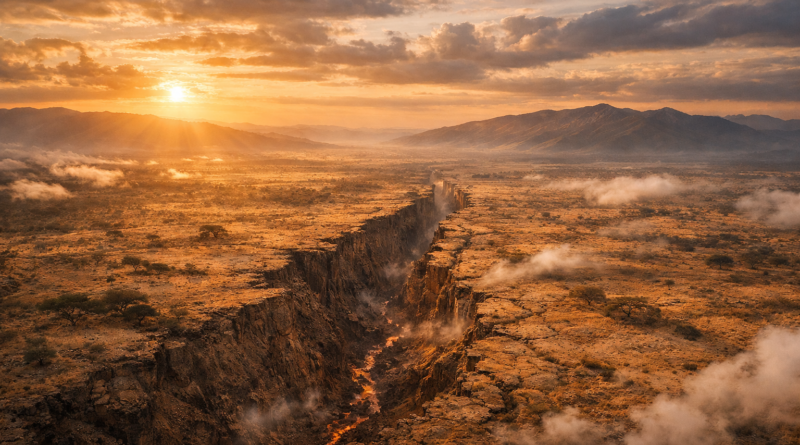
10 Geology Insights That Reveal How Continents Break and Oceans Are Born
There are moments in geology when the planet seems to reveal its deepest intentions. Not through sudden cataclysms, but through slow, powerful movements that unfold beneath our feet, unnoticed until the landscape itself begins to change. Across the world, scientists are tracking a series of subtle but profound geological signals that suggest Earth is entering a new phase of tectonic restlessness — a period where continents stretch, fracture, and quietly prepare for transformations that will unfold over millions of years.
One of the most striking examples lies in East Africa, where the ground is pulling apart with a force that is both ancient and newly awakened. The Great Rift Valley, a scar stretching thousands of kilometers, is widening year after year. What appears to be a tranquil savanna is, in reality, the early stage of a continental breakup. The land rises and sinks, cracks open, and shifts with a rhythm that mirrors the slow heartbeat of the planet. Geologists believe that this region may one day give birth to a new ocean, splitting Africa into two landmasses.
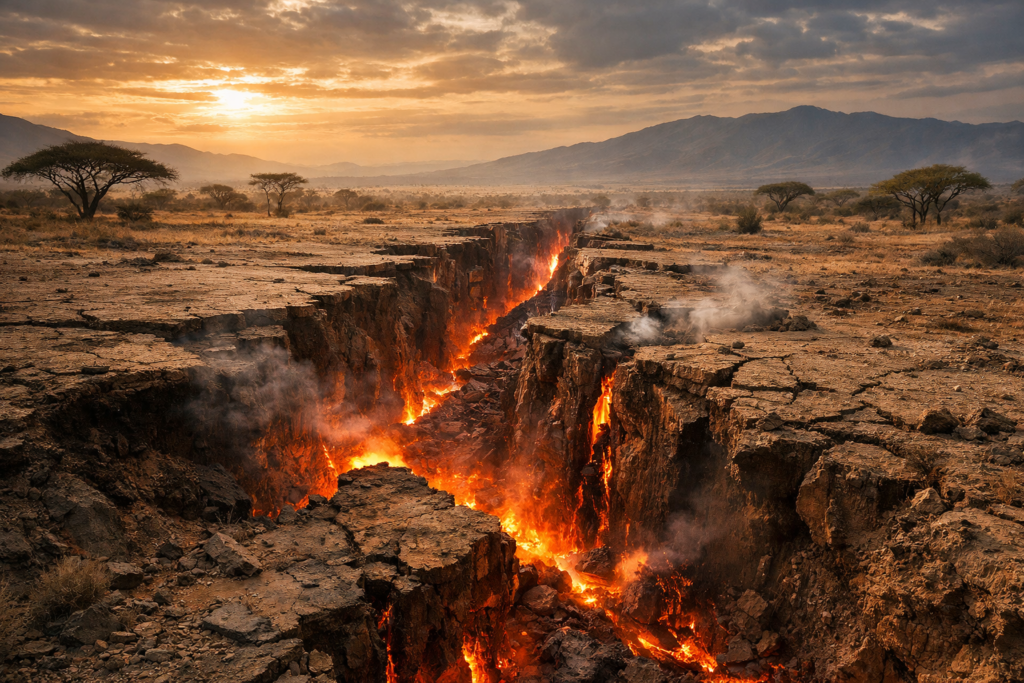
But Africa is not alone. Across the globe, similar tectonic tensions are building. In the Pacific Northwest, deep beneath the forests and coastlines, a subduction zone is awakening. Pressure accumulates silently as one plate grinds beneath another, storing energy that will one day be released in a seismic event capable of reshaping entire coastlines. These forces are not sudden intrusions into Earth’s calm surface — they are the continuation of a geological story billions of years old.
To understand these movements, scientists look not only at the present but also at the ancient past. Some of the oldest rocks on Earth still carry the memory of a planet in constant motion, preserving chemical signatures that reveal how continents formed, collided, and drifted apart. These stones act like geological diaries, recording the rise of mountains, the opening of oceans, and the long cycles of creation and destruction that define our world. A deeper exploration of this concept appears in The Stone That Remembers: How Earth’s Oldest Rocks Preserve the Memory of a Living Planet, which examines how ancient minerals store the history of Earth’s earliest transformations.
Today, modern instruments allow scientists to detect movements as small as a few millimeters per year. Satellites track the shifting of tectonic plates with extraordinary precision, revealing patterns that were invisible to previous generations. What emerges is a portrait of a planet that is anything but static. Continents drift like slow-moving rafts. Oceans expand and contract. Mountain ranges rise, erode, and rise again. Beneath the crust, molten rock circulates in vast convection currents, driving the tectonic engine that shapes every coastline and every valley.
Geology teaches us that Earth is not a finished world. It is a world in progress — restless, dynamic, and always evolving. The fractures we see today are the first lines of future maps. The quiet rumblings beneath our feet are the early notes of transformations that will outlast civilizations. And the landscapes we take for granted are temporary sculptures carved by forces far older and more powerful than anything humanity can create.
In the end, the planet’s story is written not in sudden disasters but in the slow, persistent movements that reshape continents and redefine the boundaries of oceans. To study geology is to witness Earth in motion — a living world whose deepest forces continue to shape the future of the surface we call home.
In the quiet rhythm of shifting plates and rising landscapes, geology reminds us that Earth is never still. Every fracture, every uplift, every distant tremor is part of a story still unfolding — a slow, relentless transformation that continues shaping the world long after our brief moment upon it.