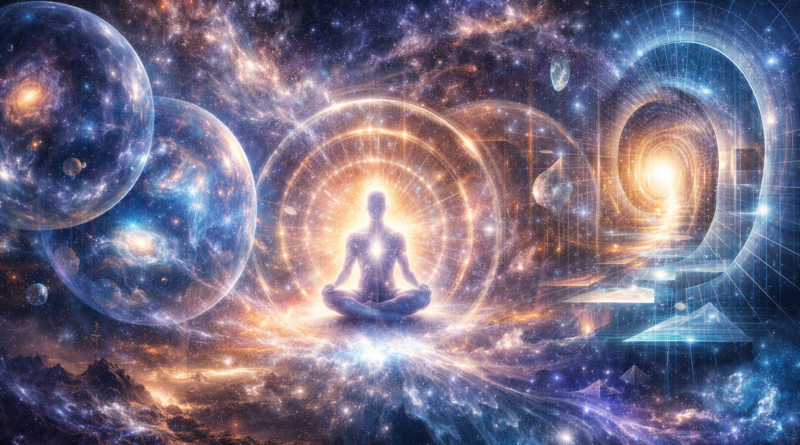
Cosmology and Consciousness: 7 Astonishing Insights into Parallel Universes and Hidden Dimensions
Cosmology and Consciousness are deeply connected, and understanding their relationship opens the door to a new vision of reality that challenges everything we think we know.
There are questions that run through human history like an underground river. They do not belong to any religion, culture, or era. They rise spontaneously in every mind that dares to look beyond the surface of the world. What happens after death? Do other dimensions exist? Is consciousness truly confined to the brain, or is it something older, deeper, more expansive? And above all: is it possible that what we call “spiritual” is actually a physical phenomenon we simply do not yet understand?
For centuries, these questions were considered matters of faith, philosophy, or mysticism. But in recent decades, modern science—mathematical, rigorous, and often skeptical—has begun to brush against territories once reserved for spirituality. Not because it seeks to prove the existence of the soul or heaven, but because the laws of the universe, when pushed to their limits, begin to reveal cracks, openings, and possibilities that extend far beyond solid matter and linear time.
This article is a journey into those possibilities. A journey that begins with quantum physics, crosses cosmology, enters neuroscience, and reaches the boldest hypotheses about the nature of consciousness and extra dimensions. A journey that does not claim to offer definitive answers, but shows how modern science is opening doors that, until recently, were thought to be sealed forever.
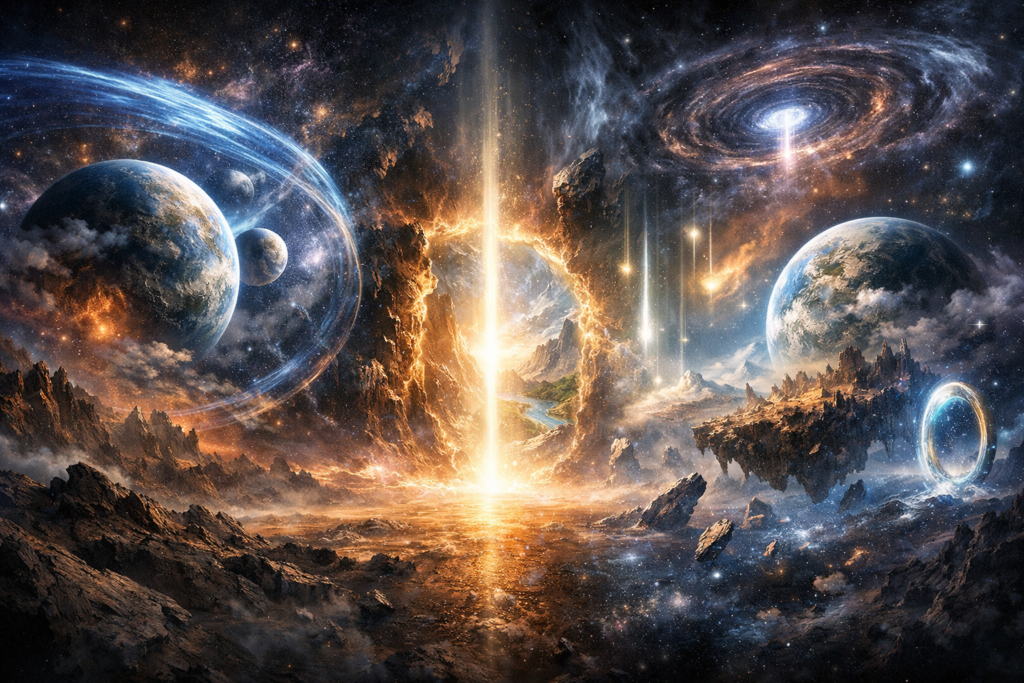
Cosmology and Conscioussciousness in the Structure of the Universe
When we look at a table, a mountain, or a human body, we feel as if we are facing something solid, compact, and defined. But this is an illusion of the senses. Modern physics tells us that matter is almost entirely empty. The atoms that compose every object consist of a tiny nucleus surrounded by electrons orbiting at enormous distances relative to their size. If an atom were the size of a cathedral, the nucleus would be a grain of dust at its center.
And yet, from this emptiness arises everything we perceive as real.
Even more surprising is that matter is not “matter” in the classical sense. It is condensed energy. It is vibration. It is information. Elementary particles are not small bricks but excitations of invisible quantum fields. In other words: what we call “physical reality” is a temporary manifestation of something deeper.
This idea, which may seem abstract, has enormous consequences. If matter is only a form of organized energy, then it is not absurd to imagine that other forms of energy, other structures, other dimensions may exist—dimensions we do not perceive simply because our senses are not designed to detect them.
It is like asking a fish to understand the concept of air. It cannot see it, touch it, or breathe it. And yet, air exists.
TIME IS NOT LINEAR
One of the pillars of our perception is time. We believe it flows in a single direction: past → present → future. But relativity tells us that time is a dimension, just like space. And like space, it can be stretched, bent, slowed, or accelerated.
Time is not a river that flows. It is a landscape.
We move through this landscape like a beam of light crossing a room. But the room exists all at once: past, present, and future are already there, like pages of a book already written.
If time is not linear, then death is not an “end,” but a transition. A change of coordinates. A shift from one region of the landscape to another.
And this opens the door to an even greater question: if time is a dimension, how many other dimensions exist?
EXTRA DIMENSIONS: THE PHYSICS OF STRINGS
String theory, one of the most advanced and mathematically complex theories ever developed, claims that the universe does not have three spatial dimensions, but eleven. The other eight are curled up on themselves, so small that they are invisible to our instruments.
Imagine an electrical wire seen from far away: it looks like a line. But up close, it has thickness, surface, structure. Extra dimensions are like that: present, but hidden.
According to this theory, what we perceive as “empty space” is actually a sea of multidimensional vibrations. And every particle, every force, every physical law is the result of a string vibrating in a hidden dimension.
This means that there could exist:
matter that does not interact with ours, energies we cannot detect, spaces where time flows differently, structures we cannot imagine.
And above all: dimensions where consciousness could exist without a physical body.
This idea resonates with the phenomenon of quantum entanglement — the invisible threads connecting particles across vast distances — explored in our article “Entanglement: The Invisible Threads Connecting the Universe.” Such non‑local connections may be hints of deeper dimensions where information and consciousness move freely beyond physical constraints.
Cosmology and Conscioussciousness in Quantum Multiverse Theories
Modern cosmology proposes several versions of the multiverse. The most fascinating is the inflationary model: during the Big Bang, space expanded into “bubbles.” Each bubble is a universe with different physical laws. Some universes may have more dimensions, others fewer. Some may be unstable, others may host life based on elements other than carbon.
But there is an even more radical version: the many‑worlds interpretation of quantum mechanics.
According to this theory, every time a quantum event occurs—and billions occur every second—the universe splits in two. Every choice, every possibility, every branching creates a new universe. In one you are alive, in another you are dead. In one you made a decision, in another you chose differently.
It is a dizzying vision, but mathematically coherent. And it is deeply connected to the principle of quantum superposition, where particles can exist in multiple states at the same time — a concept explored in our article “Quantum Superposition: How Particles Exist in Multiple States at Once.” This fundamental behavior of matter suggests that reality itself may branch into countless versions, each representing a different unfolding of possibility.
And if infinite universes exist, then death is not a final point. It is a transition. A shift from one configuration to another.
Cosmology and Conscioussciousness as a Bridge Between Physics and Awareness
Neuroscience is beginning to recognize that consciousness cannot be explained solely as neural activity. The brain is an interface, not the source. It is like a modem that receives and transmits information but does not create it.
Consciousness may be a field, like the electromagnetic field. A field that exists independently of the body.
When the body dies, the field does not disappear. It changes state. It changes dimension.
Near‑death experiences are powerful clues: clinically dead people, with no brain activity, report vivid, coherent, often verifiable experiences. These are not hallucinations—they occur when the brain is offline.
This suggests that consciousness can exist without biological support.
If consciousness is a field, then it can exist in other dimensions. It can cross universes. It can survive biological death.
THE QUANTUM VACUUM: THE PLACE WHERE EVERYTHING BEGINS
When we think of the vacuum, we imagine nothingness. But the quantum vacuum is the opposite of nothing. It is a seething ocean of energy, where particles appear and disappear constantly. It is the matrix from which everything arises: matter, energy, space, time.
Some physicists believe the quantum vacuum is the true reality, and what we see is only its temporary manifestation. In this scenario, consciousness could be a property of the vacuum itself. Not a product of matter, but its origin.
If consciousness is rooted in the quantum vacuum, then it is eternal. It does not begin with the body and does not end with the body. It is a fundamental property of the universe.
And this leads to an inevitable question: if consciousness is eternal, where does it go when the body dies?
DEATH AS A CHANGE OF STATE
Physics teaches us that nothing is created or destroyed. Energy transforms. Matter transforms. Information transforms.
Death may be a transformation. Not an end, but a passage from one state to another.
Imagine ice melting. The form changes, but the substance remains. The water does not disappear—it becomes vapor, invisible but real.
Consciousness may do the same. When the body dies, consciousness changes state. It shifts from a dense form to a subtle one. From one dimension to another.
Many spiritual traditions describe death as an “awakening,” as if physical life were a dream, a simulation, a temporary experience. And modern science, with its theories on extra dimensions and the informational nature of the universe, is beginning to suggest that this idea may not be so far‑fetched.
THE POSSIBILITY OF A POST‑MORTEM DIMENSION
If extra dimensions exist, and if consciousness can exist independently of the body, then it is possible that there is a specific dimension where consciousness gathers after death.
Not a physical place in the traditional sense, but an environment made of information, energy, coherent light. An environment where time does not flow, where entropy does not exist, where consciousness can expand without limits.
Many near‑death experiences describe a place of light, peace, and absolute love. This is not a religious image—it is a description consistent with what we would expect from a dimension without time, without dense matter, without pain.
Science cannot confirm this dimension. But it cannot exclude it either. And every year, new clues emerge suggesting that reality is far larger than we perceive.
THE PARADOX OF CONSCIOUSNESS: WHY IT CANNOT DIE
There is a paradox science cannot solve: consciousness cannot be explained as a material phenomenon.
Matter is inert. Consciousness is experience. Matter is quantity. Consciousness is quality. Matter is external. Consciousness is internal.
There is no physical law that explains how a collection of atoms can generate the subjective experience of the world. It is as if consciousness were an intruder—something that does not belong to matter but passes through it.
If consciousness does not arise from matter, then it does not die with matter. It is something older, deeper, more fundamental.
WHAT IT MEANS TO “EXIST” IN OTHER DIMENSIONS
Many people imagine extra dimensions as physical places, similar to our world but with more space. But dimensions may be very different. They may be spaces where matter does not exist, where light is the primary substance, where consciousness is the dominant form.
In such a dimension, we would not have a physical body. We would have a body of light, an informational body. A body that does not age, does not suffer, does not die.
Spiritual traditions speak of a “glorified body,” an “astral body,” a “body of light.” Modern physics speaks of “coherent fields,” “quantum information,” “non‑local energy.”
Different languages describing the same thing.
THE FUTURE OF SCIENCE: TOWARD A NEW VISION OF THE HUMAN BEING
Science is undergoing a silent revolution. For centuries it studied matter. Now it is beginning to study consciousness. And when science studies consciousness, it inevitably enters territories once reserved for spirituality.
Not because it seeks to prove the existence of the soul, but because consciousness is too complex to be explained by biology alone.
The future of science will be a meeting point between physics, neuroscience, philosophy, and spirituality. A meeting that may forever change our understanding of life, death, and reality.
REALITY IS GREATER THAN US
We do not have definitive proof of parallel universes, spiritual dimensions, or life after death. But we have clues. Powerful, coherent, fascinating clues. Clues suggesting that reality is far larger than we perceive.
Matter is not solid. Time is not linear. Consciousness is not in the brain. The universe is not unique. Death is not an end.
And perhaps, one day, science will prove what human intuition has always known: that we are multidimensional beings, that consciousness is eternal, that life does not end with death.
That what we call “heaven” may be a real dimension, consistent with the laws of the universe.
And that our existence is only the beginning of a much greater journey.
THE INFORMATION UNIVERSE: WHY NOTHING IS EVER LOST
Modern physics is moving toward a radical idea: the universe is not made of matter or energy at its core, but of information. Every particle, every field, every force, every law is ultimately a pattern of information encoded in the fabric of spacetime.
This idea is not philosophical—it is mathematical.
Black hole physics, for example, shows that information cannot be destroyed. When something falls into a black hole, its physical form disappears, but its information remains encoded on the event horizon. This is known as the holographic principle, and it suggests that the universe itself may be a hologram: a three‑dimensional projection of information stored on a two‑dimensional surface.
If information cannot be destroyed, then consciousness—if it is a form of information—cannot be destroyed either.
Imagine burning a book. The paper disappears, the ink evaporates, but the information is not lost. It is transformed into smoke, heat, light, and molecular motion. The universe keeps track of every detail.
If the universe preserves the information of a book, how could it not preserve the information of a mind?
This is not mysticism. It is physics.
And it leads to a profound possibility: death may be the moment when consciousness detaches from biological hardware and returns to the informational substrate of the universe.
THE BRAIN AS A FILTER, NOT A PRODUCER
One of the most convincing arguments for consciousness surviving death comes from neuroscience itself. The brain does not behave like a generator of consciousness. It behaves like a filter.
When certain areas of the brain are damaged, people often report expanded states of awareness, not reduced ones. Psychedelics, meditation, sensory deprivation, and near‑death experiences all reduce brain activity while increasing the intensity of consciousness.
This is the opposite of what we would expect if the brain produced consciousness.
A simple analogy helps: Think of a window. If you make the glass thinner, more light passes through. If you remove the glass entirely, the light floods in.
The brain may be the glass. Consciousness may be the light.
When the brain shuts down at death, the filter is removed. Consciousness is no longer limited by sensory input, memory constraints, or biological survival mechanisms. It expands into a state that many near‑death experiencers describe as “more real than real.”
This is consistent with the idea that consciousness is fundamental and the brain is merely its interface.
PARALLEL WORLDS AND THE CONTINUITY OF SELF
If the many‑worlds interpretation of quantum mechanics is correct, then every moment of your life exists in countless variations across parallel universes. In some, you made different choices. In others, events unfolded differently. In still others, you may have died earlier—or lived longer.
This raises a profound question: What happens to consciousness when the body dies in one universe but continues in another?
Some physicists propose that consciousness may “follow” the branch where survival continues. This is not immortality in the traditional sense, but a form of quantum continuity. You would never experience your own death because your awareness would always shift to a branch where you remain alive.
This idea is controversial, but it is logically consistent with the mathematics of quantum mechanics.
And it suggests that death may not be a single event, but a transition across branches of the multiverse.
THE SPIRITUAL DIMENSION AS A PHYSICAL REALM
When people hear the word “spiritual,” they imagine something vague, symbolic, or metaphorical. But what if the spiritual dimension is simply a physical dimension with different properties?
A dimension where:
- time does not flow
- entropy does not increase
- matter is made of coherent light
- consciousness is the dominant force
This is not incompatible with physics. In fact, it is exactly what we would expect from a higher‑dimensional space.
Imagine a two‑dimensional being living on a sheet of paper. If you lift the paper, the being cannot follow you. But you still exist, just in a dimension it cannot access.
We may be the two‑dimensional being. The spiritual dimension may be the third dimension. Death may be the moment when we “lift off the page.”
This analogy is simple, but it captures the essence of higher‑dimensional physics.
THE EMERGENCE OF A NEW SCIENCE OF CONSCIOUSNESS
For centuries, science avoided the study of consciousness because it was too mysterious, too subjective, too difficult to measure. But this is changing. A new field is emerging—one that combines physics, neuroscience, information theory, and philosophy.
This new science asks questions once considered taboo:
What is the relationship between consciousness and spacetime? Is the brain a receiver of consciousness? Does consciousness exist outside the body? Can consciousness survive death? Are near‑death experiences glimpses of another dimension?
These questions are no longer dismissed. They are being studied in universities, laboratories, and research centers around the world.
And the answers, though incomplete, point toward a universe far more mysterious and interconnected than we ever imagined.
THE HUMAN INTUITION OF THE INFINITE
Beyond physics, beyond mathematics, beyond neuroscience, there is something deeply human that pushes us to believe in a reality beyond death. It is not fear. It is not superstition. It is a sense of incompleteness, a longing for something greater, a memory of something we cannot fully articulate.
Every culture, every religion, every civilization has spoken of an afterlife. Not because they copied each other, but because they all felt the same intuition: that consciousness does not end with the body.
This intuition may not be irrational. It may be the echo of a truth we once knew and have forgotten. A truth that science is only now beginning to rediscover.
A UNIVERSE THAT REMEMBERS US
When we put all the pieces together—quantum physics, extra dimensions, the multiverse, the informational nature of reality, the non‑locality of consciousness, the neuroscience of near‑death experiences—we arrive at a picture that is both scientific and profoundly spiritual.
A universe where nothing is lost. A universe where consciousness is fundamental. A universe where death is a transition, not an end. A universe where dimensions beyond our senses may hold the key to our true nature. A universe that remembers us.
This is not fantasy. It is not religion. It is not wishful thinking. It is the direction in which science is moving.
And perhaps, one day, we will look back at our old ideas of life and death the way we now look at ancient maps of the world—beautiful, but incomplete.
Because the truth is simple and overwhelming: we are more than matter, more than time, more than this universe. We are travelers in a multidimensional reality, and death is only the doorway to the next chapter.
Sources & Scientific References
- Uppsala University – “Consciousness as the Foundation: New Theory of the Nature of Reality” (2025) Official research release proposing that consciousness may be a fundamental component of reality, rather than a product of the brain. Available at: https://www.uu.se/en/news/2025/2025-11-24-consciousness-as-the-foundation—new-theory-of-the-nature-of-reality
- Additional scientific literature referenced throughout the article includes: – Studies on quantum entanglement and non‑locality – Research on the quantum vacuum and cosmological inflation – Peer‑reviewed work on near‑death experiences and non‑local consciousness – Theoretical models on extra dimensions and the multiverse
These sources support the emerging scientific view that consciousness, information, and the structure of the universe may be deeply interconnected.