
The Day Earth Was Hit by the Most Powerful Explosion in the Universe
The most powerful explosion in the universe struck Earth on December 27, 2004, in a moment so brief and silent that no one noticed it, yet so intense that NASA’s satellites were pushed beyond their limits. While the world was still focused on the devastation of the Indian Ocean tsunami, a cosmic event from fifty thousand light‑years away reached our planet with enough force to disturb Earth’s magnetic field and rewrite the way scientists understand stellar violence.
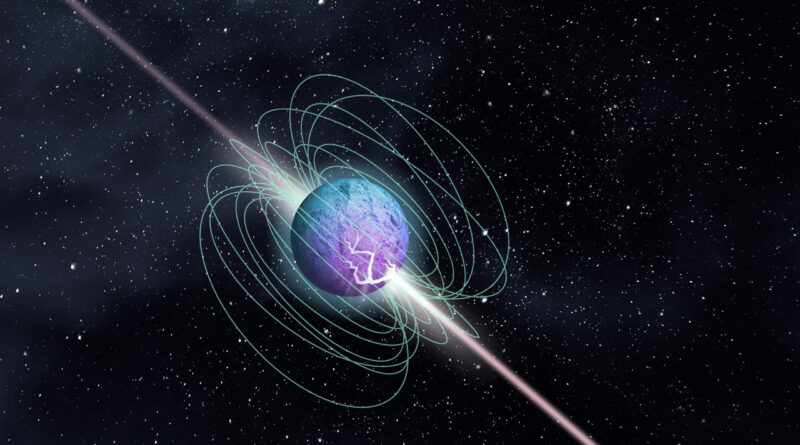
It began with a sudden spike in satellite readings. Instruments saturated instantly, as if overwhelmed by a flood of invisible fire. Engineers suspected a malfunction, a corrupted signal, something technical and mundane. But the truth was far from ordinary. The Earth had been struck by a gamma‑ray flash so powerful that it exceeded anything modern astronomy had ever recorded. Its source was a magnetar known as SGR 1806‑20, a hyper‑magnetized neutron star capable of storing energies that defy human imagination.
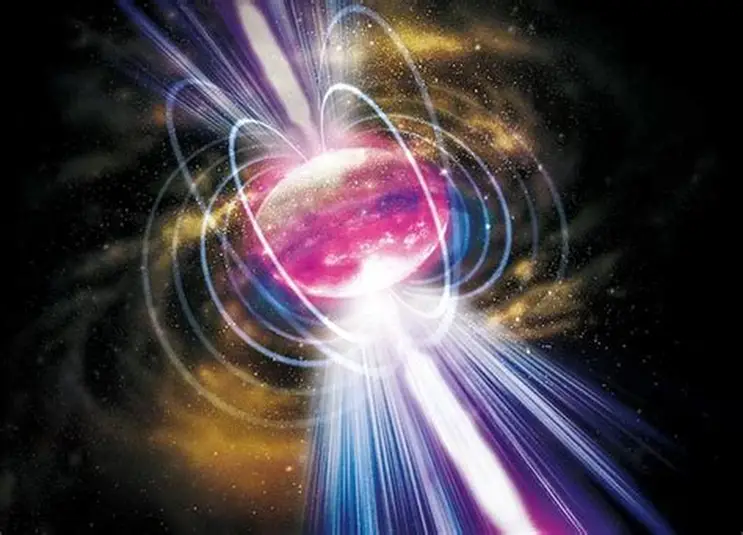
Despite being located 50,000 light‑years away — halfway across the Milky Way — the explosion still managed to leave a measurable imprint on our planet. In just 0.2 seconds, the magnetar released more energy than the Sun emits in 250,000 years. The numbers are almost impossible to grasp, yet the effects were real: Earth’s ionosphere trembled, radio signals wavered, and scientific instruments went off‑scale. For a brief instant, our world was brushed by a force so extreme that, had it occurred within 10 light‑years, it would have sterilized the planet completely.
The event was so extraordinary that the Harvard–Smithsonian Center for Astrophysics later described how the blast affected Earth despite originating from halfway across the galaxy, emphasizing the unprecedented scale of the explosion. Blast Affected Earth From Halfway Across The Milky Way
This cosmic shockwave is a reminder of how fragile our existence truly is. It echoes the same delicate balance explored in our article Cosmic Fine‑Tuning for Life, where the Universe reveals itself as a system held together by razor‑thin margins. The 2004 magnetar event is another chapter in that story: a demonstration that the cosmos is both breathtakingly beautiful and unimaginably violent.
Since that day, scientists have continued to ask the same unsettling question: how many other explosions like this are already on their way toward us, traveling silently at the speed of light? We cannot see them coming. We cannot stop them. We can only study them, understand them, and accept that our planet moves through a Universe ruled by forces far beyond our control.
And perhaps this is the true essence of astronomy: the realization that above our heads, every single day, unfolds a theater of unimaginable power, and that we — tiny observers on a pale blue dot — can only watch, measure, and tell the story.