
When the Land Rises: The Silent Rebound Transforming Scandinavia’s Future
In the far north of Europe, where the landscape seems carved from ice and silence, something immense is happening beneath the feet of millions of people. It isn’t an earthquake, it isn’t an eruption, and it isn’t even a sudden event. It is a slow, steady, relentless movement: the land is rising.
Scientists call it post‑glacial rebound, the upward lift of the Earth’s crust after the disappearance of the massive ice sheets that, until 20,000 years ago, pressed down on Scandinavia with billions of tons of weight. Today, that weight is gone — and the crust, finally free, is rising back toward its natural shape.
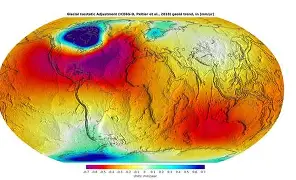
The phenomenon is so powerful that some regions of Sweden and Finland are emerging from the sea at a rate of 8–10 millimeters per year, one of the fastest uplift rates on the planet. Entire bays are turning into plains, historic ports are becoming too shallow for ships, and new islands are literally being born from the water.
But what makes this phenomenon even more fascinating is what it reveals about the deep workings of our planet. The uplift is not uniform: some areas rise faster, others more slowly. This shows that the Earth’s mantle — the hot, viscous layer beneath the crust — is not homogeneous. It behaves like a solid ocean with currents, density variations, and regions that are “softer” or “stiffer.”
It is the same kind of deep‑Earth dynamic that has produced anomalies like the mysterious Indian Ocean Gravity Hole, a massive region where gravity is unusually low and whose origin scientists are still trying to understand. “The Indian Ocean Gravity Hole: A Deep Earth Mystery Unveiled”
In Scandinavia, however, the rebound is not just a scientific curiosity: it is a transformation reshaping maps, economies, and cultural identities. Coastal communities are adapting ports, infrastructure, and trade routes. Some villages are literally “rising” out of the sea, while newly exposed land becomes available for agriculture and conservation.
And then comes the larger question: what does all this tell us about the planet’s future. Post‑glacial rebound is a living reminder that Earth is never still. It is a dynamic organism responding to climate shifts with deep, slow, but unstoppable movements. And as the modern world faces new climatic changes, understanding these processes becomes essential.
The rise of Scandinavia is a quiet reminder: the story of our planet is not written only in the ice that melts, but also in the land that rises.