
Radiative Cooling Materials: The New Passive Technology That Lowers Temperatures Without Electricity Across Cities and Buildings
Radiative Cooling Materials are redefining how the world approaches cooling, offering a passive, electricity‑free solution capable of lowering temperatures even under direct sunlight. This new class of materials uses the physics of the atmospheric window to emit heat directly into space, creating a cooling effect that is already being tested in California, China, and several research institutions worldwide.
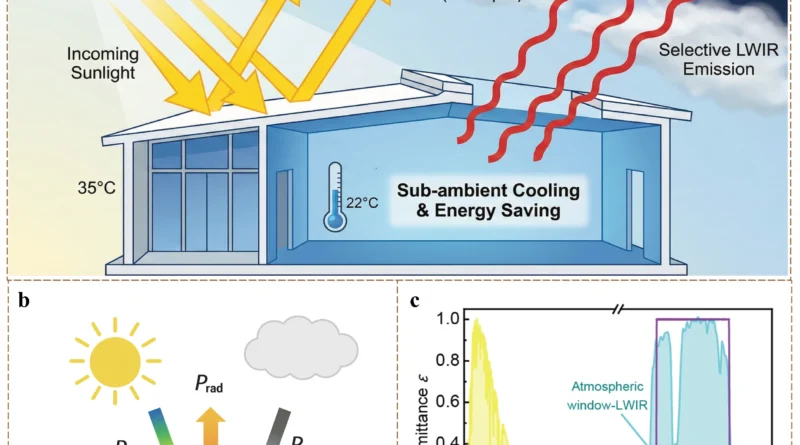
There is a new class of materials quietly reshaping the future of cooling, and it does so without compressors, fans, refrigerants, or electricity. These materials, known as radiative cooling surfaces, are engineered to emit heat directly into outer space through a natural physical window in the atmosphere. It sounds almost magical, but it is grounded in solid physics: the Earth’s atmosphere has a transparency band between 8 and 13 micrometers, allowing infrared radiation to escape into space without being absorbed. Radiative materials exploit this window to cool themselves — and the structures they cover — even under direct sunlight.
The concept is simple but revolutionary. Traditional cooling systems consume enormous amounts of electricity. Air conditioning alone accounts for 10% of global electricity use, according to the International Energy Agency. In hot regions, cooling demand can reach 50–70% of peak electricity load during summer afternoons. Radiative cooling materials offer a radically different approach: instead of consuming energy, they release it.
The first breakthrough came in 2014, when researchers at Stanford University demonstrated a material capable of achieving 5°C of cooling below ambient temperature under full sunlight. This was not shade cooling or evaporative cooling — it was pure radiative cooling. Since then, the technology has advanced rapidly. In 2020, a team at the University of Colorado developed a scalable film capable of up to 10°C of sub‑ambient cooling, using a multilayer polymer structure that reflects 97% of sunlight while emitting infrared radiation efficiently.
Today, radiative cooling materials are no longer confined to laboratories. They are being deployed in real environments. In California, pilot installations on commercial rooftops have shown energy savings of 15–20% in air‑conditioning use during peak summer months. In China, large‑scale tests on warehouse roofs demonstrated temperature reductions of 4–6°C inside the buildings, significantly lowering cooling demand. These results come from published studies by institutions such as Lawrence Berkeley National Laboratory and Tsinghua University.
The physics behind these materials is elegant. They combine high solar reflectance — preventing the surface from heating — with high thermal emissivity in the atmospheric window. This dual property allows them to radiate heat into space even when the sun is shining. In essence, they behave like mirrors for sunlight and like open windows for heat.
The potential applications are enormous. Radiative cooling films could be applied to rooftops, vehicles, outdoor equipment, water tanks, and even textiles. In cities suffering from heatwaves, they could reduce the urban heat island effect. In developing countries, they could provide cooling without electricity, improving comfort and reducing energy poverty. In industrial settings, they could lower the temperature of machinery, reducing wear and improving efficiency.
The economic implications are equally significant. Cooling is one of the fastest‑growing energy demands in the world. The IEA estimates that global cooling energy consumption will triple by 2050. Radiative materials could offset a substantial portion of this growth. A building equipped with radiative cooling surfaces could reduce annual cooling costs by 10–25%, depending on climate and installation area. For large commercial buildings, this translates into thousands of dollars saved per year.
The environmental impact is even more compelling. Air conditioners rely on refrigerants such as HFCs, which have extremely high global warming potential. Reducing AC usage means reducing refrigerant leakage and lowering emissions. Radiative cooling materials operate without chemicals, without electricity, and without moving parts. They are passive, durable, and scalable.
Of course, challenges remain. Radiative cooling is most effective in dry climates with clear skies. In humid or cloudy regions, performance decreases. Materials must also withstand UV exposure, dust accumulation, and mechanical wear. Researchers are working on coatings that self‑clean, resist weathering, and maintain performance over decades. The technology is advancing quickly, but widespread adoption will require continued innovation.
Still, the momentum is undeniable. Radiative cooling is moving from scientific curiosity to industrial reality. It represents a new paradigm in thermal management — one that does not fight heat with more energy, but with physics itself. As cities grow hotter and energy systems become strained, materials that cool without electricity may become one of the most important tools in the global climate strategy.
Radiative cooling is not a futuristic dream. It is already here, already working, and already proving that the future of cooling may not require more power — only smarter materials.