
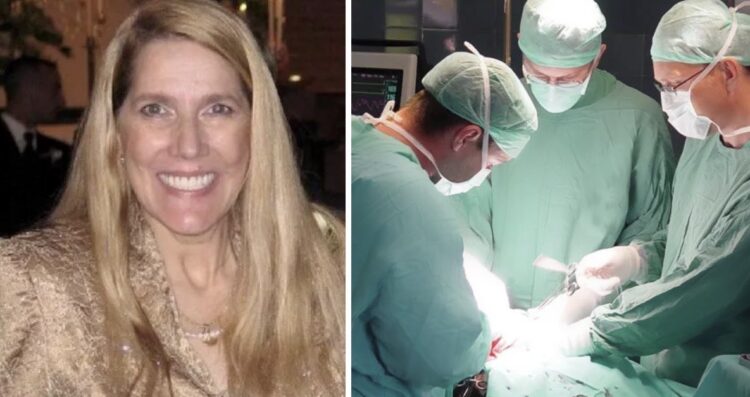
Near-Death Experience Case – The Extraordinary Story of Pam Reynolds
Near-Death Experience Case When Pam Reynolds arrived at the Emory University Hospital, she wasn’t just a patient waiting for surgery. She was a woman walking along the edge of an invisible cliff. The aneurysm growing inside her skull was enormous, positioned so deep and so close to the brain stem that no surgeon could reach it without risking her life. It was a silent bomb, ready to explode at any moment, and the only way to save her was a procedure that resembled a journey beyond life more than a medical operation.
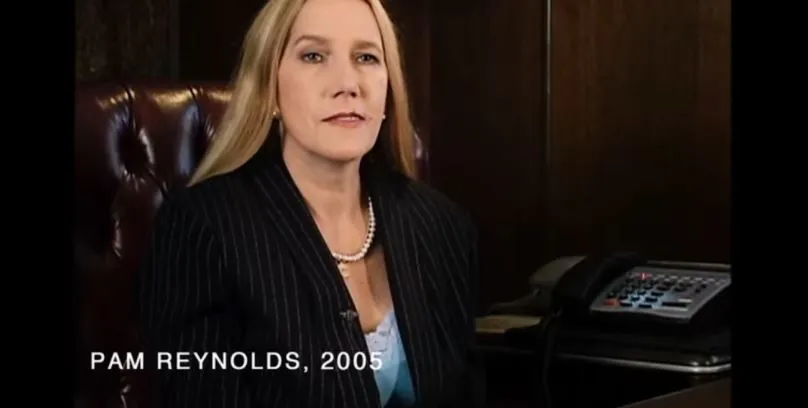
Pam Reynolds became one of the most discussed subjects in the history of the Near-Death Experience Case phenomenon, not because she sought attention, but because her testimony forced doctors to confront something they could not explain. Her story would soon become a reference point for anyone studying the fragile boundary between consciousness and the body.
The doctors decided to place her in a state of deep hypothermic arrest. Her body would be cooled down to fifteen degrees Celsius. Her heart would be stopped. Her blood drained from the brain. Her electrical activity reduced to zero. In that moment, Pam would not be in a coma. She would not be sedated. She would be, according to every clinical parameter, dead. Only then could the surgeons operate.
When the procedure began, her body reacted exactly as expected. Her temperature dropped slowly, her breathing weakened, her heart slowed until it stopped completely. Her ears were sealed with devices emitting extremely loud sounds, designed to detect any neurological response. But there was no response. The EEG monitor showed a flat line, an absolute silence. It was the point where medicine says consciousness cannot exist. And yet, in that silence, something happened.
What makes this Near-Death Experience Case so unsettling is the precision of her perceptions during a moment in which her brain showed no measurable activity. Pam later said that at a certain moment she felt herself being pulled upward, as if an invisible force were lifting her out of her body. She didn’t see heavenly lights, sacred figures, or endless tunnels.
She saw the operating room. She saw her own body lying on the table, motionless and pale, surrounded by doctors moving with almost ritual precision. She saw the instruments, the lights, the monitors. And she saw a surgical drill she had never seen before, a particular model with a shape unlike anything she could recognize from everyday life. She described it so accurately that when the doctors heard her account after the surgery, they fell silent. It was impossible for her to have seen it.
She also said she heard a female voice saying that a vein was too narrow. That sentence had been spoken at that exact moment by one of the nurses. But Pam could not have heard it. Her ears were sealed. Her brain showed no activity. And yet the sentence reached her as if it had been whispered directly into her mind.
The most surprising part of her story came when she described the moment of her return. She said she perceived a deep sound, like a vortex pulling her downward, back into her body. She said she didn’t want to return, that the sensation was like being squeezed into something too small, as if her consciousness were larger than the body receiving it. And then, suddenly, she opened her eyes. Her first memory was a song. A song the doctors were listening to in the operating room while warming her body back to normal temperature. That detail, too, was confirmed.
Many researchers still consider the Pam Reynolds story a cornerstone Near-Death Experience Case, a rare moment where clinical data and human consciousness collide. The emotional weight of this Near-Death Experience Case lies in the fact that Pam described sensations and sounds that matched the surgical timeline exactly, as if her awareness had remained active while her body was clinically silent.
The Pam Reynolds case became one of the most studied in medical history because it wasn’t a symbolic or spiritual tale. It was an experience filled with verifiable details, described by a woman who, at that moment, should not have been able to see, hear, or perceive anything. Her consciousness, somehow, continued to exist even when her body was completely shut down.
It is a case that aligns in a remarkable way with what I explored in Beyond the Threshold, where the boundary between life and consciousness does not appear as a clear line but as a thin, fragile threshold that science still cannot explain. Pam never tried to turn her experience into a religious message or a mystical revelation. She simply recounted what she remembered, with a simplicity that makes her story even more unsettling. She did not claim to have seen the afterlife. She only said she saw what, according to medicine, she should not have been able to see.
Even today, the Pam Reynolds narrative remains a Near-Death Experience Case that challenges the limits of neuroscience and raises questions about where consciousness truly resides. Her story remains a crack in the wall of our understanding, a crack through which a question continues to slip, one that no one can ignore: if consciousness can exist when the body is shut down, then where does the essence of who we are truly reside?
If you want to explore more stories that cross the fragile boundary between life and consciousness, you can continue with the NDE collection, starting from The Light That Waited Beyond the Silence