
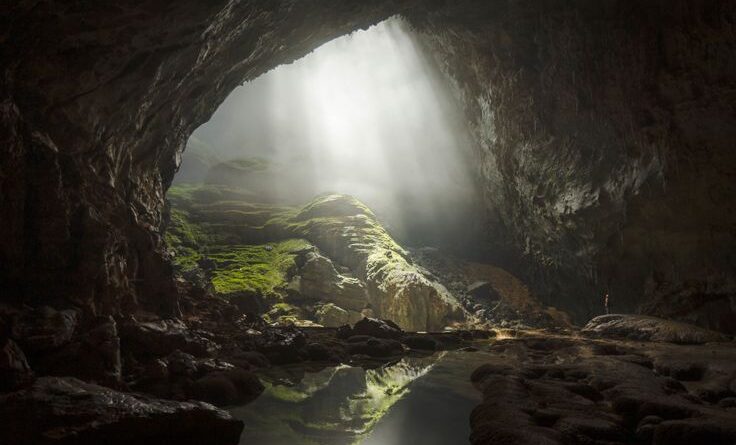
Breathing Caves — How Air Moves Through the Earth’s Hidden Passages
Breathing caves are real geological systems where air moves in and out with unexpected strength, creating currents that can be felt even before entering the passage.
There are places on Earth where air behaves in ways that seem independent from the wind, the seasons, or anything happening on the surface. These are caves that blow and inhale air with surprising force, creating currents you can feel even before stepping inside. It is not a rare or mysterious phenomenon: it is a natural expression of the physics of air, observed in several karst systems around the world. And yet, when you stand before an entrance that emits a steady breath, the sensation is that you are witnessing something that should not exist.
One of the best‑known examples is found in Tennessee, where several cavities known as “Blowing Caves” display very noticeable seasonal airflows. Here the phenomenon can be felt a few meters from the entrance: air flows outward during colder periods and may reverse direction when external temperatures rise. This is not a random behavior but the direct consequence of the difference in density between the air inside the cave and the air outside. When the air inside is warmer, it becomes less dense and tends to rise, generating an outward flow. When it is cooler, it becomes heavier and is replaced by the lighter external air entering the cavity.
The phenomenon is also clearly visible in Kentucky, within the Mammoth Cave National Park system. Speleologists have used air currents for decades to locate new entrances and hidden passages. The airflow here does not depend solely on temperature but on the complex structure of the underground system. Mammoth Cave has entrances at different elevations, creating a natural chimney effect: colder air tends to sink toward lower entrances, while warmer air rises toward higher ones. When atmospheric pressure changes rapidly, the airflow can reverse direction within minutes. It is a dynamic behavior shaped by the cave’s geometry and external conditions.
Similar phenomena are documented in the Slovenian Karst, where speleologists rely on air currents to identify new cavities. In some areas, especially in deeper systems, the air moves strongly enough to be clearly felt at the entrance. These are not violent winds, but precise signals indicating the presence of internal passages. Natural ventilation has been studied here for years because it helps maintain a stable microclimate inside the caves, with temperatures that fluctuate far less than those outside.
The most scientifically studied cases, however, are found in the western United States, in Wind Cave National Park and Jewel Cave National Monument, both located in South Dakota. Here the phenomenon of “barometric winds” is so evident that these caves are considered global reference points. When atmospheric pressure changes rapidly—such as before a storm—the air inside the cave reacts immediately. If external pressure rises, air is pushed into the cave. If it drops, internal air is expelled with force. At certain moments the airflow is so intense that it feels like wind produced by a machine, yet it is simply the natural response of a vast underground system trying to restore equilibrium.
The physical explanation is straightforward. Air always moves to restore balance between zones with different densities. Air density depends on temperature and pressure. If a cave has one or more entrances, every external variation is immediately reflected inside. Warmer air is less dense and tends to rise; cooler air is denser and tends to sink. When atmospheric pressure changes, the internal air responds with a flow that can be weak or very strong, depending on the cave’s structure. There is no “delay” in the equilibrium: there is simply a system reacting in real time to external conditions.
In many caves the airflow changes with the seasons. During colder periods, the warmer and less dense internal air tends to flow outward. During warmer periods, the lighter external air enters the cavity. But this behavior is not universal: it depends on the elevation of the entrances, the length of the passages, the presence of internal chambers, and the overall geometry of the system. Every cave has its own “rhythm,” determined by its structure and the climate around it.
Standing before a cave that breathes feels like witnessing something impossible. Air emerges from the rock as if blown by a hidden fan. Then, at other times, it is pulled inward with equal strength. It is a natural behavior that recalls rivers that flow backward—another phenomenon that seems to defy logic but has a precise physical explanation. As described in the article The Rivers That Flow Backwards — When Water Defies Gravity and Logic, water can reverse direction when pressure, wind, or tides change suddenly. Breathing caves belong to the same family of phenomena: real, measurable events that lie outside our everyday experience and therefore appear extraordinary.
Yet when observed closely, everything becomes clear. There is no magic, no mystery. There is only the Earth reacting to change, like a living system constantly adapting. A cave that blows air is not an enigma: it is the most visible expression of the physics of air moving through hidden spaces. It is a breath that does not belong to a living organism, but to an entire planet.