
Curiosity Honeycomb Formations on Mars: The Discovery That Reveals the Planet’s Ancient Scars
By Bernardin Moreardino
Curiosity honeycomb formations on Mars are not just another geological curiosity. They are a message carved into the planet’s surface, a mosaic of ancient scars that reveals a story from a time when Mars was warmer, wetter, and alive with geological movement…
There are discoveries that arrive quietly, almost shyly, as if the planet wants to whisper them only to those patient enough to listen. And then there are discoveries that break into the Martian stage with the force of a symbol, a sign that cannot be ignored. The new image sent by NASA’s Curiosity rover belongs to the second category. It is not just another geological detail, not another curiosity to add to the long list of Martian oddities. It is a landscape that seems to breathe history, a natural mosaic that tells a story from a past we have never seen, yet one that keeps resurfacing through perfect geometric patterns.
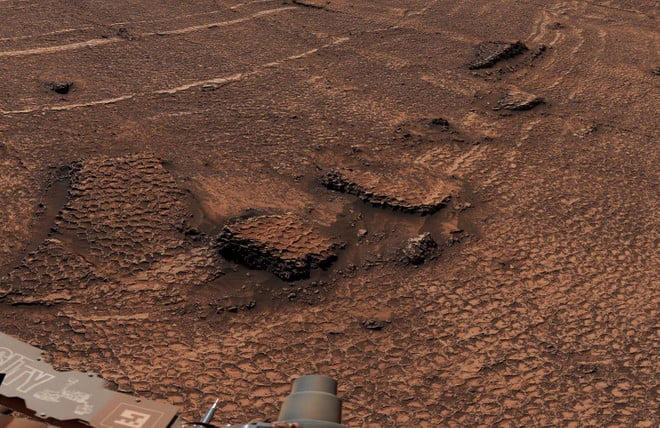
While climbing a valley that NASA engineers nicknamed Valle Grande, Curiosity pointed its cameras toward the ground and found something no one expected: an immense field of polygonal fractures, small geometric figures only a few centimeters wide, yet so numerous they cover every visible direction. They do not remain confined to the flat terrain. They climb the rocky flank of a six‑meter hill, as if an ancient invisible hand had carved that pattern everywhere, without interruption.
At first glance, they resemble honeycombs — tiny hexagonal cells repeating with surprising regularity. But they are not the work of insects, nor of any form of life. They are scars of Martian geology, traces left by processes that date back to epochs when Mars was a completely different world. A warmer world, a wetter world, a world shaped by water and climate, not by the cold and arid silence we see today.
Curiosity had already observed similar formations in the past, but always in small, isolated patches. This time, the scene is different: an entire region appears covered by these polygons, as if the terrain had preserved a collective memory of what happened billions of years ago. That is what makes this discovery so important. It is not a detail — it is a phenomenon. And when a phenomenon is widespread, it means the story it tells is not an episode, but an entire chapter.
The hypotheses about their formation are varied, and each opens a window onto a possible past. One of the most fascinating suggests that these polygons are the footprints left by mud that dried after water disappeared. Imagine a lake slowly retreating, leaving behind a vast field of wet sediment. Over time, the mud dries, contracts, and fractures, creating the geometric patterns we now see fossilized in Martian rock. If confirmed, this would mean Valle Grande may once have been a basin of water, a place where liquid remained long enough to leave permanent marks.
Another possibility involves cycles of heating and cooling. Mars, with its extreme temperature swings, may have repeatedly expanded and contracted the ground, generating polygonal fractures similar to those seen in Earth’s deserts. Or it may have been a process of sediment compression — a slow expulsion of trapped water that gradually shaped the surface into these regular forms.
As always with Mars, the truth is not immediate. Curiosity will need to analyze the chemical composition of the rocks, study the depth of the fractures, and compare the images with terrestrial geological models. Its onboard laboratory, capable of analyzing samples with remarkable precision, is already collecting data that may reveal which mechanism sculpted this landscape.
This discovery adds to a long list of clues Curiosity has gathered since landing in Gale Crater fourteen years ago. During its mission, it has found sulfur crystals, metallic meteorites, traces of ancient rivers, stratified sediments that tell the story of lakes forming and disappearing. It has detected carbon‑based organic molecules — considered precursors to RNA and DNA. These are not proofs of life, but they are proofs of possibility. And on a planet that now appears cold and barren, possibility is already a scientific miracle.
And it is precisely here, in the middle of this mosaic of ancient processes, that the memory of cosmic impacts becomes impossible to ignore. Meteorites have shaped Mars just as they have shaped Earth, and some of those impacts have rewritten entire chapters of planetary history. That connection becomes even clearer when we look at one of our own most dramatic extinction events, explored in depth in Rare CO Chondrite Dinosaur Extinction: The Cosmic Impact That Changed Earth Forever — a reminder that cosmic debris has the power to transform worlds, erase species, and redefine the future of life.
The honeycomb field discovered in Valle Grande fits perfectly into this mosaic. It does not tell us life existed, but it tells us the terrain experienced complex, dynamic processes linked to water and climate. It tells us Mars was not always a desert. It tells us the planet had a rich, layered past full of events that left deep marks.
Looking at those polygonal fractures, one feels as though observing a code — a geological language waiting to be deciphered. Each polygon is a letter, each cluster a word, each field a sentence. Curiosity, with its mechanical patience, is reading that text line by line. And we, millions of kilometers away, can only wait for the rover to tell us what is written.
Mars does not speak with a voice. It speaks with its rocks, its scars, its geometry. And when it reveals an entire honeycomb landscape, it does not do so by chance. It does so because that sign matters. Because that landscape is a message.
And thanks to Curiosity, we have finally begun to read it.
