
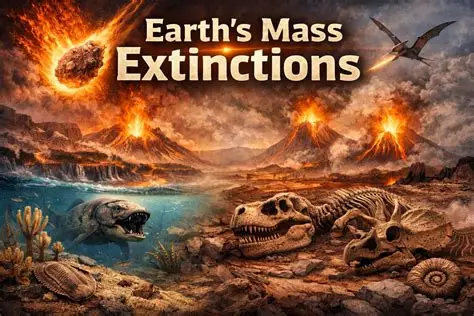
Mass Extinction: When the Planet Starts Sending Warnings in 2026
Mass extinction is no longer a distant scientific hypothesis but a growing environmental reality shaping the world in 2026. As we explored in When the Planet Starts Sending Warnings: The New Environmental Signals Reshaping 2026, the planet is sending increasingly urgent warnings—melting glaciers, collapsing river systems, destabilized forests, and oceans warming beyond predictable limits. These signals are not isolated anomalies; they form a coherent narrative of a world entering a new phase of instability, one that humanity can no longer afford to ignore.
There are years in which the planet whispers, and years in which it raises its voice. By 2026, Earth is no longer whispering. It is speaking in a language of extremes—melting glaciers, collapsing river systems, destabilized forests, and oceans behaving like engines pushed beyond their limits. Scientists describe this moment as a threshold, a turning point in which environmental signals are no longer isolated anomalies but interconnected warnings of a world entering a new phase of instability. The question is no longer whether these signals exist, but whether humanity is willing to listen.
The story of this transformation begins in the cryosphere, the frozen archive of Earth’s climatic past. For decades, glaciers melted slowly, predictably, following seasonal rhythms that shaped ecosystems and human life. But in recent years, those rhythms have broken. Atmospheric rivers—massive corridors of moisture—now strike even in mid‑winter, delivering heat waves to regions that once remained frozen year‑round. Glaciers respond with sudden pulses of meltwater, releasing ancient layers of ice and awakening microbial ecosystems that have been dormant for tens of thousands of years. What once seemed like a distant theoretical risk has become a tangible scientific concern: the re‑emergence of ancient microbes in a warming world.
This phenomenon is not isolated. It is part of a broader pattern of environmental destabilization that is reshaping the outlook for 2026. Across the world’s rivers, oxygen levels are collapsing at a pace that has stunned researchers. Freshwater ecosystems—long considered more resilient than oceans—are losing oxygen faster than marine environments. Entire river systems are shifting from life‑supporting habitats to zones of biological stress. Fisheries collapse, agricultural cycles falter, and communities that depend on river health face an uncertain future. Scientists call this the “great freshwater shock,” a rapid destabilization that challenges decades of assumptions about how rivers respond to warming.
Forests, too, are entering unfamiliar territory. Satellite data from early 2026 reveals a sharp rise in tree mortality across tropical and temperate regions. The cause is not only heat, but the collapse of moisture cycles that once sustained these ecosystems. In some regions, forests are no longer absorbing carbon—they are releasing it. The Amazon, Southeast Asia, and parts of Central Africa are experiencing what researchers describe as “structural weakening,” a slow unraveling of ecological networks that once seemed unbreakable. These forests, which have acted as stabilizers of the global climate for millennia, are beginning to falter.
Meanwhile, the oceans—the planet’s great moderators—are showing signs of exhaustion. Marine heatwaves are becoming longer, deeper, and more frequent. Coral systems bleach and die. Species migrate toward cooler waters, disrupting food chains and altering the dynamics of entire ecosystems. The North Atlantic, in particular, is undergoing changes that scientists describe as “unprecedented in the observational record.” Shifts in circulation patterns could reshape weather systems across Europe and North America, altering rainfall, storm intensity, and seasonal cycles.
What makes 2026 different is not the presence of environmental threats, but their convergence. Each signal—melting glaciers, oxygen‑starved rivers, weakened forests, warming oceans—is part of a larger pattern. The planet is entering a decade in which environmental systems no longer respond gradually but abruptly, crossing thresholds that were once theoretical. The environmental signals reshaping 2026 are not isolated warnings; they are interconnected symptoms of a world undergoing rapid reorganization.
This convergence forces governments, scientists, and communities to rethink adaptation strategies. Traditional models, built on linear projections, struggle to keep pace with a world that is changing in jumps rather than steps. The environmental decade ahead will not be defined by single events but by the interaction of multiple stressors, each amplifying the others. The challenge is not only to understand these signals but to interpret what they mean for the future of human societies.
One of the clearest indicators of this shift is the decline of pollinators—bees and butterflies—across Europe, North America, and parts of Asia. In just one generation, bee populations have fallen by more than 30 percent. In the southwestern United States, more than 450 butterfly species are disappearing. These declines are not merely ecological tragedies; they are direct threats to global food security. Pollinators sustain the agricultural systems that feed billions. Without them, crop yields fall, food prices rise, and entire regions face instability.
The cause of this decline is multifaceted: warming temperatures, habitat loss, pesticide use, and the disruption of seasonal cycles. But at its core lies the same driver behind the planet’s other environmental signals: human‑induced climate change. Rising temperatures make once‑hospitable habitats unlivable. Flowers bloom too early or too late. Migration patterns break. The delicate synchrony between species collapses.
This pattern repeats across ecosystems. In the Amazon, deforestation accelerates the drying of the forest, making it more vulnerable to fires. In the Arctic, melting sea ice reshapes the migration routes of marine mammals. In mountain regions, warming temperatures destabilize glaciers, threatening water supplies for millions. Everywhere, the planet’s signals point to the same conclusion: Earth is reorganizing itself in response to human activity.
Scientists call this era the Anthropocene—the geological epoch in which human influence has become the dominant force shaping the planet. Some argue that it began with the rise of agriculture 12,000 years ago. Others place its beginning in the Industrial Revolution. Many point to the “Great Acceleration,” the period after World War II when population growth, resource consumption, and technological expansion transformed the planet at unprecedented speed. Regardless of the exact starting point, the Anthropocene is defined by one reality: humanity has become a geological agent.
This transformation is visible not only in ecosystems but in the very structure of the planet. Plastic particles are embedded in sediments. Industrial chemicals circulate through the atmosphere. Radioactive isotopes from nuclear tests form geological markers. The world in which our grandparents were born no longer exists. The world of 2026 is something new—familiar in appearance, but fundamentally altered in its dynamics.
The environmental signals reshaping 2026 are not warnings of a distant future. They are descriptions of the present. They reveal a planet that is shifting faster than science predicted, entering a decade of uncertainty in which the stability that supported human civilization for thousands of years can no longer be taken for granted.
The question now is whether societies can adapt as quickly as the planet is changing. Adaptation requires more than technological innovation. It requires a rethinking of economic systems, agricultural practices, energy production, and global cooperation. It requires acknowledging that the environmental signals are not temporary disturbances but indicators of a long‑term transformation.
The time available to maintain the balance that allowed humanity to thrive is running out. Once it passes, we do not know what challenges we will face or what kind of world will emerge. But one truth is clear: the planet has already entered its next chapter. The rest of us are still trying to catch up.