
PFAS Destruction: How Science Is Rewriting the Fate of the “Forever Chemicals”
PFAS destruction is no longer a distant scientific hope—it is becoming a measurable reality as new technologies begin to degrade the world’s most persistent chemicals.
For decades, PFAS have been known as the “forever chemicals”—a vast family of fluorinated compounds engineered to resist heat, oil, water, and chemical reactions. Their extraordinary stability, driven by the strength of the carbon–fluorine bond, made them indispensable in modern manufacturing. It also made them nearly impossible to destroy. The assumption that PFAS were essentially indestructible shaped environmental policy, industrial practice, and scientific research for more than half a century.
But that assumption is now being fundamentally challenged. Not overturned, not erased, but challenged in a way that opens a new chapter in environmental chemistry. A series of breakthroughs across multiple research institutions has shown that PFAS can be degraded—sometimes dramatically—under conditions that were once considered impractical. The story of PFAS destruction is no longer a scientific impossibility. It is becoming a scientific frontier.
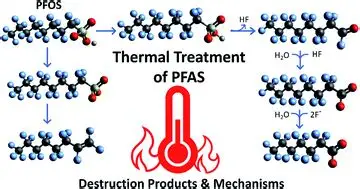
To understand the significance of these discoveries, it’s important to recognize why PFAS have been so difficult to eliminate. The carbon–fluorine bond is one of the strongest in organic chemistry, and PFAS molecules vary widely in structure and reactivity. No single method can “break PFAS” as a whole category. Instead, emerging technologies are demonstrating the ability to initiate the breakdown of carbon–fluorine bonds in specific PFAS compounds, progressively degrading the molecules through multi‑step reactions that yield less persistent products.
One of the most widely discussed advances comes from Northwestern University, where researchers developed a method capable of degrading certain PFAS under relatively mild conditions. The process does not produce “harmless byproducts”—a phrase too absolute for environmental chemistry—but instead generates less persistent products, including fluoride ions and other degradation intermediates. This nuance matters: the breakthrough is real, but it is not a universal solution.
At UC Riverside, scientists achieved up to 95% degradation of targeted PFAS under controlled laboratory conditions. It is a remarkable result, yet it must be interpreted correctly. “Degradation” does not necessarily mean complete mineralization. It means the PFAS molecules were broken down into smaller, less stable fragments that can be further treated or mineralized through additional steps.
Georgia Tech reported another milestone: systems capable of removing up to 99% of PFAS from water. But removal is not destruction. Many existing technologies—activated carbon, ion‑exchange resins, membrane filtration—do not eliminate PFAS; they simply transfer them from water to another waste stream. The concentrated PFAS still require final destruction. This is precisely where the new generation of chemical, catalytic, and electrochemical methods becomes essential.
Unlike conventional filtration methods, which merely relocate PFAS rather than eliminate them, these emerging technologies aim to permanently degrade the molecules. They target the core of the problem: the extraordinary persistence of the carbon–fluorine bond. And while none of these methods is ready for universal deployment, together they represent a profound shift in scientific understanding.
The long‑standing assumption that PFAS could not be efficiently destroyed under practical conditions has now been fundamentally challenged. The barrier was not shattered, but it has been cracked open. The field is moving from resignation to possibility.
The implications are enormous. PFAS contamination affects drinking water, soil, wildlife, and human health across the globe. A scalable method for degrading PFAS would transform environmental remediation, reshape industrial accountability, and redefine how we manage persistent pollutants. But the path ahead requires caution: scalable technologies, cost‑effective systems, regulatory frameworks, and a deeper understanding of degradation products are all essential before these methods can be widely adopted.
Still, something important has changed. Science is no longer standing outside an impenetrable wall. It has found the first openings. It has begun to rewrite a story that once seemed fixed in stone. And for one of the most persistent pollutants ever created, that shift is nothing short of extraordinary.