

Fossilised snake embryo found in 105 million-year-old amber
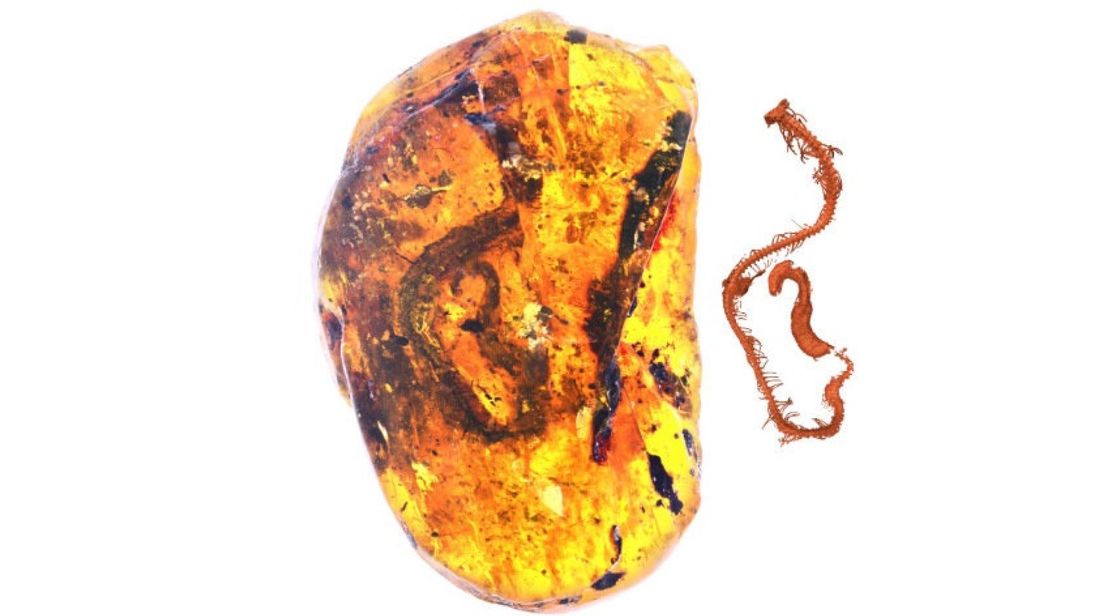
well-preserved skeleton (reconstruction on right) was found in a
pebble-sized chunk of amber. Pic: Ming Bai, Chinese Academy of Sciences
first-ever fossilised snake embryo, preserved in a pebble-sized chunk of
amber from 105 million years ago.
Dating back to the Mesozoic period of the Cretaceous
era, the fossil in Myanmar, formerly known as Burma, provides revelatory
new information about how modern snakes evolved.
Paleontologists from the University of Alberta have established
that the snake species is linked to other ancient snakes from
Argentina, Africa, India and Australia.
Professor Michael Caldwell
of Albert’s department of biological sciences said: “It is an important
– and until now, missing – component of understanding snake evolution
from southern continents, that is Gondwana, in the mid-Mesozoic.”
Alongside
(adsbygoogle = window.adsbygoogle || []).push({});
his international team in Australia, China and the US, Professor
Caldwell has tracked the migration of these Gondwanan snakes, from the
megacontinent Gondwana.
Their analysis of the amber fragment which
preserved the fossil has given them important clues about the
environment of the time.
“It is clear that this little snake was
living in a forested environment with numerous insects and plants, as
these are preserved in the clast,” explained Professor Caldwell.
“Not only do we have the first baby snake, we also have the first definitive evidence of a fossil snake living in a forest.”
Using CT scans, the scientific team studied the amber fossil and compared it with modern snakes’ embryos.
What
they found helped “refine our understanding of early snake evolution,
as 100-million-year-old snakes are known from only 20 or so relatively
complete fossil snake species,” said Prof Caldwell.