Tehran Burns as a New Supreme Leader Rises: A Night That Changes Everything
Tehran burns under relentless strikes as Iran fires back with missiles and a new Supreme Leader rises into a war already closing in around him.

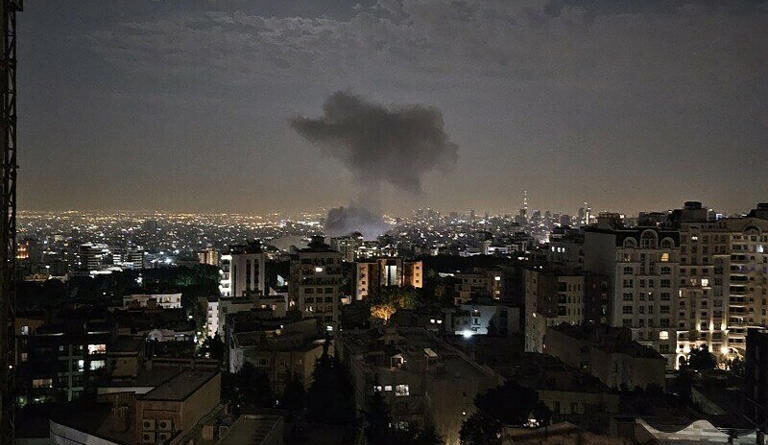
Tehran trembles long before dawn. The city, wrapped in a haze of smoke and dust, feels suspended between two heartbeats—one belonging to the past that has just been erased, the other to a future that no one can yet decipher. The bombardments have not stopped for hours. They fall in waves, rolling across the capital like metallic thunder, striking military compounds, energy grids, and the symbolic nerves of a nation that refuses to collapse. Every explosion reshapes the skyline, every shockwave reminds the world that the war has entered a phase from which it cannot easily retreat.
Inside this storm, Iran has answered with fire. More than forty missiles have been launched toward American bases and allied positions across the Gulf, streaking through the night like burning signatures of defiance. Radar screens from Kuwait to Bahrain lit up in unison, tracing the arcs of retaliation. The message was unmistakable: Iran may be wounded, but it is not silent. It will not allow the sky to belong to its enemies alone.
And then, in the middle of the chaos, came the announcement that changed the tone of the conflict entirely. Mojtaba Khamenei, the son of the Supreme Leader killed in the opening strikes, has been elevated to the highest seat of power. A succession that once seemed improbable has become reality in the most violent of circumstances. His rise is not ceremonial—it is a declaration that the Islamic Republic intends to preserve continuity even as the ground shakes beneath it.
But the world did not greet this transition with diplomacy. Israel responded within minutes, stating that whoever leads Iran will be a target. No recognition, no pause, no space for negotiation—only the cold confirmation that the new Supreme Leader inherits not only authority, but a crosshair. His first hours in power unfold under the roar of jets and the glow of burning infrastructure.
Tehran, battered yet unbroken, absorbs all of this at once: the bombs, the missiles, the succession, the threats. The city feels like the epicenter of a geopolitical earthquake whose tremors are already reaching far beyond the Middle East. The war is no longer a sequence of strikes and counterstrikes—it is a transformation, a rewriting of power, identity, and survival.
Tonight, Iran stands in the fire. And the world watches, knowing that what happens here will shape the months ahead in ways no one can fully predict.