
Us iran tensions Reach a Breaking Point: Inside the Most Volatile Day of 2026
The crisis between the United States and Iran has entered one of its most unpredictable phases, and today, May 30, 2026, feels like a turning point. What was supposed to be a fragile path toward de‑escalation has instead become a tightrope stretched over a landscape of missiles, political ultimatums, and diplomatic contradictions. The world is watching two nations circling each other with a mix of caution and defiance, each move amplified by the fear that a single miscalculation could ignite a regional firestorm.
In Washington, the tone hardened overnight. President Donald Trump reaffirmed that any agreement with Tehran will only be possible if Iran respects what he called his “red lines,” a phrase that has already become the headline of the day. At the center of those lines is the absolute prohibition for Iran to acquire a nuclear weapon. The message was delivered after a tense two‑hour meeting inside the Situation Room, a sign that the administration is weighing a potential diplomatic opening but refuses to show even a hint of weakness. The United States is willing to negotiate, but only on its own terms, and only if Tehran demonstrates concrete steps toward de‑escalation.
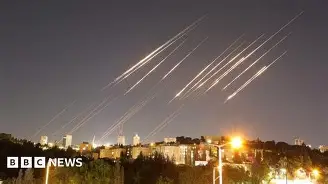
Yet the reality on the ground tells a different story. Just hours before the White House statement, a ballistic missile launched from Iranian territory struck a military installation in Kuwait. The explosion injured five Americans, including both military personnel and civilian contractors. The missile, identified as a Fateh‑110, was intercepted by Kuwaiti defenses, but the debris rained down on the base, destroying a U.S. MQ‑9 Reaper drone and damaging another. It was a reminder that even when diplomacy inches forward, the battlefield can pull everything backward in an instant.
The attack in Kuwait has intensified scrutiny on Iran’s military capabilities, especially after new reports suggested that Tehran may have used Chinese‑made technology to shoot down an American F‑15E earlier this spring. U.S. intelligence agencies are still investigating, but if confirmed, it would mark a significant shift in the balance of power, revealing a deeper technological partnership between Iran and Beijing. For Washington, this possibility is more than a military concern; it is a geopolitical alarm bell.
Despite the violence, diplomats insist that a negotiated solution is still within reach. According to multiple international outlets, the United States and Iran have already drafted a preliminary agreement that would extend the ceasefire by sixty days, reopen the Strait of Hormuz to commercial traffic, and establish a framework for renewed talks on Iran’s nuclear program. It is a document that could, in theory, stabilize the region. But Trump has not yet approved it, and his hesitation has created a vacuum filled with speculation, pressure, and political theater.
Tehran, meanwhile, has responded with its usual ambiguity. Official channels deny the existence of any agreement, calling Western reports “fabricated,” while semi‑official media hint that negotiations are ongoing but fragile. The dual messaging reflects Iran’s internal struggle: a regime that wants sanctions relief and international legitimacy, yet refuses to appear submissive to American demands.
As the diplomatic fog thickens, the military situation continues to deteriorate. The United States has carried out what it describes as “self‑defense strikes” against Iranian missile sites and naval units attempting to deploy mines in the Strait of Hormuz. The region is now a chessboard of drones, warships, and surveillance aircraft, each maneuvering in a space where a single misstep could trigger a chain reaction. Israel’s ongoing operations in Lebanon and Gaza only add another layer of volatility, complicating every attempt at negotiation.
Today’s tension is defined by a paradox. On one side, diplomats are closer than ever to a written agreement. On the other, the skies above the Middle East are filled with drones, missiles, and the echoes of retaliatory strikes. It is a moment suspended between war and diplomacy, where neither path seems fully open, yet neither is entirely closed. The world has seen this pattern before, but rarely with stakes this high or with so many actors involved.
What emerges from this day is a sense of precariousness. The United States and Iran are engaged in a dangerous dance, each step calculated but each outcome uncertain. The attack in Kuwait, the warnings from Washington, the denials from Tehran, and the shadow of Chinese involvement all contribute to a narrative that feels increasingly unstable. The next move could be diplomatic, or it could be military. And the difference between the two may depend on decisions made in the next few hours, not days.
For now, the world waits. The Middle East holds its breath. And the fragile thread connecting Washington and Tehran stretches a little thinner, vibrating with the tension of a crisis that refuses to settle.