Digital Human Evolution: How the Algorithm Is Rewriting Modern Society
Digital human evolution is no longer a distant concept but the silent transformation unfolding inside our daily lives. There comes a moment in the history of every civilization when human beings stop being the authors of their own destiny and become part of a mechanism greater than themselves. Today, that mechanism is the algorithm—an invisible architect that observes, measures, anticipates, and shapes our perception of reality. Modern society is no longer built on direct experience, but on interaction with a digital ecosystem that guides emotions, influences desires, and molds identity without ever revealing its presence.
There comes a moment in the history of every civilization when human beings stop being the protagonists of their own destiny and become part of a mechanism greater than themselves. It is never an abrupt change, never a sudden leap, never a revolution. It is a slow metamorphosis, silent and inevitable. A transformation that does not touch the body but the mind. It does not alter biology, but perception. It does not reshape nature, but the way we interpret it.
Today, we are standing exactly at that point.
Modern society is no longer a community built on relationships, encounters, glances, mistakes, and the natural rhythm of life. It has become a psychological organism, a collective mind guided by an invisible intelligence that has no face, no emotions, no morality: the algorithm.
The algorithm is not an abstract entity. It is a system that observes, measures, records, analyzes. It is an eye that never sleeps, an archive that never forgets, a calculator that never tires. And above all, it is a silent architect that constructs our perception of reality.
We no longer choose what to see; the algorithm shows us what it wants us to see. We no longer decide what to desire; the algorithm suggests what we should want. We no longer form our opinions; the algorithm delivers the ones most compatible with our psychological profile.
And all of this happens without violence, without imposition, without force. It happens through habit.
Human beings are creatures of habit. And the algorithm knows this. It knows how long we linger on a video, how fast we scroll, how often we return to an app, how deeply an image affects us, how quickly a comment irritates us. It knows what makes us laugh, what makes us angry, what keeps us awake at night.
And it uses all of this to guide us.
This is not political control. It is not military control. It is psychological control.
It is the most effective form of control ever created, because you do not perceive it as control. You perceive it as choice.
Concrete examples are everywhere, hidden in plain sight.
A person opens their phone “just for a minute” and emerges an hour later, without knowing how. A teenager spends more time interacting with an algorithm than with another human being. A mother scrolls through videos while her child speaks to her, unaware that she is ignoring him. A man watches content he never searched for, but that the algorithm has decided he will enjoy. A young woman changes the way she dresses, speaks, thinks, because her feed shows her a lifestyle she never chose but unconsciously absorbed.
These are not accidents. They are signals.
Signals of a deep, irreversible transformation that is rewriting the collective psychology of our species.
The new generations no longer belong to the real world the way their fathers and grandfathers did. They do not know silence, slowness, boredom, or the creative solitude that once shaped identity. They do not know unfiltered reality, the kind that forces you to look another person in the eyes, to make mistakes, to fall, to rise again. For them, the world is a continuous stream of images, sounds, notifications, and suggestions. A world that does not require effort, only attention. A world that does not ask to be lived, only consumed.
And when a generation grows inside such an environment, its psychology changes. Its perception of time changes. Its sense of identity changes. Its way of loving, suffering, desiring, imagining changes. Its way of thinking changes.
The future of the human‑digital species is a future in which human beings will no longer be defined by direct experience, but by their interaction with the system. A future in which memory will no longer be personal, but shared. In which emotions will no longer be spontaneous, but suggested. In which choices will no longer be free, but optimized.
And all of this does not happen because someone forces it. It happens because it is comfortable. It happens because it is easy. It happens because the human mind has always sought the simplest path to survive.
The algorithm does not dominate through force. It dominates through repetition. Through habit. Through psychology.
Every time we open our phone “just for a minute,” we surrender a fragment of our attention. Every time we scroll without thinking, we surrender a fragment of our will. Every time we let a suggestion decide for us, we surrender a fragment of our identity.
And fragment by fragment, the human‑digital species takes shape.
It is not a new species in the body, but in the mind. Not a stronger species, but a more adaptable one. Not a freer species, but a more connected one. Not a deeper species, but a more reactive one.
The transformation has already begun. And humanity will never be the same.
The Future of the Human‑Digital Species
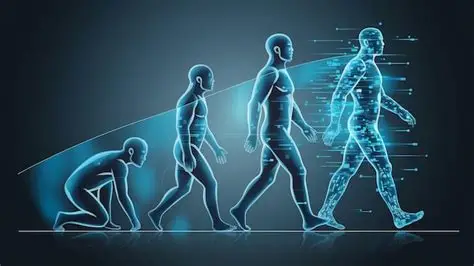
There is a point in history when the human being stops being what it has always been and becomes something else. It is not a sudden shift, not a revolution, not an explosion. It is a metamorphosis that unfolds quietly, almost imperceptibly, like a tide that rises without making a sound. A transformation that does not reshape the body but the mind, not the biology but the consciousness, not the world but the way we inhabit it.
Today, humanity stands exactly at that threshold.
The human‑digital species is emerging from the fusion between our ancient instincts and the new environment we have created—an environment that is no longer natural but algorithmic. A world that does not grow, but updates. A world that does not evolve, but optimizes. A world that does not breathe, but calculates.
In this new era, the human being is no longer defined by direct experience but by interaction. Not by memory, but by data. Not by identity, but by profile. The digital ecosystem has become the new habitat of the mind, and the mind has adapted with a speed that biology could never match.
The new generations are the first to be born entirely inside this environment. They do not remember the world as it once was—slow, imperfect, unpredictable. They do not know the silence that shaped thought, the boredom that sparked imagination, the solitude that forged character. They do not know the weight of time, the depth of waiting, the intimacy of real presence.
For them, the world is a stream. A continuous flow of images, sounds, impulses, suggestions. A world that does not ask to be lived, only consumed. A world that does not challenge, only entertains. A world that does not demand effort, only attention.
And when a generation grows inside such a world, its psychology changes. Its perception of reality changes. Its emotional landscape changes. Its sense of self changes.
The future of the human‑digital species is not a future of machines replacing humans. It is a future of humans reshaped by the logic of machines. A future in which emotions will be influenced by algorithms, desires will be guided by patterns, and choices will be optimized rather than freely made. A future in which the boundary between what we want and what we are shown will become so thin that we may no longer distinguish the two.
This transformation does not happen through force. It happens through comfort. Through repetition. Through the subtle seduction of convenience.
Every time we surrender a moment of silence to a notification, we give away a fragment of our inner world. Every time we let a suggestion replace a decision, we give away a fragment of our autonomy. Every time we allow the algorithm to anticipate our desires, we give away a fragment of our identity.
And fragment by fragment, the human‑digital species takes shape.
It is not a species with a new body, but with a new mind. A mind that reacts faster but reflects less. A mind that connects more but feels less. A mind that knows everything but understands very little.
The future will not be a battle between humans and machines. It will be a negotiation between what remains human and what becomes digital. A negotiation between memory and data, between intuition and prediction, between freedom and optimization.
And the question that hangs over this future is simple and immense: will this transformation make us more human, or less?
The answer is not written. It depends on whether we will remember that before the algorithm, there was life. A life made of silence, mistakes, encounters, unpredictability. A life that could not be measured, calculated, or optimized. A life that was real.
The future of the human‑digital species has already begun. And the true challenge will not be adapting to the digital world, but preserving the part of us that still belongs to the earth, to the senses, to the soul.