
Rare CO Chondrite Dinosaur Extinction: The Cosmic Impact That Changed Earth Forever
Rare CO chondrite dinosaur extinction evidence is reshaping our understanding of the catastrophic event that ended the age of dinosaurs 66 million years ago. New isotopic analysis suggests that the asteroid responsible was an extraordinarily rare CO chondrite, a primitive space rock whose fine dust may have triggered the global collapse that wiped out 75 percent of all species.
For more than a century, scientists have tried to reconstruct the final moments of the dinosaurs — a story written in fire, dust, and silence. The extinction event that ended their reign 66 million years ago has always been traced back to a single catastrophic impact: a massive asteroid slamming into Earth with unimaginable force. But the identity of that cosmic intruder remained a mystery. What kind of object was capable of triggering the collapse of ecosystems across the planet? What chemical fingerprint did it leave behind? And where in the vast architecture of the Solar System did it come from?
In 2026, a team of researchers from the University of British Columbia, Paris, Brussels, and Vienna finally offered a compelling answer. By analyzing the faintest traces of nickel isotopes preserved in the global clay layer left behind by the impact, they concluded that the dinosaur‑killer was not an ordinary space rock. It was a rare CO chondrite — a type of carbonaceous meteorite so uncommon that only a tiny fraction of meteorites found on Earth belong to this class. This discovery reshapes our understanding of the event that wiped out 75 percent of all species, including every non‑avian dinosaur.
The revelation is more than a scientific detail. It changes the narrative of the extinction itself, shifting the focus from sulfur‑driven atmospheric collapse to the devastating power of fine dust and debris. And it underscores a deeper truth: the dinosaurs were not simply unlucky. They were struck by one of the rarest and most destructive projectiles the Solar System could produce.
A Rare Visitor from the Outer Solar System
CO chondrites — carbonaceous chondrites of the Ornans class — are among the most primitive materials in the Solar System. They contain less carbon, zinc, water, and sulfur than other meteorite families. Their chemistry is unusual, almost alien compared to the meteorites commonly displayed in museums. According to Dr. Philippe Claeys, who contributed to the study as a visiting professor at UBC, these rocks are unlike anything typically found on Earth.
This difference matters. For decades, scientists believed that sulfur released during the impact played a major role in cooling the planet, blocking sunlight, and collapsing food chains. But if the impactor contained very little sulfur, then the catastrophe must have unfolded differently. The new evidence suggests that the true killer was not sulfur from the asteroid itself, but the enormous quantities of fine debris blasted into the atmosphere when the object vaporized upon impact.
That debris — tiny particles of pulverized rock — would have spread across the globe, forming a veil that blocked sunlight for months or even years. Photosynthesis would have collapsed. Temperatures would have plunged. Ecosystems would have spiraled into chaos. In this scenario, the asteroid did not need to carry sulfur to be deadly. Its dust alone was enough to rewrite the history of life.
The Nickel Signature That Solved a Mystery
Identifying the impactor was a monumental challenge. When the asteroid struck Earth, it vaporized instantly, leaving behind only microscopic traces of its original material. These traces were preserved in a thin layer of clay deposited around the world — the Cretaceous‑Paleogene boundary, a geological scar marking the end of the dinosaurs.
Scientists from the Institut de Physique du Globe and Université de Paris performed highly precise measurements of nickel isotopes in these samples. Nickel is a key element in meteorites, and its isotopic signature acts like a fingerprint. Even though only a minute fraction of the original object survived, the nickel isotopes were enough to reveal its identity.
The results pointed unmistakably to CO chondrites. This class of meteorites represents only a small portion of the already rare carbonaceous chondrites, which themselves account for about five percent of meteorites found on Earth. In other words, the asteroid that ended the age of dinosaurs was not just destructive — it was extraordinarily rare.
A Cosmic Origin Still Shrouded in Mystery
Where did this rare meteorite come from? The answer remains uncertain. It may have originated in a distant region of the outer Solar System, where primitive rocky debris still orbits the Sun. Or it may have come from the outer part of the asteroid belt near Jupiter, a region known for producing unusual and ancient materials.
Whatever its origin, the projectile traveled across space for millions of years before intersecting Earth’s orbit at precisely the wrong moment. Its arrival was a cosmic accident — a collision that reshaped the trajectory of life.
Dr. Claeys notes that being struck by such a rare object highlights the extraordinary misfortune of the dinosaurs. They were not doomed by a common asteroid. They were wiped out by a cosmic outlier, a visitor from a remote corner of the Solar System carrying the power to transform the planet.
The Chicxulub Impact: A Moment That Changed Everything
The asteroid itself measured between 10 and 15 kilometers across. It struck Earth at roughly 64,000 km/h, releasing energy equivalent to billions of nuclear bombs. The impact created the Chicxulub crater, now buried beneath Mexico’s Yucatán Peninsula — a silent monument to the day the world changed.
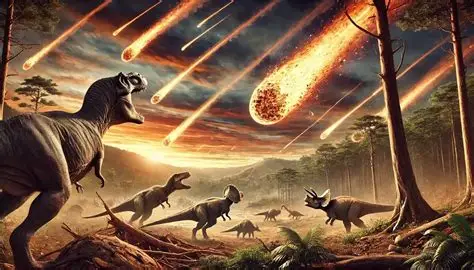
The force of the collision vaporized rock, ignited global fires, and launched debris high into the atmosphere. Within hours, the planet was plunged into darkness. Within days, temperatures dropped. Within months, ecosystems collapsed. And within a few years, the age of dinosaurs was over.
A New Chapter in Understanding Extinction
This new identification of the impactor does not rewrite the entire extinction story, but it sharpens it. It clarifies the chemistry of the event, the nature of the projectile, and the mechanisms that drove global collapse. It also opens new questions: Why was such a rare object on a collision course with Earth? How often do CO chondrites cross our orbit? And what does this tell us about the future risks posed by distant regions of the Solar System?
Science advances by refining details, and sometimes those details change everything. The discovery that the dinosaur‑killer was a rare CO chondrite adds a new layer of depth to one of the most dramatic events in Earth’s history. It reminds us that our planet’s story is shaped not only by the familiar, but by the extraordinary — by rare visitors from the darkness of space, carrying the power to transform life in an instant.
