
Stonehenge Altar Stone Origin: The Discovery That Rewrites Britain’s Prehistory
Stonehenge Altar Stone origin is at the center of a groundbreaking scientific debate that is transforming our understanding of one of the world’s most iconic prehistoric monuments. For decades, archaeologists believed the massive pale-green sandstone block came from Wales, but new research published in Nature now points decisively toward Scotland’s Orcadian Basin. This revelation not only challenges long‑standing assumptions but also opens a new chapter in the story of how Neolithic societies moved colossal stones across vast distances.
Stonehenge has always been a riddle carved in rock, a monument that seems to breathe with the earth itself. Every generation tries to decode its meaning, and every generation eventually discovers that the monument still holds secrets capable of overturning what we thought we knew. Today, one of those secrets concerns the Stonehenge Altar Stone origin, a question that has fascinated archaeologists for decades and has now taken an unexpected turn.
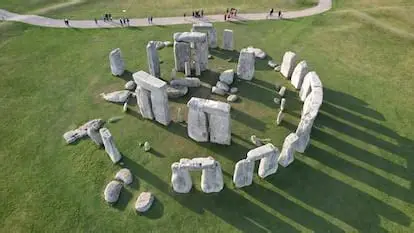
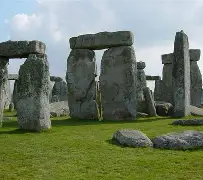
For a long time, scholars believed that the Altar Stone came from the Brecon Beacons in southeast Wales. The idea fit neatly with the established origin of the bluestones, and English Heritage supported this interpretation based on earlier geological analyses. But a new study published in Nature has challenged that assumption with evidence strong enough to reshape the narrative. According to researchers from Curtin University in Perth, the Altar Stone did not come from Wales. Its geological fingerprint points far to the north, toward Scotland.
The team analyzed a tiny sample of the stone, revealing mineral grains whose ages span deep time. Most grains crystallized between one and two billion years ago, while others date to roughly 450 million years. This combination matches the detrital ages found in the ancient red sandstones of the Orcadian Basin in northeastern Scotland. No other geological formation in Britain or Ireland presents this signature, making the Stonehenge Altar Stone origin strongly linked to this northern landscape.
The Orcadian Basin stretches from the Moray Firth to the Shetland Islands, a region shaped by Devonian sediments, fine-grained sandstones, siltstones, and mudstones deposited in long-vanished lakes. It is a remote territory, separated from Salisbury Plain by roughly 750 kilometers. And yet, according to the new research, it is from this distant northern landscape that the Altar Stone began its journey around 2600 BCE.
This discovery raises a compelling question: how could Neolithic communities transport a six‑ton block of micaceous sandstone across such an immense distance? The stone is nearly five meters long, one meter wide, and half a meter thick. Even today, moving such an object would require planning, engineering, and considerable manpower. Yet someone accomplished this feat more than four thousand years ago.
The authors of the study explored this puzzle with caution. A purely overland route would have been extremely complex, crossing mountains, rivers, and dense prehistoric forests. For this reason, the researchers consider a maritime journey far more plausible. Neolithic societies in Britain may have possessed coastal navigation skills more advanced than previously assumed. Large wooden vessels, long-distance exchange networks, and established sea routes could have allowed the stone to travel down the Scottish coast, around the eastern shores of Britain, and eventually toward southern England. This scenario does not exclude some overland transport, but it suggests that the sea played a central role in the stone’s long voyage.
This interpretation aligns with other archaeological evidence. The Neolithic communities of Britain were capable of organizing large-scale construction projects, coordinating labor across extended groups, and managing resources with remarkable sophistication. The transport of the Altar Stone would have required planning, cooperation, and a shared cultural purpose strong enough to justify such an effort. It hints at a society far more interconnected than previously imagined, with networks capable of moving people, ideas, and even massive stones across vast distances.
Richard Bevins of Aberystwyth University, co-author of the study, emphasized that this discovery is only the beginning. Identifying the Orcadian Basin as the likely Stonehenge Altar Stone origin is a major step, but the exact quarry remains unknown. The basin covers a wide area, and future research will need to compare additional samples, refine geochemical analyses, and reconstruct ancient landscapes to pinpoint the precise source.
This story is not simply about geology. It is about human determination. It is about a civilization that, without confirmed evidence of using wheels for such tasks and without proof of employing draft animals for heavy transport, managed to achieve something that seems almost impossible. It is about a monument that continues to evolve, revealing new layers of meaning as scientific methods advance. It is about the ability of ancient societies to imagine and accomplish feats that challenge our assumptions about what prehistoric humans were capable of.
Stonehenge has never been just a circle of stones. It is a chronicle carved in rock, a testament to ingenuity, a bridge between distant eras. And now, thanks to a stone that came from the far north, we know that its story is even broader, more complex, and more astonishing than we ever believed.
If you’re fascinated by how modern science continues to reshape our understanding of ancient civilizations, you may also enjoy reading about another extraordinary discovery: Tutankhamun’s Meteoric Dagger: A Celestial Gift That Rewrites Ancient Egyptian History.