
Space Debris Metal Spheres: The Astonishing Discovery on Australian Beaches
Space debris metal spheres appearing on Australian beaches have sparked both curiosity and concern, turning a quiet shoreline into an unexpected scene of scientific investigation. These mysterious objects, likely remnants of spacecraft hardware, survived atmospheric re-entry and landed intact on the sand, prompting authorities to issue strict warnings to residents.
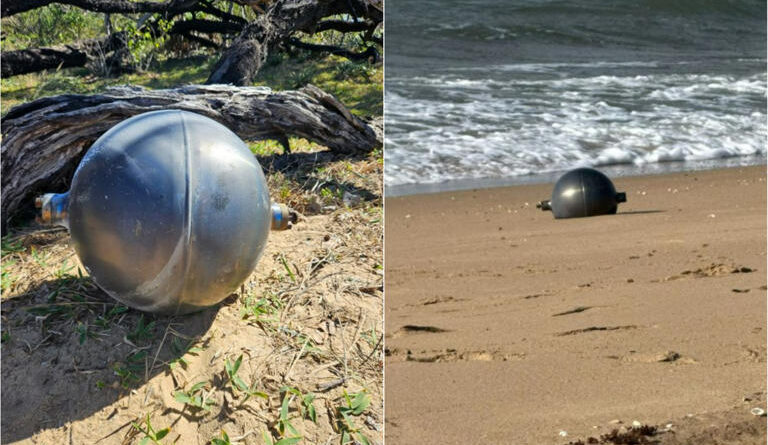
The quiet shoreline of Queensland turned into an unexpected scene of investigation when several metallic spheres washed ashore, prompting an immediate alert from local authorities. What looked at first like harmless industrial scrap quickly revealed itself to be something far more complex: possible remnants of spacecraft hardware, objects that had survived the violent descent through Earth’s atmosphere and landed intact on the sand. The discovery triggered a wave of curiosity, but also a strict warning. Residents were told not to touch the objects, not to approach them, and to call emergency services if they spotted more. The message was clear and urgent: these “space balls” could be dangerous.
The spheres, scattered across Forrest Beach, appeared to be pressurized tanks—components commonly used in satellites and rocket stages. Their shape, thickness, and burn marks matched the profile of aerospace hardware that fails to fully disintegrate during re-entry. When a satellite or rocket stage falls back to Earth, most of its structure burns up in the upper atmosphere. But certain parts, especially spherical tanks made of titanium or steel, are engineered to withstand extreme pressure and temperature. These are the components most likely to survive the descent and reach the ground.
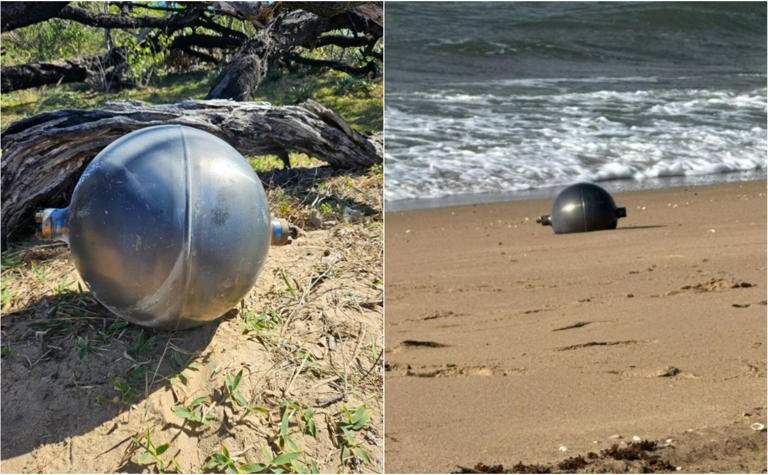
The danger lies not in the metal itself, but in what these tanks may have contained. Many spacecraft propulsion systems use hydrazine, a highly toxic and carcinogenic chemical. Hydrazine is volatile, corrosive, and capable of causing severe damage to the skin, lungs, and nervous system. It has no distinct smell, which means exposure can occur without warning. Even trace amounts can be hazardous. For this reason, emergency teams arrived wearing protective suits, sealed off the area, and handled the objects with specialized equipment. The spheres were placed into secure containers and transported for analysis, away from the public and the shoreline.
The incident highlights a growing issue: the increasing presence of space debris entering Earth’s atmosphere. As the number of satellites and rocket launches rises each year, so does the probability that fragments will fall back to Earth. Most debris burns up harmlessly, but not all. In recent years, several countries have reported similar discoveries—metallic spheres in fields, cylindrical tanks in deserts, and scorched panels in remote forests. Each case reminds us that space exploration, while extraordinary, leaves behind a trail of hardware that eventually returns home.
What makes the Queensland discovery particularly striking is the contrast between the serene beach landscape and the harsh reality of aerospace engineering. The spheres, resting quietly on the sand, are the final stage of a journey that began hundreds of kilometers above Earth. They endured the vacuum of space, the heat of re-entry, and the chaotic tumbling descent through the atmosphere. Their arrival is a physical reminder of how interconnected our planet has become with the machinery orbiting above it.
Authorities have not yet confirmed the exact origin of the spheres, but early assessments suggest they belong to a satellite or rocket stage that re-entered recently. Tracking re-entry events is complex, and identifying specific components requires detailed analysis. Engineers will examine the alloy composition, weld patterns, and structural design to determine which mission the objects came from. This process can take days or weeks, depending on the condition of the debris.
For residents, the message remains simple: space debris is not a souvenir. It is engineered hardware that may contain toxic residues, sharp edges, or pressurized components. The warning issued by emergency services—“Do not touch the space balls”—is not an exaggeration but a necessary precaution grounded in aerospace safety protocols. Even when a tank appears empty, microscopic traces of propellant can remain inside, capable of causing harm.
The discovery also raises broader questions about the future of space activity. As humanity expands its presence in orbit, the responsibility to manage debris becomes increasingly important. International agencies are developing guidelines for safer re-entry, improved tracking, and responsible disposal of spacecraft components. But until these systems are fully implemented, occasional fragments will continue to fall back to Earth, sometimes landing in unexpected places like the beaches of Queensland.
The metal spheres found on the sand are more than just objects; they are artifacts of our technological era, reminders of the invisible infrastructure orbiting above us. Their arrival is a story of science, engineering, and caution—a moment where the boundary between Earth and space briefly touches the everyday world. And for the people who encountered them, it is a moment they will not forget: the day when the ocean delivered pieces of the sky.