
Alzheimer Early Cortical Changes: The Brain May Show Its First Signs Years Before Plaques Appear
Alzheimer early cortical changes may be the first quiet signals of a disease that begins long before memory falters. For decades, we imagined Alzheimer’s as something that arrives suddenly, almost like a shadow crossing the threshold of awareness. A forgotten detail, a missed appointment, a name that slips away for a moment. Yet the brain may begin changing much earlier, silently, invisibly, while life continues as usual.
For a long time, we have imagined Alzheimer’s disease almost as something that arrives at a certain point in life, when memory begins to fail and the people around us start noticing that something is wrong.
First, a forgotten detail. Then a missed appointment. A word that simply does not come. A familiar name that, for a few seconds, seems to have disappeared.
But the brain may actually begin changing much earlier.
A new study published in Nature Neuroscience adds an important piece to this story. Researchers found that certain changes in the cerebral cortex can be detected up to seven years before elevated levels of beta‑amyloid become visible on PET scans, one of the proteins most closely studied in Alzheimer’s disease.
Seven years is a long time.
In seven years, a person can change jobs, move to another city, become a grandparent, lose someone they love, or simply begin a completely different chapter of their life. And throughout all that time, they may feel perfectly normal.
The study comes from a remarkably long period of observation. Researchers at the University of Oslo followed older adults who, at the beginning of the study, showed no obvious signs of cognitive problems. The participants underwent repeated brain imaging over a period of almost twenty years.
It was precisely the opportunity to look at the same brains over such a long period that allowed the researchers to see something that a single MRI scan would probably never reveal.
When the scientists compared the images, they found that people who would later develop elevated levels of beta‑amyloid already showed differences in their cerebral cortex.
The typical picture we associate with Alzheimer’s was not yet there. There were not necessarily noticeable memory problems. The changes were much more subtle.
In these individuals, the cortex tended to be thicker and showed a reduction in the normal process of cortical thinning. These differences could be detected up to seven years before the transition to elevated beta‑amyloid levels.
And this is where the research becomes particularly interesting.
Because it may mean that Alzheimer’s does not necessarily begin at the moment when we can see the plaques. Or, at the very least, the story may be more complicated than we once thought.
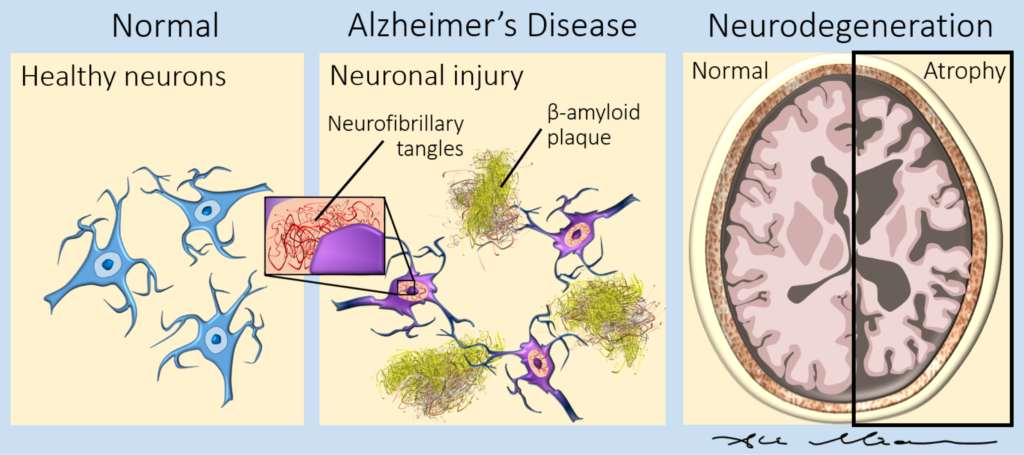
For years, Alzheimer’s research has focused heavily on beta‑amyloid. The plaques formed by this protein are one of the characteristic features of the disease and have become one of the main targets of both diagnostic research and drug development.
But the brain is not a photograph. It is a living system, constantly changing.
Before a protein becomes clearly visible through a diagnostic technique, other biological changes may already have taken place. Some could involve the way brain cells communicate, the structure of brain tissue, or the way different neural networks function.
The Norwegian study does not prove that a particular cortical change is, by itself, the cause of Alzheimer’s disease.
And that distinction matters.
It does not mean that someone with a particular feature on an MRI scan will necessarily develop Alzheimer’s. Nor does it mean that doctors can currently diagnose Alzheimer’s seven years earlier during a routine examination.
The finding is more cautious, but perhaps even more useful: the brain may preserve signs of future disease long before the tools we currently use are able to clearly detect amyloid plaques.
It is a subtle difference.
But in medical research, subtle differences can matter enormously.
Imagine looking at a house through a window. For years, everything appears normal. Then, one day, you notice a crack in the wall.
The natural reaction would be to say that the house began to deteriorate when the crack appeared.
But that may not be true. The crack could simply be the moment when the problem became visible. The brain may work in much the same way.
The researchers also observed a degree of correspondence between the areas where cortical thickness changed and the regions where beta‑amyloid later tended to accumulate. The timing of the cortical changes also appeared to follow, at least to some extent, the progression of protein accumulation.
This raises a huge question. If we could recognize these signals early enough, could we intervene sooner? It is probably one of the most important questions in Alzheimer’s research today.
Treatments can have different effects depending on when they are given. More broadly, many neurodegenerative diseases are extremely difficult to tackle once significant damage has already occurred. Detecting the disease earlier could therefore make an enormous difference.
But this is where we need to resist easy optimism.
An MRI scan is not an oracle. A change in the cortex is not a diagnosis. And seven years is not yet a ready‑made therapeutic window that doctors can simply use in hospitals.
The research is telling us something more fundamental: we may need to look further back.
Perhaps the earliest stage of Alzheimer’s does not begin when a person starts forgetting things.
Perhaps it is much quieter.
It may begin while everyday life continues normally, when nobody would have any reason to suspect that something is happening inside the brain.
And perhaps that is the most human part of this discovery. The disease may have a beginning that does not look like a beginning at all. It could be a slow, almost invisible process that remains below the threshold of our awareness for years.
The challenge for neuroscience now will be to determine which of these changes are simply associated with the disease and which could become genuine early markers — reliable enough to be used in clinical practice.
Because recognizing that something is changing is only the first step.
The much harder question comes next:
What do we do when we discover it?
— Dr. Rachel Mills, Zemeghub Editorial Team
Early Activated Microglia: The First Cells to Sense Alzheimer’s Disease Microglia are among the earliest responders in Alzheimer’s, activating long before cognitive symptoms appear. This article complements your new piece by showing how cellular activation begins quietly, just like early cortical changes.
Blood Biomarkers for Alzheimer’s: New Evidence May Detect the Disease in Its Earliest Stages This article explores another early‑stage indicator of Alzheimer’s — blood biomarkers — creating a perfect internal connection with your discussion of early cortical changes.
