
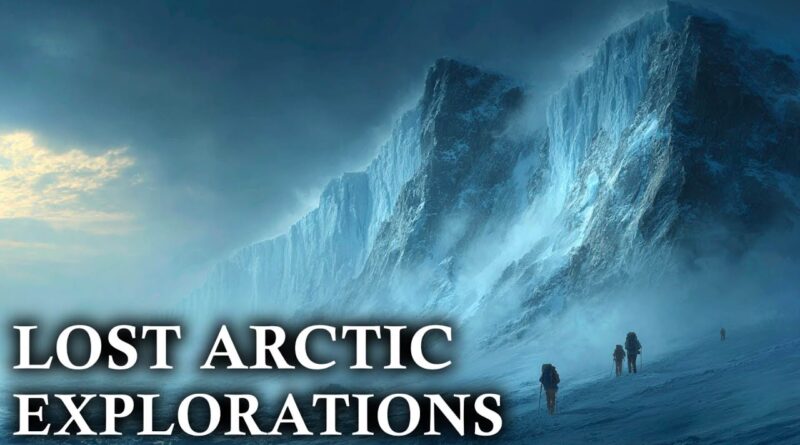
Lost Arctic Civilization: The People Who Vanished Into the Ice
Written by Bernardin Moreardino Co‑Founder & Editorial Director, Zemeghub Exploring the human stories behind science, technology, and the changing world.
The Arctic begins with silence. Not the silence we know from quiet rooms or empty streets, but a silence so vast it feels alive. A silence that presses against the skin, that fills the lungs, that becomes part of the landscape itself. In this silence, the wind moves like a ghost, sweeping across endless plains of ice, carving ridges into frozen seas, whispering through valleys where no human voice has echoed for thousands of years. It is here, in this world of cold and quiet, that the story of the lost Arctic civilization begins.
For most people, the Arctic is a blank space on the map, a place defined by absence—no cities, no roads, no crowds, no noise. But thousands of years ago, long before modern explorers set foot on these frozen lands, the Arctic was home to cultures that thrived in ways we are only beginning to understand. They lived in harmony with the ice, mastering its dangers, reading its patterns, surviving in conditions that would kill most humans in hours. And then, mysteriously, they vanished.
Our journey starts on the western coast of Greenland, where cliffs rise like ancient monuments from the frozen sea. The air here is sharp, almost metallic, and the light has a strange clarity, as if the world were made of glass. Archaeologists came to this place searching for traces of early human migration, but what they found was something far more enigmatic: the remains of a people known as the Saqqaq.
The Saqqaq lived more than four thousand years ago, in a time when the Arctic was already a realm of extremes. They built shelters from turf and stone, hunted seals with tools carved from bone, and moved across the ice with a confidence that seems almost supernatural. Their footprints, preserved in frozen soil, show a people who walked lightly, as if they belonged to the land in a way we no longer do. Their tools reveal a craftsmanship so refined it challenges our assumptions about ancient technology. Their bones tell stories of endurance, of adaptation, of a life lived on the edge of the possible.
And yet, despite all this, the Saqqaq disappeared. Not slowly, not gradually, but completely. When scientists analyzed DNA preserved in a lock of ancient hair found in the permafrost, they discovered something astonishing: the Saqqaq were not ancestors of the Inuit. They were not ancestors of any living population. Their genetic line ended entirely. They are a branch of humanity that rose, survived, and then faded into extinction, leaving behind only fragments of their existence.
As we move northward, the landscape changes. The mountains grow darker, the ice thicker, the wind colder. The Arctic reveals its layers slowly, like a story told in whispers. In this deeper silence, we encounter another mysterious culture: the Dorset people. Inuit legends call them “The Giants of the North,” not because they were truly giants, but because they seemed larger than life—taller, stronger, quieter, more enigmatic than any other people who lived in these lands.
The Dorset did not use bows. They did not build kayaks. They did not keep dogs. Their way of life was entirely different from every other Arctic population. Their sculptures, carved from bone and ivory, depict faces with haunting expressions—eyes that seem to stare across centuries, features that feel both human and otherworldly. Their houses were built with remarkable precision, designed to trap warmth in a land where warmth barely exists. Their tools show a deep understanding of the environment, a knowledge passed down through generations, refined through countless winters.
And yet, like the Saqqaq, the Dorset vanished.
Inuit oral traditions speak of the Dorset as spirits of the ice, beings who appeared and disappeared in the Arctic fog. Some stories say they communicated only through gestures. Others say they lived in a world parallel to the human one. But the archaeological record tells a colder truth: around the year 1200, the Arctic began to warm. Ice retreated. Animal migration routes shifted. And into this changing world came the Thule people, ancestors of today’s Inuit, carrying advanced technologies—bows, kayaks, dog sleds.
The Dorset could not adapt. And so, without war, without conflict, without violence, they faded away. It is as if they accepted their fate, as if they understood that their world was ending.
Farther west, across the Canadian Arctic Archipelago, the permafrost hides even older secrets. Here, scientists have found traces of cultures that predate both Saqqaq and Dorset. Cultures that lived more than five thousand years ago, in a time when the Arctic was even more brutal than today. These ancient peoples left behind tools of stone so refined they seem modern. They built fires in places where temperatures now drop below minus fifty. They survived in conditions that defy imagination.
And then, like all the others, they disappeared.
The mystery of the lost Arctic civilization is not just a story of archaeology. It is a story of climate, of adaptation, of human fragility. These cultures were not destroyed by war or empire. They were destroyed by the changing world—by ice advancing, by ice retreating, by animals migrating, by the shifting balance of nature. The Arctic decides who may stay and who must leave.
Today, the Arctic is changing again. The ice melts faster than ever before. Ancient structures emerge from the thawing ground. Bones, tools, and remnants of forgotten lives rise from the permafrost, as if the past itself is trying to speak. As scientists study these remains, one question echoes through every discovery: what can we learn from these vanished peoples?
We learn that survival is never guaranteed. We learn that adaptation is the key to life. We learn that civilizations can disappear without leaving descendants, without leaving stories, without leaving memory. We learn that the Earth changes, and that those who cannot change with it are lost.
But we also learn something deeper: that the Arctic is not empty. It is a library of human history, written in ice instead of ink. And as the ice melts, that library opens. It reveals stories we never knew existed. It reminds us that humanity is older, more diverse, and more fragile than we ever imagined.
The Arctic is not just a place. It is a witness. It is a guardian of forgotten worlds. And now, as the ice retreats, those worlds are returning to the light
The Arctic asks us to remember, but it also asks us to listen. And as we continue our journey deeper into its frozen heart, the landscape begins to shift again. The ice becomes more fractured, revealing veins of ancient blue that have been hidden for tens of thousands of years. The sky grows wider, stretching into a pale dome that seems to swallow the horizon. In this vastness, time feels different. It slows, stretches, becomes almost circular. The past does not feel distant here. It feels close, as if it were waiting just beneath the surface.
We travel toward Ellesmere Island, one of the northernmost places on Earth, where the air is so cold it burns the lungs. Here, the ground is a mosaic of frost-shattered rock and patches of ancient moss that cling to life with stubborn determination. It is in this unforgiving place that archaeologists discovered something extraordinary: remnants of a culture that may represent the earliest human presence in the High Arctic. These people lived more than five thousand years ago, long before the Saqqaq, long before the Dorset, long before any known Arctic civilization. Their tools, carved from stone and bone, show a level of sophistication that challenges our understanding of early human migration.
Standing in the ruins of their ancient camp, one can almost imagine the scene. A small group of hunters gathered around a fire, the flames flickering against the icy wind. The crackle of burning driftwood, carried from distant shores. The quiet murmur of voices speaking a language lost to time. Above them, the aurora dances across the sky, painting the darkness with ribbons of green and violet. These people lived in a world of extremes, yet they endured. They adapted. They survived.
And then, like all the others, they vanished.
The question that haunts scientists is simple: why? Why did so many Arctic cultures disappear? Why did they leave behind tools, shelters, and bones, but no descendants? Why did their stories end so abruptly?
To answer this, we must understand the Arctic not as a static landscape, but as a living system. The Arctic breathes. It shifts. It transforms. Over thousands of years, temperatures rise and fall, ice advances and retreats, animals migrate in patterns that can change dramatically with even slight variations in climate. For ancient peoples, these changes were not minor inconveniences. They were existential threats.
Imagine a world where the sea ice that once supported hunting routes suddenly collapses. Imagine a world where the animals you depend on—seal, walrus, caribou—change their migration paths by hundreds of kilometers. Imagine a world where winter storms grow more violent, where summer thaws flood the land, where the delicate balance between survival and starvation tips in the wrong direction. For the ancient Arctic peoples, climate was not a background condition. It was the force that shaped their destiny.
And today, that force is awakening again.
As we move across the Arctic landscape, we see signs of change everywhere. Glaciers that once towered like frozen fortresses now shrink into thin, fractured shells. Rivers of meltwater carve new paths through the tundra. Entire valleys that were once locked in ice now reveal patches of earth that have not seen sunlight in thousands of years. In these newly exposed places, archaeologists are finding artifacts that were once thought lost forever—tools, bones, fragments of clothing, even footprints preserved in ancient mud.
Each discovery is a message from the past. Each artifact is a voice speaking across millennia.
One of the most haunting discoveries came from a remote site in northern Greenland, where melting ice revealed a cluster of small stones arranged in a perfect circle. At first, scientists thought it was a natural formation. But as they examined it more closely, they realized it was the foundation of an ancient dwelling. The stones had been placed with care, forming the outline of a home that once sheltered a family from the Arctic cold. Inside the circle, they found fragments of bone, pieces of carved ivory, and a single bead made from polished antler. The bead was small, no larger than a fingernail, but it carried immense significance. It was a symbol of identity, of craftsmanship, of humanity.
Holding that bead, one cannot help but wonder about the person who made it. Who were they? What did they believe? What stories did they tell? What dreams did they have? And why did their world disappear?
The Arctic does not answer these questions directly. Instead, it offers clues—subtle, fragile, easily lost. A pattern of tool marks on a piece of bone. A cluster of footprints preserved in frozen soil. A fragment of woven sinew that once held a tool together. These clues form a tapestry of human existence, a tapestry that is incomplete but still powerful.
As we continue our journey, we reach the northern coast of Baffin Island, where cliffs rise like ancient guardians above the sea. The wind here carries the scent of salt and ice, and the waves crash against the shore with a rhythm that feels almost ceremonial. It is in this place that scientists discovered evidence of contact between the Dorset people and the Norse explorers who traveled west from Greenland nearly a thousand years ago. The idea that these two cultures—one born of ice, the other of ocean—may have met is astonishing. It suggests that the Arctic was not an isolated world, but a crossroads of human history.
Yet even this contact did not save the Dorset. Their world was already changing. The climate was warming. The ice was retreating. The animals were moving. And into this shifting landscape came the Thule, with technologies that allowed them to thrive where the Dorset struggled. The Dorset faded into legend, remembered only in Inuit stories and in the artifacts they left behind.
The disappearance of these cultures is not just a scientific mystery. It is a human tragedy. It reminds us that civilizations are fragile, that survival depends on adaptation, and that the world can change in ways that outpace even the most resilient societies. It forces us to confront the reality that our own world is changing now, faster than ever before.
As we move toward the final part of our journey, the Arctic reveals one last secret. In a remote valley in the Canadian High Arctic, scientists discovered a series of ancient footprints preserved in permafrost. The footprints belonged to a small group of people—men, women, and children—walking together across the frozen ground. The prints were spaced evenly, suggesting a calm, steady pace. They were heading toward the mountains, away from the coast. No one knows why. Perhaps they were searching for food. Perhaps they were fleeing a storm. Perhaps they were migrating to a new land.
What is certain is that these footprints are the last traces of a people who would soon vanish forever.
Standing in that valley, looking at those ancient prints, one feels a profound connection to the past. These were real people, with real lives, real hopes, real fears. They walked across the Arctic with purpose, with determination, with courage. And now, all that remains of them are the impressions they left in the frozen earth.
The Arctic holds their memory. And as the ice melts, that memory returns to us.
The story of the lost Arctic civilization is not a story of failure. It is a story of resilience, of adaptation, of human ingenuity. It is a story that reminds us that the Earth is powerful, that climate shapes destiny, and that survival requires constant change. It is a story that echoes across time, urging us to listen, to learn, to remember.
And as we leave the Arctic behind, the silence returns. But it is no longer empty. It is filled with voices—voices of the Saqqaq, the Dorset, the ancient peoples who walked these lands long before history began. Their stories live on in the ice, in the wind, in the vastness of the Arctic itself.
They have not vanished completely. They remain in the land. They remain in the memory. They remain in the silence.
As the Arctic reveals its hidden past, the planet itself continues to send signals of instability — warnings that echo far beyond the polar regions. A powerful visual exploration of these global environmental alarms can be found in Mass Extinction: When the Planet Starts Sending Warnings in 2026, where the Earth is portrayed split between life and collapse, a stark reminder of the fragile balance we are rapidly losing.
These Arctic discoveries are part of a broader pattern of environmental shifts happening across the world. New climate signals are emerging with unprecedented urgency, reshaping our understanding of the decade ahead. You can explore these global warnings in When the Planet Starts Sending Warnings: The New Environmental Signals Reshaping 2026, a deep dive into melting glaciers, collapsing rivers, and oceans entering a new phase of instability.
