Lattice‑Based Cryptography: The Powerful New Shield Protecting the Future of Post‑Quantum Security
Lattice‑Based Cryptography is emerging as one of the most important pillars of digital security in the post‑quantum era. For decades, global encryption has relied on mathematical problems such as integer factorization and discrete logarithms — problems that classical computers struggle to solve, but that quantum computers could theoretically break using Shor’s algorithm. As quantum processors continue to advance, governments and industries have begun a large‑scale migration toward cryptographic systems capable of resisting future quantum attacks. Among all proposed solutions, lattice‑based schemes have become the leading candidates, not because they are fashionable, but because they are grounded in decades of rigorous mathematical research.
The threat posed by quantum computing is not hypothetical. Between 2022 and 2026, companies such as IBM, Google, IonQ, and Rigetti demonstrated quantum processors with hundreds of physical qubits and early forms of error‑corrected operations. These machines are still far from breaking RSA‑2048, but the long‑term trajectory has convinced governments to begin migration toward post‑quantum standards. The U.S. National Institute of Standards and Technology (NIST) has already selected its first algorithms for global standardization, and three of them — CRYSTALS‑Kyber, CRYSTALS‑Dilithium, and FALCON — are lattice‑based.
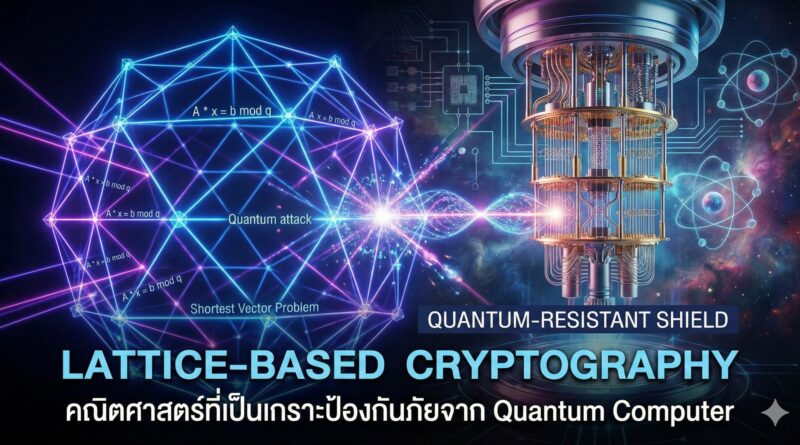
To understand why lattices matter, it helps to step back and look at the mathematics. A lattice is a geometric structure: an infinite grid of points extending in all directions, defined by a set of basis vectors. In two or three dimensions, lattices resemble a repeating city of intersections. But in hundreds or thousands of dimensions, the landscape becomes unimaginably complex. Problems that are trivial in low dimensions become computationally explosive in high dimensions. This complexity is the foundation of lattice‑based cryptography.
Imagine standing inside an infinite three‑dimensional city where every intersection repeats forever. Finding the shortest path between two intersections seems easy in a small neighborhood. But now imagine the same city in 500 dimensions. The number of possible paths becomes astronomically large, and even the most powerful computers cannot efficiently identify the optimal route. This intuitive picture captures the essence of the Shortest Vector Problem (SVP), one of the core hardness assumptions behind lattice‑based cryptography.
Another foundational problem is Learning With Errors (LWE), introduced by Oded Regev in 2005. LWE asks the solver to recover a hidden vector from noisy linear equations. The noise makes the problem extremely difficult, and no efficient quantum algorithms are currently known for solving it. The security of Kyber, Dilithium, and FALCON is based on structured variants of LWE and SIS (Short Integer Solutions), which allow fast computation while preserving hardness.
The historical roots of lattice‑based cryptography go back to the late 1980s and 1990s. Miklós Ajtai introduced groundbreaking results showing that certain lattice problems have worst‑case to average‑case reductions, meaning that breaking a cryptographic instance would imply solving the hardest cases of the underlying mathematical problem. This was revolutionary: it provided a level of theoretical assurance that classical cryptography never fully achieved. Ajtai’s work, combined with Regev’s LWE framework, laid the foundation for the modern lattice‑based schemes that dominate post‑quantum research today.
In 2022, NIST announced the first algorithms selected for post‑quantum standardization. Kyber was chosen for key establishment, while Dilithium and FALCON were selected for digital signatures. In 2024, Kyber and Dilithium were finalized as the primary standards. By 2026, major technology companies — including Google, Cloudflare, Microsoft, and Amazon Web Services — have expanded deployment of hybrid and post‑quantum TLS based on Kyber. These deployments are not universal yet, but they represent a significant shift toward quantum‑resistant security.
The reason lattices are so powerful lies in their structure. High‑dimensional lattices allow cryptographic operations that are both efficient and secure. Kyber uses the Module‑LWE problem, enabling fast key exchanges with small ciphertext sizes. Dilithium uses Module‑SIS, producing signatures that are compact enough for real‑world applications. Benchmarks published by NIST and independent researchers show that Kyber key exchanges can be performed in microseconds, making them suitable for cloud servers, mobile devices, and high‑traffic environments.
The adoption of lattice‑based cryptography is global. The European Union Agency for Cybersecurity (ENISA) recommends Kyber and Dilithium for long‑term protection of critical infrastructure. Japan’s CRYPTREC project is evaluating lattice‑based schemes for government use. China’s national cryptographic standards include algorithms inspired by LWE and SIS. The transition is not optional — it is becoming a necessity.
One of the most transformative applications of lattice‑based cryptography is homomorphic encryption, which allows computations to be performed on encrypted data without decrypting it. Fully homomorphic encryption (FHE), once considered impractical, has become increasingly viable thanks to lattice‑based schemes such as BGV, BFV, and CKKS. In 2025, Microsoft SEAL and Google’s FHE libraries enabled experimental and early production deployments of encrypted machine learning. This capability has enormous implications for privacy. Hospitals can run AI diagnostics on encrypted medical records. Banks can analyze encrypted financial transactions to detect fraud. Governments can perform statistical analysis on encrypted census data without exposing individual information.
The scientific community has strengthened confidence in lattice‑based schemes through decades of research. Papers published in Journal of Cryptology, SIAM Journal on Computing, IEEE Transactions on Information Theory, Advances in Cryptology (CRYPTO), and EUROCRYPT have analyzed the hardness of LWE, SIS, and related problems. While no cryptographic assumption is ever proven unbreakable, lattice‑based schemes currently offer the strongest combination of theoretical foundations and practical efficiency.
Challenges remain. Key sizes are larger than those used in RSA or ECC. Signature sizes can be larger, especially in schemes like Dilithium. Implementations must be carefully audited to avoid side‑channel attacks. In 2023 and 2024, researchers discovered implementation flaws in early versions of Kyber, prompting updates and hardening measures. These issues highlight the importance of rigorous engineering and continuous testing.
Yet the momentum is undeniable. In 2026, the U.S. government has begun migrating federal systems to post‑quantum cryptography, following guidelines from the Cybersecurity and Infrastructure Security Agency (CISA). Financial institutions are preparing for crypto‑agility — the ability to switch cryptographic algorithms quickly as standards evolve. Cloud providers are offering post‑quantum TLS as an option for enterprise customers. Messaging apps are experimenting with hybrid encryption that combines classical and lattice‑based schemes.
The transition to lattice‑based cryptography is not just a technological upgrade — it is a generational shift. For the first time in decades, the world is replacing the mathematical foundations of digital security. The algorithms that protect global communication are being rewritten, redesigned, and re‑engineered for a future in which quantum computers are not science fiction but scientific reality.
Lattice‑Based Cryptography is more than a defense against quantum threats. It is a new way of thinking about security, privacy, and computation. It enables encrypted AI, secure cloud computing, privacy‑preserving analytics, and cryptographic systems that can withstand the most powerful computers humanity may ever build. In the decades to come, lattice‑based systems may become one of the most influential mathematical tools for protecting complex digital ecosystems, a geometric shield built from the structure of high‑dimensional space.