
Marrakech and the High Atlas: 7 Unforgettable Experiences Through Morocco’s Living Soul
Marrakech and the High Atlas is not just a destination: it is an emotional impact that arrives like a warm wave the moment you step off the plane, a mixture of spices, dust, orange blossoms, leather, music, and voices that seem to come from another era.
Marrakech is not a city: it is an emotional impact. It arrives like a warm wave the moment you step off the plane, a mixture of spices, dust, orange blossoms, leather, music, and voices that seem to come from another era. It is a place where time does not flow in a straight line—it pulses. Every street, every doorway, every scent tells a story that is never just of the present. And when you leave the city and begin climbing toward the High Atlas, you feel Morocco shedding its skin. The mountains become a world of their own, a place where life is still measured by the sun, the wind, and the slow, steady rhythm of mules.
Marrakech and the High Atlas reveal themselves as a journey made of contrasts—between the pulse of the city and the silence of the mountains, between ancient rituals and the raw beauty of nature.
The Medina — The Ancient Heart That Never Stops Beating
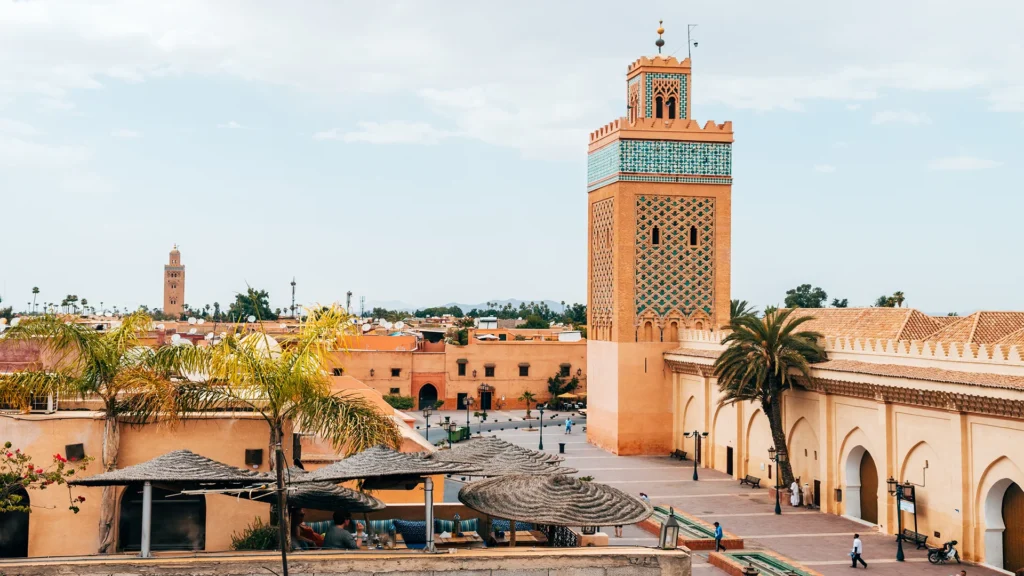
Entering the Medina feels like crossing an invisible threshold. Outside, there is traffic, taxis, scooters darting through the streets. Inside, there is a parallel universe of narrow alleys, tiny workshops, carved wooden doors, intense aromas, and colors that seem more saturated than reality. The red walls of the old city glow at sunset as if they were burning, and every step pulls you deeper into a labyrinth that does not want to be understood—it wants to be lived.
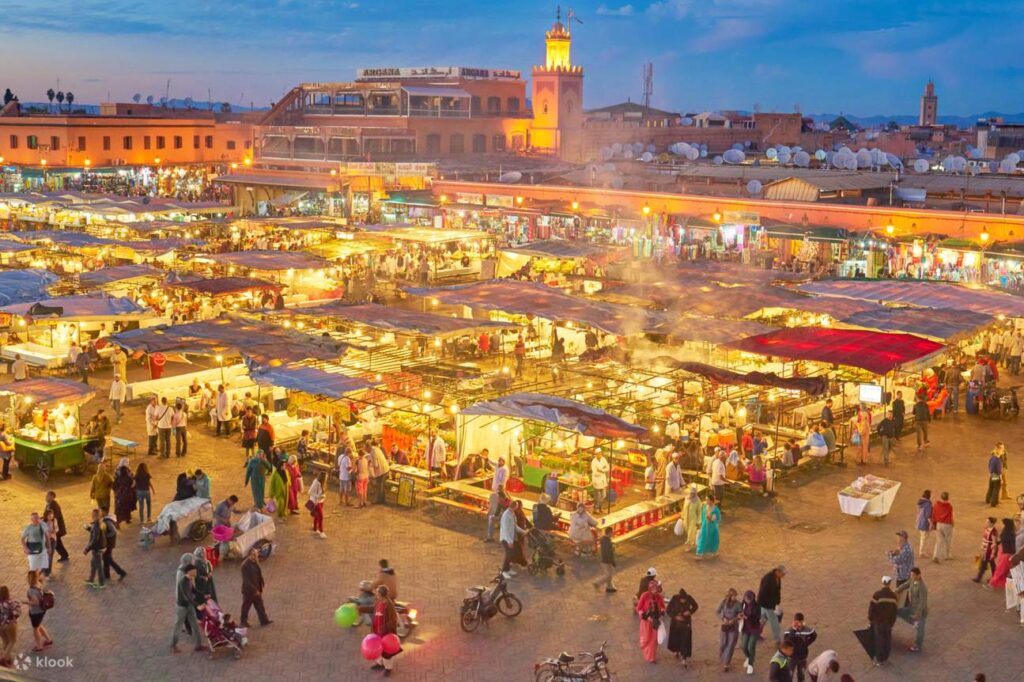
Jemaa el‑Fna is the beating heart of it all. By day, it is a vast marketplace, a controlled chaos where orange vendors, henna artists, herbalists, and musicians coexist like actors in a living theater. But at night, the square transforms completely. Lights flicker on, food stalls begin to smoke, drums echo through the air, and the atmosphere becomes unlike any other place in the world. It is a space that never sleeps, never quiets, never surrenders to silence.
Walking through the Medina, you begin to understand why Marrakech and the High Atlas are considered two halves of the same soul: one vibrant and chaotic, the other calm and timeless.
The Souks — The Labyrinth That Chooses You
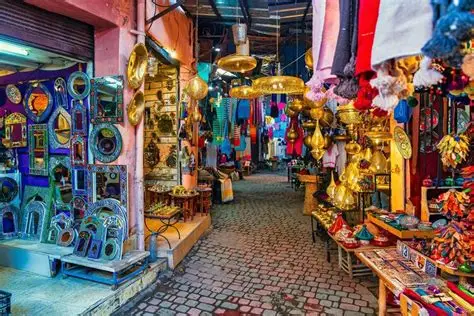
The souks are not a market: they are a full sensory experience. The alleys twist like veins, and every shop is a small universe. There is the dyers’ souk, where colorful fabrics hang like flags in the wind. The spice souk, where cumin, saffron, paprika, and cinnamon create a scent that clings to your clothes for hours. The metalworkers’ souk, where artisans hammer copper with a precision that sounds like music. And then the carpets, the jewelry, the lanterns, the ceramics.
Bargaining is not a nuisance: it is a ritual. You smile, you joke, you drink mint tea, you pretend to walk away, you return, you laugh again. It is an ancient game, a way of meeting each other halfway, of exchanging not just an object but a fragment of culture.
The souks show the urban face of Marrakech and the High Atlas, a world where craftsmanship, tradition, and human energy collide in a vibrant, living tapestry.
The Flavors of Marrakech — A Cuisine That Tells Centuries of Stories
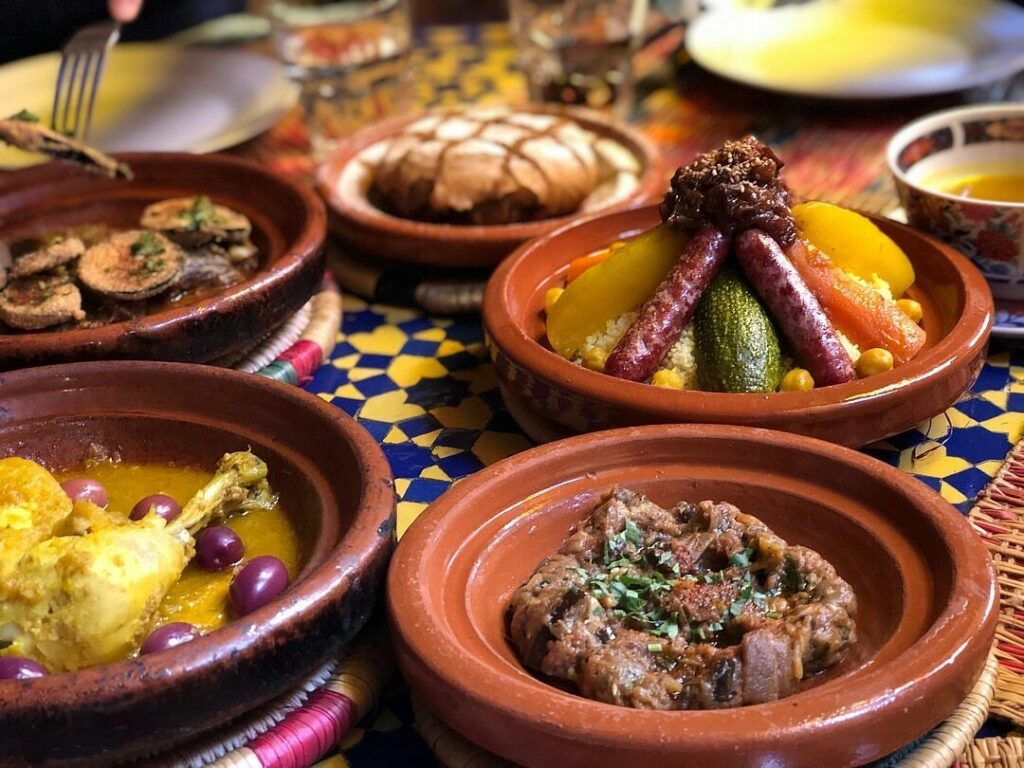
Eating in Marrakech is like reading a book written with aromas and textures. Chicken tagine with lemon and olives carries the scent of family, of slow Sundays, of traditions that never change. In local restaurants it costs between 6 and 10 euros, while in elegant riads it can reach 15–18 euros. Couscous, steamed slowly and patiently, speaks of deep roots. Harira, the soup that breaks the fast during Ramadan, costs just 1–2 euros in popular cafés, yet holds enormous symbolic value.
And then there are the sweets. Gazelle horns, soft and fragrant with almonds. Honey‑soaked briouats, sweet and crisp. Stuffed dates that look like edible jewels. Everything is infused with orange blossom water, a scent that becomes almost a physical memory.
The cuisine of Marrakech and the High Atlas reflects centuries of cultural exchange, blending Berber roots with Arab, Andalusian, and Saharan influences.
The Riads — The Hidden Soul of Marrakech
A riad is not a hotel: it is a secret world. Behind plain doors lie courtyards filled with mosaics, fountains, orange trees, and rooms scented with cedarwood. Staying in a riad means experiencing Marrakech from the inside, far from the chaos, in an oasis of silence and soft light. Prices range from 40–60 euros for simple riads to 150–250 euros for refined ones, where breakfast is a feast of honey, warm bread, olives, yogurt, and fresh fruit.
From the City to the Mountains — The Journey Toward the High Atlas
Leaving Marrakech and climbing toward the High Atlas feels like entering another Morocco. The road winds through red hills, olive groves, and rivers cutting through ancient rock. Berber villages appear like ochre dots on the mountainsides, and every curve reveals a wider, more dramatic landscape.
Imlil, at about 1,700 meters, is the gateway to Mount Toubkal, the highest peak in North Africa. Here the air is cooler, thinner, cleaner. Houses are built from earth and straw, children play in dusty streets, and the silence is so deep it seems to have its own sound.
Berber Villages — Where Time Breathes Slowly
In the villages scattered across Marrakech and the High Atlas, life follows a rhythm that modernity has not yet managed to interrupt.
In Berber villages, time does not run—it breathes. Life is simple, authentic, made of ancient gestures. Women bake bread in communal ovens, men work the fields, mules carry wood and water. Hospitality is sacred: they will offer you mint tea even if they have little, invite you to sit, tell you stories of mountains, spirits, and ancestors.
A night in a traditional guesthouse costs between 20 and 30 euros. A full meal—tagine, warm bread, tea—costs 5–7 euros. And the feeling of being in a place where life still follows the rhythm of nature is priceless.
Trekking and Nature — The High Atlas as You’ve Never Seen It
Trekking toward Mount Toubkal changes the way you look at the world. The landscape is a mosaic of green valleys, red rocks, waterfalls, and deep gorges. The refuge at 3,200 meters costs around 25–30 euros per night, and a Berber guide costs 40–60 euros per day. But the true richness lies in the sensation of being in a place where nature still dictates the rules.
Trekking across Marrakech and the High Atlas means entering landscapes that shift constantly—valleys, ridges, waterfalls, and silent peaks that seem untouched by time.
The wind carries the scent of earth, the sun lights the ridges as if they were gold, and at night the sky becomes a carpet of stars so dense it feels unreal.
Culture, Traditions, and Hospitality — The Soul of Morocco
The Berber people are among the oldest in North Africa. Their language, Tamazight, echoes through the mountains like an ancient song. Their traditions are rooted in land, family, and community. Hospitality is not a gesture—it is a sacred value. They will offer you mint tea even if they do not know you, invite you to share bread, tell you stories that feel like legends.
It is a world that still lives with dignity and simplicity, a world that teaches you that wealth is not what you own, but what you share.
Two Journeys That Speak the Same Language of the World
The mountains of the High Atlas carry the same primordial force as Patagonia — the edge of the world where nature still makes the rules, and the golden light of Marrakech holds something of the magic you described in Greece, Santorini: The Island That Lives Between Fire and Light. Different journeys, yet they speak the same language: the language of places that stay with you.
Practical Guide — Everything You Need to Know Before You Go
Best Time to Visit
Spring (March–May) and autumn (September–November) are ideal. Summer can exceed 45°C in Marrakech, while winter brings snow to the High Atlas.
How to Reach Imlil
From Marrakech, it takes 1.5–2 hours by car or taxi. A private taxi costs 25–35 euros. Shared minibuses are cheaper but slower.
What to Wear
In the Medina: light but respectful clothing. In the mountains: trekking shoes, a light jacket, and a warm layer for the evening.
Cultural Respect
In Berber villages, avoid revealing clothing. Always ask before photographing people. Accept the tea—it is a gesture of respect.
Travelers exploring Marrakech and the High Atlas should plan their journey according to the seasons, as temperatures and conditions vary dramatically between the city and the mountains.
Discover more travel stories on SavorVoyage