
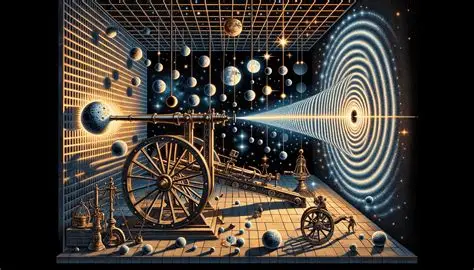
Revealing the Astonishing Emergent Time in Quantum Physics: Inside a Mini‑Universe Experiment
Emergent time in quantum physics is no longer just a theoretical curiosity. It has become something observable, measurable, and astonishingly alive inside a laboratory mini‑universe built from ultracold atoms. In a quiet room at the University of Birmingham, physicist Giovanni Barontini watched time awaken inside a perfectly isolated quantum system, as if the flow of moments were not a fundamental property of reality but a phenomenon born from the simple act of ignoring part of the universe itself.
Emergent time in quantum physics has long been a topic that lived in equations, debates, and speculative cosmology. But for the first time, it has stepped out of theory and into the real world. In a groundbreaking experiment, physicist Giovanni Barontini created a miniature universe inside a Bose‑Einstein condensate and watched time emerge from within, as if the universe itself were deciding when to feel the passage of moments. It is a discovery that forces us to rethink the nature of time, the structure of reality, and the role of the observer in shaping the universe.
Inside this tiny universe, matter behaves in ways that defy classical intuition. Thousands of rubidium atoms, cooled to near absolute zero, merge into a single quantum object. In this frozen state, Barontini isolated the system completely, removing every external influence. No vibrations, no noise, no external clock. A universe with nothing outside it. Then he split it in two using a thin sheet of laser light. One half became the bright sector, the part he observed. The other half became the dark sector, the part he deliberately ignored. This act of ignoring was not a mistake—it was the key to unlocking time.
Atoms in the bright sector sloshed back and forth, spilling over the barrier and retreating again. When they flooded into the observed region, Barontini called it the Big Bang. When they drained out, he called it the Big Crunch. These names were not poetic exaggerations; they were a way to describe how entropy moved inside the system. Entropy—the measure of disorder—became the engine of time. Barontini built an internal clock based entirely on entropy flow. When entropy moved, time advanced. When entropy slowed, time slowed. When entropy stopped, time stopped.
What astonished him was how perfectly this internal time matched the sequence of events, even though it flowed at a different rate than laboratory time. Sometimes it accelerated. Sometimes it slowed. Sometimes it froze completely. It was as if the miniature universe had its own heartbeat, independent of the external world. And all of this happened without any external reference, exactly as predicted by the Wheeler‑DeWitt equation, the central equation of quantum gravity that describes the universe as a timeless whole.
But the deeper implications of this experiment go far beyond the laboratory. They touch the foundations of physics, the meaning of observation, and the possibility that time itself is not fundamental. The idea that time might be emergent has been discussed for decades, but always in the abstract. Now, for the first time, it has been seen happening.
And what makes it even more striking is that both time and the arrow of time—the reason time flows forward—may arise from ignorance. By choosing not to observe the dark sector, Barontini gave up information. That loss of information, encoded in entropy, generated time in the bright sector. In other words, time may not be a fundamental ingredient of the universe. It may be a consequence of the observer’s limited knowledge.
This idea resonates with the principles of Quantum Superposition, where the state of a system depends on what the observer chooses to measure, and with the reflections surrounding Cosmic Fine‑Tuning, where the universe appears precisely calibrated to allow complexity and life. But here the concept goes further: time itself may be emergent, not fundamental. It may arise only when an observer interacts with the universe in a way that hides part of its information. In a sense, time may be the shadow cast by our own ignorance.
The experiment also raises profound questions about the nature of cosmology. If emergent time in quantum physics can be observed in a miniature universe, what does that imply about the real universe? Could the cosmic flow of time be nothing more than a large‑scale version of what Barontini saw in his condensate? Could the arrow of time—the forward march from past to future—be a reflection of the fact that we cannot access all the information in the universe? And if time can stop inside a quantum system, could something similar happen in extreme cosmic environments, such as near black holes or during the earliest moments after the Big Bang?
Barontini believes this is only the beginning. With ultracold atoms, magnetic traps, and laser barriers, scientists can simulate black hole analogues, early‑universe conditions, and even the dynamics of cosmic collapse. It is a new kind of cosmology—not by observing the sky, but by building universes in the lab. A way to test ideas that were once confined to equations and thought experiments. A way to explore the architecture of reality from the inside out.
His experiment does not answer the ultimate question of what time truly is. But it shows that time can emerge, change rhythm, freeze, and be born from ignorance. And that alone is a profound shift. It means time might not be a foundation of the universe, but a consequence of how we observe it. A concept that once lived only in theory has now been seen happening for real. And if emergent time in quantum physics can be engineered, manipulated, and studied, then the next frontier may be even more radical: understanding whether the universe itself is built on principles that only reveal themselves when we choose not to look.