
Patagonia — the edge of the world where nature still makes the rules
Arriving in Patagonia means leaving behind everything predictable. Cities shrink into dots on a map, roads stretch into infinity, and the sky expands until it becomes a continent of its own. This is not a place that welcomes you; it tests you. And for that very reason, no one returns from Patagonia unchanged.
How to get there: the journey to the end of the world
Patagonia is split between Argentina and Chile, and reaching it is already part of the experience.
Travelers coming from northern Argentina fly into El Calafate, the gateway to the glaciers. The flight from Buenos Aires takes about three hours, but the sensation is that of landing on another planet — an endless expanse of steppe, glacial lakes, and mountains that seem to rise out of nothing.
On the Chilean side, the natural entry point is Punta Arenas, facing the Strait of Magellan. From there, the road leads north to Puerto Natales, the starting point for Torres del Paine National Park. Buses connect the cities with surprising punctuality, and the journey itself is a prelude to the vastness that awaits.
Those who want to push even farther south reach Ushuaia, the world’s southernmost city, where the Andes plunge into the ocean and the wind carries the scent of Antarctica.
Torres del Paine: the sanctuary of Chilean wilderness

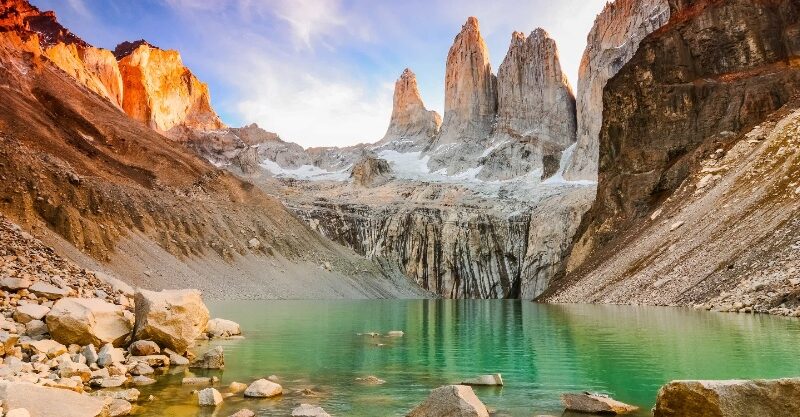
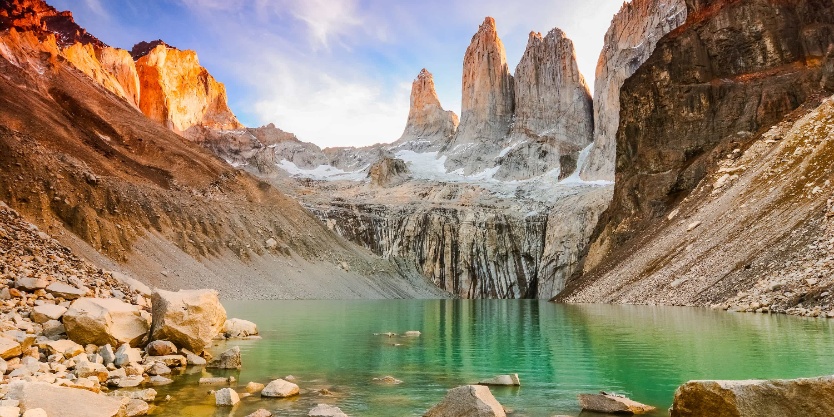
Torres del Paine National Park is not a destination — it is an epiphany. The three granite towers that give the park its name rise like cathedrals carved by the wind. The lakes shift color throughout the day, from turquoise to metallic gray. Guanacos graze as if they were the rightful owners of the land, and condors draw slow circles in the sky.
Trekking here is not a walk — it is a pilgrimage.
The famous W Circuit takes four or five days, but every step feels like a revelation. The longer, wilder O Circuit is a journey into pure solitude, where the only sound is the wind brushing against the mountains.
El Calafate and Perito Moreno: the glacier that breathes

On the Argentine side, the protagonist is the Perito Moreno Glacier, a living giant that advances two meters per day. Standing before its sixty‑meter-high wall of ice, time seems to stop. Then a thunderous crack breaks the silence: a block of ice collapses into the lake, sending a wave rolling across the water like a heartbeat of the earth itself.
Walkways allow visitors to observe the glacier up close, but the true experience is trekking on the ice — crampons sinking into the blue surface, crevasses glowing like veins of frozen light.
El Chaltén: the capital of trekking

A few hours from El Calafate lies El Chaltén, a village born for hikers. Here, Mount Fitz Roy dominates the horizon like an ancient guardian. Trails begin directly from the town and lead to glacial lakes, lenga forests, and viewpoints that look like paintings.
The trek to Laguna de los Tres is one of the most iconic in South America — a climb that ends at a natural amphitheater where Fitz Roy reflects in the water like a stone deity.
Wildlife: a world that lives without fear of humans

Patagonia is one of the few places on Earth where animals do not run away.
Guanacos cross the road with regal calm. Foxes watch travelers without fear. Pumas — invisible but ever-present — rule the food chain. And along the coast, between Puerto Madryn and the Valdés Peninsula, whales, orcas, elephant seals, and penguins turn the ocean into a natural theater.
Patagonian cuisine: flavors born from wind and fire

Patagonian food is simple, robust, and deeply authentic.
The signature dish is asado de cordero, lamb slow-cooked over an open fire until it becomes tender and aromatic, infused with the taste of the land.
Guanaco meat, served grilled or stewed, is a local specialty.
Centolla, the giant king crab of Tierra del Fuego, is a treasure of the southern seas.
Then come the wild berries, artisanal cheeses, village-brewed beers, and Patagonian wines that are gaining international acclaim.
Prices and atmosphere: vastness has no price
Patagonia is not cheap, but it is far from inaccessible. Accommodation ranges from simple hostels to luxury lodges immersed in nature. Transportation is reliable, trekking is free, and experiences — like glacier cruises — are worth every cent.
But the true value of Patagonia cannot be measured in money.
It is the feeling of being small before a nature that does not need humans to exist.
It is the silence you cannot find anywhere else.
It is the freedom you feel when the wind cuts through you.
Patagonia today: the call of the wild world
In 2026, Patagonia is more desired than ever.
It is not a destination — it is a rite of passage.
A place where nature still makes the rules, and humans can only listen.
For travelers drawn to remote frontiers where nature still shapes every moment, the Faroe Islands offer another world of wind‑carved cliffs, quiet villages, and raw northern beauty.
Discover the Faroe Islands →Faroe Islands: Denmark’s Remote Nordic Escape of Nature and Tradition