
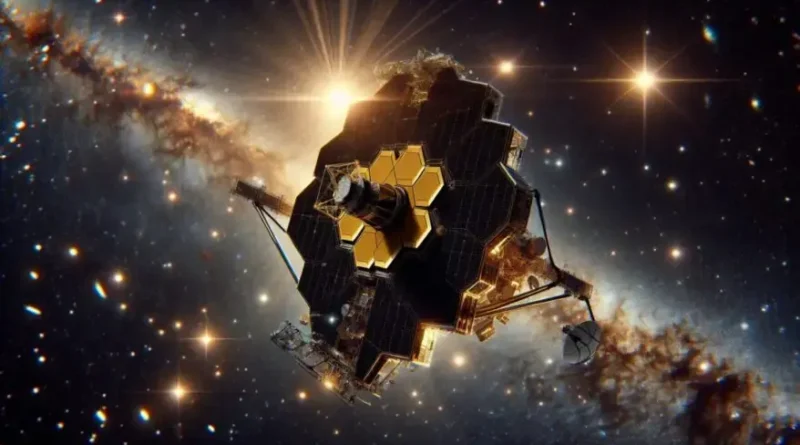
Cosmology 2026: The New Frontiers of the Universe Revealed by JWST
Cosmology 2026 is reshaping our understanding of the Universe. With the James Webb Space Telescope delivering unprecedented observations of early galaxies, dark‑matter structures, and the large‑scale architecture of spacetime, researchers are refining the foundations of modern cosmology with new data and new theoretical perspectives.
Cosmology in 2026 is a landscape in constant motion. Month after month, the James Webb Space Telescope adds new pieces to a mosaic we had never seen with such clarity: galaxies emerging earlier than expected, cosmic structures stretching across hundreds of millions of light‑years, signals that may hint at new interpretations of dark matter, and theoretical models attempting to describe spacetime as an emergent informational system. We are not witnessing definitive revolutions, but rather a slow and fascinating refinement of our understanding.
What is becoming increasingly clear is that the Universe revealed by JWST is more dynamic, more complex, and richer in variations than the standard ΛCDM model originally anticipated. This does not overturn the foundations of modern cosmology, but it does encourage researchers to adjust the details, especially those concerning the formation of the earliest structures.
Ultra‑high‑redshift galaxies: what we truly know in 2026
Throughout 2025 and 2026, JWST has identified several candidates for extremely high‑redshift galaxies, some potentially beyond z ≈ 12. The scientific community is working to obtain spectroscopic confirmations, because only spectroscopy can determine their true distance and cosmic age. A number of these candidates have appeared in arXiv preprints and have been discussed at international conferences, but the term “confirmed” remains reserved for cases where spectroscopy has already provided precise measurements.
What is certain is that JWST is observing galaxies that appear more luminous and more massive than expected during the first few hundred million years after the Big Bang. This does not imply a failure of the ΛCDM model; instead, it suggests that early star formation may have been more efficient, or that the physics of primordial gas behaved differently from what current simulations assume.
The cosmic web and dark matter: new maps, new questions
Large radio and infrared surveys, combined with JWST data, are producing increasingly detailed maps of the cosmic web. The dark‑matter filaments predicted for decades by hierarchical structure‑formation models now appear with remarkable clarity. Some of the structures observed seem to extend across vast cosmic distances, confirming that dark matter is the primary architect of the Universe’s large‑scale geometry.
The curvature seen in these filaments does not challenge General Relativity; it is a natural consequence of the gravitational potential generated by the distribution of matter. However, the precision of these new maps is opening the door to more refined studies of dark‑matter dynamics and its interaction with ordinary matter.
Primordial black holes: an open hypothesis
In 2026, primordial black holes remain an active and intriguing hypothesis for explaining part of the dark‑matter population. Certain microlensing anomalies observed by OGLE and Gaia are compatible with compact objects whose masses are lower than those of typical stellar black holes. Yet no definitive evidence exists that these objects are truly primordial.
The scientific community treats this possibility as interesting but not conclusive. Primordial black holes remain one of several hypotheses, alongside exotic particles, modified weak‑interaction physics, and other theoretical proposals.
The curvature of the Universe: a subtle and ongoing debate
Combined analyses of Planck data and newer observations continue to indicate that the Universe is consistent with a curvature extremely close to zero. Some studies explore the possibility of slight positive or negative curvature, but these variations generally fall within statistical uncertainties. As of 2026, there is no consensus suggesting a significant deviation from flatness.
Still, the question remains open. The geometry of the Universe is a fundamental parameter, and every new observation helps reduce the margin of uncertainty.
Galaxies with little or no dark matter: a real but complex phenomenon
In recent years, astronomers have identified a handful of galaxies that appear to contain far less dark matter than expected. JWST has improved the precision of these measurements, and in 2026 the phenomenon is considered real, though rare. Possible explanations include violent gravitational interactions that separate ordinary matter from dark matter, or particular dynamical configurations that make mass estimates difficult.
These cases do not undermine the ΛCDM model, but they offer valuable opportunities to study dark matter under extreme conditions.
Information‑based cosmology: a theoretical frontier
In 2026, several research lines explore the idea that spacetime and matter may emerge from deeper layers of quantum information. These are theoretical models, not observational conclusions. They appear in specialized publications and conference discussions, representing one of the most active directions in contemporary theoretical physics.
These approaches do not replace standard cosmology; instead, they attempt to describe gravity and the structure of the Universe in a language closer to information theory. It is a field in evolution, fascinating, but still far from a definitive formulation.
A richer Universe, not a simpler one
The year 2026 is not defined by upheavals, but by refinements. JWST is revealing a Universe that is more varied and more complex, where early galaxies form faster than expected, dark matter shapes immense structures, and theoretical physics attempts to build models that unify gravity, quantum mechanics, and information.
We do not yet have final answers, but we do have a broader view. And that broader view is already a step forward.
These new perspectives on the structure of the Universe, and on the possible connections between information and spacetime, resonate with the ideas explored in Cosmology and Consciousness: 7 Astonishing Insights into Parallel Universes and Hidden Dimensions, where cosmology meets the deepest questions about the nature of reality.
As Cosmology 2026 continues to evolve, JWST’s discoveries highlight a Universe that is richer, more complex, and more dynamic than previously imagined.