
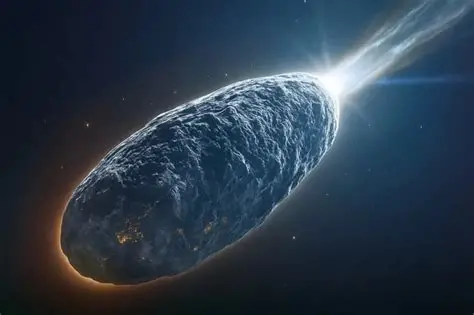
3I/ATLAS — Scientific Analysis of a Potential Interstellar Comet Under NASA and ESA Observation
A New Interstellar Candidate in the Solar System
The appearance of a fast, hyperbolic object such as 3I/ATLAS represents one of the most significant developments in planetary astronomy. Interstellar objects are no longer theoretical constructs; they are now part of observational reality. The discoveries of 1I/ʻOumuamua in 2017 and 2I/Borisov in 2019 demonstrated that fragments from other star systems occasionally enter the Solar System, carrying chemical and physical signatures formed under entirely different stellar environments. A candidate like 3I/ATLAS, if confirmed, would become the third known interstellar visitor and the first to be studied with the full capabilities of modern space telescopes, allowing astronomers to characterize its composition, structure, and dynamical history with unprecedented precision.
Detection and Orbital Reconstruction
The earliest indications of 3I/ATLAS emerged from wide‑field survey pipelines designed to detect faint, fast‑moving objects. These systems identify anomalies when an object’s motion does not match the gravitational behavior expected of Solar System bodies. A trajectory that does not close into a bound orbit, an eccentricity greater than one, and an inbound velocity exceeding the Solar System escape threshold all point toward an interstellar origin. Confirmation, however, requires repeated astrometric measurements to eliminate observational errors and gravitational perturbations. As with previous interstellar detections, the classification process is iterative and depends on continuous refinement of the orbital solution.
The scientific foundation for this classification is now supported by the first primary research publication dedicated entirely to the object: “Discovery and Preliminary Characterization of a Third Interstellar Object: 3I/ATLAS”, available as an arXiv preprint. The study, authored by an international team including researchers from Michigan State University, the ESA NEO Coordination Centre in Frascati, JPL/NASA, and the University of Hawaii, confirms several key orbital parameters. According to the published dataset, 3I/ATLAS exhibits an eccentricity of e ≈ 6.1, a hyperbolic excess velocity of v∞ ≈ 58 km/s, and a discovery date of 1 July 2025. These values place the object well outside the dynamical range of Solar System comets and firmly within the expected domain of interstellar visitors. The same study documents an active coma with visible dust jets, confirming that the object is not inert but a volatile‑rich comet undergoing sublimation as it approaches the Sun.
Primary scientific source: https://arxiv.org/html/2507.02757v3
NASA’s Scientific Interest and Observational Strategy
NASA’s response to a candidate interstellar object is shaped by the lessons learned from ʻOumuamua, which was discovered too late for detailed characterization. With 3I/ATLAS, the observational infrastructure is significantly more advanced. The Hubble Space Telescope provides high‑resolution imaging of the coma, revealing dust jets, sublimation patterns, and nucleus morphology. The James Webb Space Telescope contributes infrared spectroscopy capable of detecting carbon monoxide, carbon dioxide, methane, and complex organics. NEOWISE adds thermal infrared data that helps estimate nucleus size and albedo. Ground‑based coordination through the Minor Planet Center ensures that telescopes across the world maintain continuous tracking. Together, these assets form the most comprehensive observational network ever applied to a potential interstellar comet.
ESA’s Complementary Role in Trajectory and Composition Analysis
The European Space Agency contributes essential data that enhances trajectory modeling and compositional analysis. The Gaia mission provides astrometric precision unmatched by any other instrument, reducing uncertainties in the object’s orbital parameters and helping distinguish between a true interstellar trajectory and a perturbed Solar System orbit. Large observatories in Chile and the Canary Islands supply deep imaging and high‑resolution spectroscopy. Depending on spacecraft geometry, the JUICE mission may capture opportunistic observations without requiring mission deviation. ESA’s involvement ensures that the object’s motion, composition, and activity are characterized with maximum accuracy.
Physical and Chemical Characteristics of 3I/ATLAS
Although 3I/ATLAS remains a candidate, early modeling suggests several features consistent with interstellar comets. Its hyperbolic trajectory indicates that it is not gravitationally bound to the Sun. Its coma appears active, with dust jets emerging as it approaches perihelion. The asymmetry of these jets suggests long‑term exposure to interstellar radiation fields, cosmic rays, and micrometeoroid impacts. Spectroscopic expectations, based on 2I/Borisov and interstellar ice models, include elevated carbon monoxide abundance, potential depletion of water ice, and the presence of complex organics formed in cold interstellar environments. These signatures would provide direct evidence of chemical processes occurring in other planetary systems.
The arXiv publication reinforces this interpretation by documenting the presence of dust jets and a dynamically evolving coma, consistent with a nucleus composed of volatile ices that sublimate under solar heating. The combination of extreme orbital parameters and active cometary behavior strengthens the case for an interstellar origin.
Scientific Importance of a Confirmed Interstellar Comet
A confirmed interstellar comet is not merely an observational curiosity. It is a physical sample from another star system. Its composition reveals whether other planetary systems produce comets with similar or distinct chemical profiles compared to those in the Solar System. Its structure provides constraints on temperature gradients, radiation environments, and disk chemistry in its parent system. Its detection contributes to estimates of how frequently interstellar objects pass through the Solar System. Modern simulations suggest that thousands of such objects cross our region each year, but only a small fraction are detectable. Studying 3I/ATLAS helps refine these models and improves our understanding of the galactic environment.
Observational Challenges and Limitations
Studying a fast‑moving interstellar object presents significant challenges. Its high velocity reduces the available observation window. Its brightness changes rapidly as it approaches and recedes from the Sun. Its coma evolves unpredictably, shaped by outgassing events that can alter its trajectory. Coordinating observations across multiple spacecraft and telescopes requires precise timing and global collaboration. These challenges underscore the importance of multi‑agency cooperation and the need for rapid response capabilities in future surveys.
Broader Implications for Astronomy and Planetary Science
Interstellar objects like 3I/ATLAS redefine the boundaries of planetary science. They link Solar System studies with galactic chemical evolution, exoplanetary system formation, stellar dynamics, and interstellar medium processes. Each detection expands the empirical foundation for understanding how common — or rare — planetary systems like ours may be.
They also connect naturally with other Zemeghub investigations into cosmic phenomena, including the evolving nature of Dark Energy May Be Changing — Altering the Fate of the Universe, the physics behind A Strange Supernova May Solve a Major Cosmic Mystery, the detection of Black Hole Twisting Spacetime Detected for the First Time, the revised classification of Uranus and Neptune May Not Be “Ice Giants” After All, the fragility of Earth’s magnetic environment described in A Solar Superstorm Crushed Earth’s Plasmasphere, the growing orbital risks explored in The Space Debris Crisis Is Intensifying, the search for hidden forces in Earth Is Becoming a Detector for Hidden Cosmic Forces, and the atmospheric mysteries of TRAPPIST‑1e May Have a Titan‑Like Atmosphere. These topics form a broader scientific context in which interstellar objects play a crucial role.