
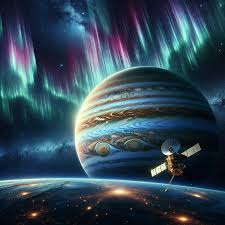
Jupiter, the Giant of the Solar System, Surprises Again: A Stunning Glimpse of Its Auroras

Jupiter, the behemoth of our planetary neighborhood, continues to unveil breathtaking secrets.
This time, scientists have captured mesmerizing images of its auroras—an achievement that few ever thought possible.
These celestial light shows, similar to Earth’s northern and southern lights but vastly more intense, highlight the immense power of Jupiter’s magnetic field and the interactions between charged particles and the planet’s thick, swirling atmosphere.
A Celestial Spectacle Like No Other
Auroras on Jupiter are not just beautiful—they are proof of the planet’s turbulent, electrified environment.
Unlike Earth, where solar winds trigger our auroras, Jupiter’s immense magnetic field, nearly 20,000 times stronger than Earth’s, traps charged particles from its volcanic moon, Io.
These particles slam into the planet’s poles, creating dazzling light displays that extend far beyond anything we experience on Earth.
Recent observations using cutting-edge telescopes and space probes have allowed scientists to capture these auroras in unprecedented detail.
Images show dynamic arcs of light dancing over the poles, fueled by interactions between Jupiter’s magnetic field and the solar wind.
Some auroras on Jupiter appear as ultraviolet ribbons stretching across the sky, far larger than any auroral event seen on Earth.
How Scientists Captured the Impossible
For years, imaging Jupiter’s auroras with high resolution seemed a near impossibility.
The planet’s overwhelming brightness often drowned out the subtle details of these phenomena.
However, thanks to advancements in observational technology—particularly the powerful instruments aboard the James Webb Space Telescope and the Juno spacecraft—scientists have succeeded in capturing the full majesty of these lights.
Juno, which has been orbiting Jupiter since 2016, provided crucial close-up data of its auroras by flying directly over the poles. Infrared and ultraviolet sensors enabled the probe to pierce through Jupiter’s thick atmosphere, revealing dynamic, pulsing auroras in ways that previous missions never could.
Meanwhile, the James Webb Space Telescope offered unparalleled clarity from afar, allowing scientists to see how solar activity influences these displays.
Why These Auroras Matter
Beyond their stunning beauty, Jupiter’s auroras serve as vital keys to understanding the planet’s mysterious interior and powerful magnetosphere. By studying how charged particles interact with the gas giant’s atmosphere, scientists gain deeper insights into the complex physics governing planetary magnetic fields.
Jupiter, often seen as a miniature solar system in itself, helps researchers refine their understanding of magnetism beyond Earth—knowledge that could eventually be applied to studies of exoplanets and other celestial bodies.
Additionally, the findings raise new questions about the volcanic moon Io.
If Io is constantly supplying charged particles to fuel these auroras, how does this impact its own environment? Scientists are now investigating how these interactions shape Jupiter’s broader system, possibly influencing the planet’s powerful storms and radiation belts.
Looking Ahead: More Mysteries Await
Even as these incredible images astound scientists and space enthusiasts alike, Jupiter remains an enigma.
Future missions, such as the upcoming Europa Clipper, will continue to examine Jupiter and its moons, looking for more surprises.
In the meantime, the discovery of these stunning auroras is a humbling reminder that even the oldest and most observed planets in our solar system still have secrets to share.
Jupiter, a planet long regarded as a symbol of cosmic power, has once again proven that the universe never ceases to amaze.
The images of its auroras are not just scientific achievements—they are a testament to the beauty and mystery of our celestial surroundings.