
Mind and Electromagnetic Fields: The Astonishing Science Behind the Heart–Brain Connection
Mind and electromagnetic fields are not abstract concepts or metaphors; they are measurable physical phenomena that shape the way the heart and brain communicate. For decades, science has described thought as a process confined within the brain, but modern research is expanding this view, showing how biological fields, neural oscillations and emotional states interact in ways far more complex than previously assumed.
For decades, science has described thought as a phenomenon confined within the brain, an electrochemical process that leaves no trace outside the skull. Yet contemporary research, while not overturning the established paradigm, is expanding the picture. Today we know that the mind is not an isolated entity: it is a physical process that generates fields, signals, oscillations, and information that interact with the body and, in more subtle ways, with the surrounding environment. This does not demonstrate any “mental influence on physical reality” in the cinematic sense, but it does reveal a richer understanding of how thoughts and emotions participate in biological systems and the fields that shape them.
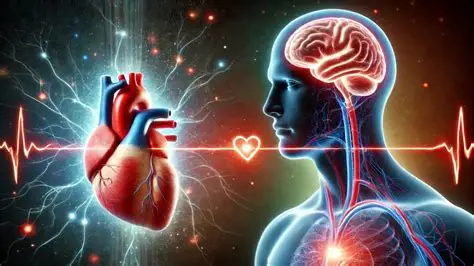
The most solid point, the one no scientist disputes, concerns the heart. The heart produces the strongest electrical signal in the human body, measurable through ECG, and its corresponding magnetic field can be detected using magnetocardiography. This field is not a metaphor; it is a real physical phenomenon that extends into the space around the body. Modern physiology has shown that the heart is not merely a pump but a sensory organ that sends signals to the brain through the autonomic nervous system. Brain regions involved in interoceptive perception—such as the insula, the cingulate cortex, and the somatosensory cortex—respond to signals originating from the heart, modulating attention, emotion, and perception. Heartbeat-evoked potentials, recorded through electrophysiological techniques, demonstrate that each heartbeat produces a measurable response in the brain. This is established science, not speculation.
It is equally well demonstrated that emotional states alter heart rate variability, and that this variability influences the regulation of the autonomic nervous system. When a person is calm, the heart displays greater rhythmic coherence; when stressed, the rhythm becomes irregular. These changes are not “subtle energies” but physiological dynamics that influence perception, memory, and decision-making. In this sense, emotions and thoughts alter lived reality because they change the way the brain interprets the world.
Alongside these solid findings, there exists a more uncertain territory where science does not speak of certainties but of possibilities. Living cells emit biophotons, extremely faint light emissions measurable with sensitive instruments. Their existence is a fact. What is not demonstrated is their role in neural or cognitive communication. Some researchers hypothesize that these emissions may contribute to cellular synchronization, but this remains an idea, not a conclusion. It is essential to maintain this distinction: biophoton emission is real, its role in consciousness is still under investigation.
The same caution applies to theories involving quantum physics. The proposal by Penrose and Hameroff, known as Orch-OR, suggests that microtubules within neurons may sustain quantum coherence and that these states could contribute to consciousness. It is an intriguing theory, built on mathematical models and some experimental observations, but it is not proven. Many neuroscientists consider it unlikely that quantum coherence could persist in the warm, wet environment of the brain. Others argue that microtubules may offer special conditions that allow a form of coherence. The truth is that the question remains open: there is no consensus, no definitive proof, but there is a line of research worth following.
Another hypothesis involves radical pairs, pairs of electrons with correlated spins that can be influenced by magnetic fields. Some models suggest that these phenomena might play a role in cognitive processes. Here too, we are in the realm of possibilities: theoretical models exist, preliminary data exist, but no demonstration shows that radical pairs are involved in consciousness.
The most speculative proposal concerns the zero-point field, the quantum vacuum field. Some researchers have hypothesized that the brain might resonate with specific frequencies of this field, and that such resonance could contribute to consciousness. It is a captivating idea, but it belongs to theoretical physics, not experimental physiology. There are no measurements showing a direct coupling between the brain and the zero-point field. There are mathematical models exploring this possibility. It is crucial to present it as such: a possibility, not a proof.
When discussing “reality as a field of probability,” one enters a territory where quantum physics and philosophy intertwine. Quantum physics describes certain phenomena probabilistically, but this does not imply that macroscopic reality is a probability field in the intuitive sense. It is a metaphor useful for explaining complex concepts, but not a literal description of the world.
Thought, however, is physical in the most concrete sense: it is neuronal activity, the movement of ions, the generation of electrical and magnetic fields. It is information propagating through biological networks. Saying that thought “produces quantum information” goes beyond available evidence. Saying that thought is a physical phenomenon is entirely correct.
Modern science, therefore, does not claim that the mind alters physical reality in a cinematic way. It claims something more sober but no less fascinating: the mind is a physical process that interacts with the body and environment through fields, signals, and oscillations. Some lines of research suggest that more subtle interactions may exist, possibly even quantum ones, but these ideas belong to the frontier of science, not its established core.
The distinction is essential. What is demonstrated concerns the heart, the brain, electromagnetic fields, and the physiology of emotions. What is hypothesized concerns quantum coherence, radical pairs, cognitive biophotonics, and the zero-point field. Presenting these ideas as possibilities rather than certainties allows us to build a compelling narrative without betraying scientific rigor.